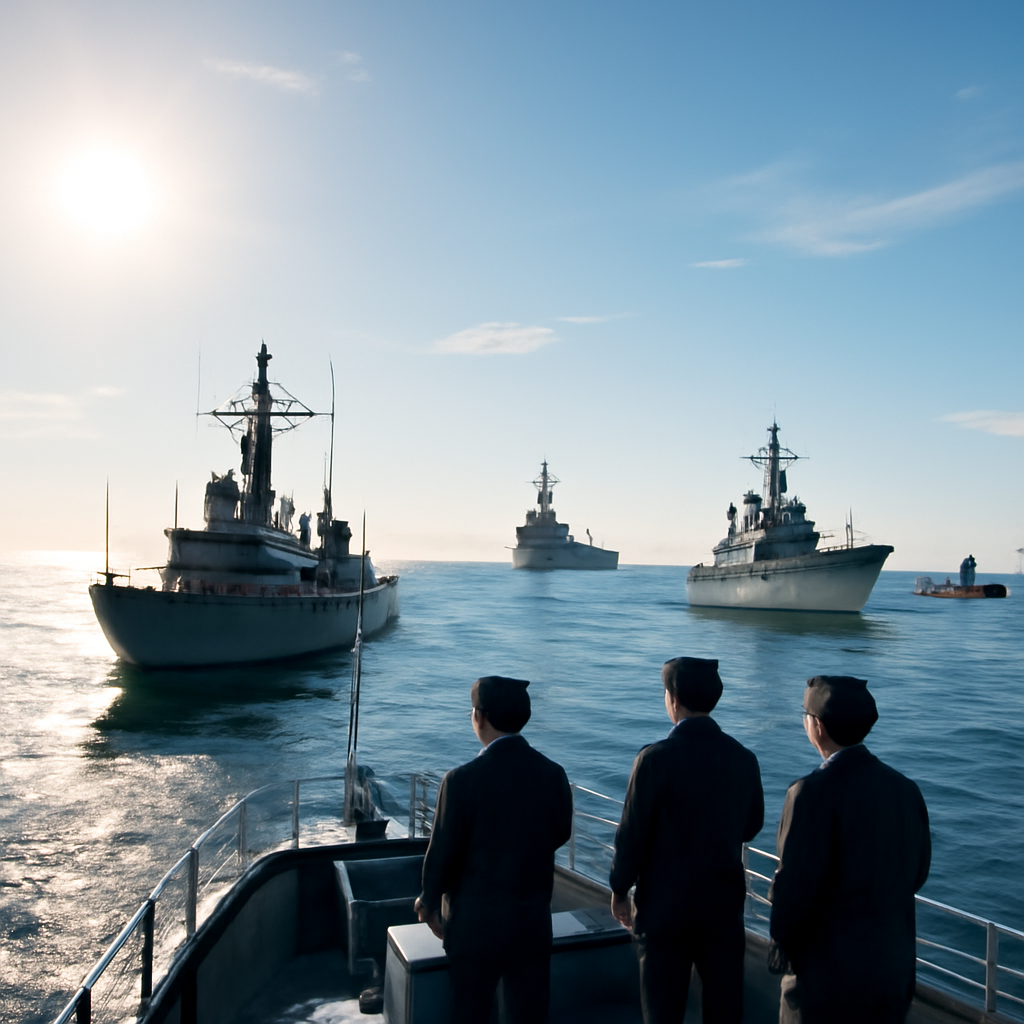
“30 countries, 30,000 personnel, 31 surface ships, five submarines and 500 exercise events” — those are the numbers that framed this year’s Rim of the Pacific exercise (RIMPAC), a month-long maritime mobilisation that doubled as a showcase for shifting balances and political signalling across the Indo‑Pacific.
RIMPAC and South Korea’s maritime coming of age
This year’s RIMPAC, which concluded on 31 July, marked a milestone: Rear Admiral Kim In‑ho became the first South Korean officer to command RIMPAC’s Combined Force Maritime Component. South Korea’s contribution was the largest after the US Navy’s, and the force list reflected that breadth — from P‑8 Poseidon maritime patrol aircraft aloft, to an Aegis guided‑missile destroyer on the surface and the domestically designed KSS‑III submarine below. The source notes what the force lacked: nuclear‑powered submarines (they are ‘working on it’) and fixed‑wing carrier aviation (described as ‘aspirational’).
RIMPAC also broadened its membership: the Philippine Coast Guard participated for the first time, and Fiji sent a platoon of soldiers — another ‘first‑time participant’ status for the exercise. The operational scale and diversity of participants underline how routine coalition maritime operations have become in the region.
Scarborough Shoal: law, administration and military theatre
Diplomacy and domestic regulation collided at Scarborough Shoal in late July and early August. The Philippines formally deposited a hydrographic chart with the United Nations specifying the normal baselines of Bajo de Masinloc, the reef roughly 200 km west of Luzon. The next day China issued a policy for the Huangyan Island National Nature Reserve that includes a prohibition on entry except on “Beijing‑approved business.” The two moves were directed at the same feature, known internationally as Scarborough Shoal.
The administrative steps were accompanied by force: on 1 August a Chinese navy amphibious warfare taskforce exercised in the area with bomber escort, and earlier, the China Coast Guard allegedly used water‑cannon against Philippine ships during confrontations on 23–24 July. Those operations followed a combined US–Japan–Philippines exercise from 21–25 July in the same neighbourhood that included the USS George Washington carrier strike group, two US Coast Guard cutters and two Philippine Coast Guard ships.

Audit-ready is a season. It shouldn't be.
Evidence in spreadsheets, controls drifting between audits, frameworks multiplying on flat headcount. Nubivance runs continuous compliance on Rapid7 Cyber GRC - SOC 2, HIPAA, ISO 27001, PCI, CMMC.
End the scrambleUSS George Washington in Da Nang: symbolism and proximity
The USS George Washington left that combined exercise and arrived in Da Nang on 30 July for a five‑day goodwill visit — the fourth US carrier visit to Vietnam since relations normalised in 1995, and the first since Washington and Hanoi signed their Comprehensive Strategic Partnership in 2023. The source underscores the symbolism: Da Nang is where the US ground war in Vietnam began in 1965, and the area remains proximate to other regional flashpoints. China’s seizure of the Paracel Islands “at gunpoint in 1974” and the forward base that supports Beijing’s occupation of those islands — located at Sanya on Hainan Island — lies less than 300 km from Da Nang, the article notes.
Solomon Islands signs a shiprider Maritime Law Enforcement Agreement with the US
Days after returning from Washington, Solomon Islands’ new prime minister, Matthew Wale, signed a ‘shiprider agreement’ with the United States in Honiara — a form of Maritime Law Enforcement Agreement (MLEA) that authorises Solomon Islands law enforcement officers “to embark on designated US vessels to jointly undertake maritime surveillance and enforcement operations.” The Solomon Islands government said the new MLEA “will support national efforts to combat illegal, unreported and unregulated fishing, transnational crime, illicit trafficking, and other unlawful maritime activities.”
The piece places the new agreement in a wider pattern: Washington has brokered MLEAs across the Pacific since 2007 (beginning with the Cook Islands) and, since 2022, has upgraded deals with the Federated States of Micronesia, Palau and Samoa to enhanced MLEAs that permit US enforcement of a partner’s laws inside that state’s exclusive economic zone. The article says the Solomon Islands deal “doesn’t appear to be within the scope” of those enhanced arrangements. Opposition leader and former prime minister Manasseh Sogavare has claimed the deal amounts to a US violation of Solomon Islands’ sovereignty.
What this means for the Philippines, China, and Pacific island states
- Philippines: Manila has translated its Scarborough claim into a formal hydrographic deposit at the UN, sharpening the legal geometry of its position even as maritime confrontations and Chinese administrative measures intensify.
- China: Beijing paired domestic administrative control (the Huangyan Island National Nature Reserve policy) with naval exercises, signalling a willingness to match legal‑administrative steps with military presence in the shoal’s vicinity.
- Pacific island states and the US: The Solomon Islands MLEA extends a pattern of US maritime cooperation across independent Pacific states, reinforcing practical enforcement ties while provoking domestic political debate about sovereignty.
The fortnight’s record is clear: maritime diplomacy and domestic legal moves are now being wargamed alongside large, multinational exercises. Whether those parallel tracks produce managed competition or escalating incidents will depend on decisions not yet made — whether Beijing enforces its reserve policy, whether Manila presses the hydrographic deposit diplomatically, and how often shiprider operations are activated in the Solomon Islands’ waters. Each choice will be a test of whether law, administration and presence can be reconciled at sea.
https://www.aspistrategist.org.au/fault-lines-whatever-floats-your-boat/