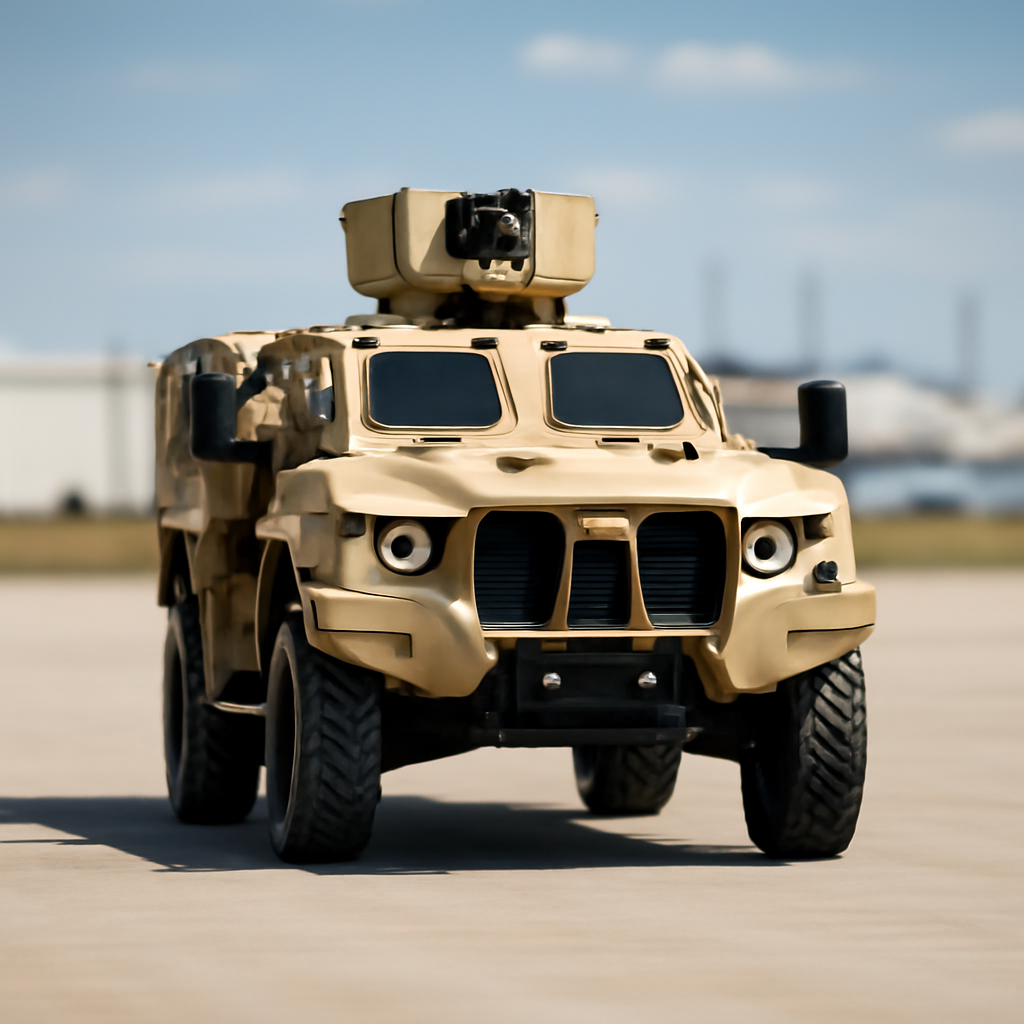
“[The Marines] have an urgent and well-defined need for a combat proven vehicle today, and that’s what the JLTV is,” Logan Jones, chief growth officer for Oshkosh Defense, told Breaking Defense. His company is now actively proposing its JLTV A1 to the Marine Corps as the service solicits potential second suppliers to close what Oshkosh calls mounting “readiness gaps.”
Oshkosh Defense’s pitch: close readiness gaps with a production-ready A1
Oshkosh framed its bid around speed of delivery and an active production capability. The company notes that it delivered the last JLTV to the Marine Corps a year ago and says AM General, the current prime supplier to the Marine Corps, has experienced a 20- to 24-month delivery delay that is widening a “readiness gap.” Jones told Breaking Defense that the Marines need a “combat proven vehicle today” and that the JLTV fits that requirement.
Oshkosh also emphasized its production posture: its commercial side represents 90 percent of business and the firm runs a mixed commercial/defense production line rather than a cold line. Jones said that mix line lets Oshkosh “flexibly add up to certain quantities” and that a foreign military sale to the Netherlands is coming online, which Oshkosh argues will allow it to deliver JLTVs faster than competitors.
AM General’s response and its production timeline
AM General, the sole supplier under the current Army-led joint program office (JPO) contract, did not directly confirm whether it is behind schedule or how many JLTVs remain to be delivered to the Marines. Instead, an AM General spokesperson told Breaking Defense the company has maintained “clear and transparent communication” with the JPO and is “aligned with a delivery schedule that keeps us on path for testing/evaluation in 2026.”
The spokesperson described the JLTV A2 as “significantly improved from the A1,” said the manufacturing process has been “streamlined,” and added that the company “expect[s] to hit full production in 2027.” AM General characterized the Marine Corps’ request for information (RFI) as a “standard activity” for a program in year three of a five-year base contract period and said it is executing a “parallel path strategy” covering both production ramp-up and support for government testing and evaluation throughout 2026.
The Army did not respond to a Breaking Defense request for comment on how many JLTV A2s have been delivered or whether AM General is behind schedule.

This site is the portfolio.
OSINTSights runs on Cloudflare Workers, D1, R2, and Vectorize, with an AI pipeline on Hetzner ARM. Nubivance designed, built, and operates it. We do the same for clients.
See what we buildMarine Corps RFI: scope and what it does — and does not — mean
The RFI issued by the Marine Corps sought potential vendors for “mature, production-ready, rapidly fieldable” commercial or “non-developmental” JLTV variants without specifying whether it is seeking A1 or A2 models. In a statement to Breaking Defense, the Marine Corps said it “continuously evaluates acquisition options to ensure it can meet approved JLTV requirements, preserve readiness, and reduce fielding risk.”
The service emphasized that AM General remains under contract through the Army-led JPO and that the RFI does not “represent a contract award, source-selection decision, or final decision to change suppliers.” That caveat is notable against the backdrop of a larger Army program decision: as part of the Army Transformation Initiative, the Army announced it did not plan to procure JLTVs beyond the 250 vehicles scheduled for delivery to the Army in January 2025. A congressional report this month recorded Army leaders’ view that the tranche-based contract remained intact because the last tranche was purchased in January.
What this means for the Marine Corps, Oshkosh Defense, and AM General
- The Marine Corps: The service is using the RFI to assess options for preserving readiness and reducing fielding risk while AM General remains under contract; responses will inform whether a second source is needed to maintain delivery momentum.
- Oshkosh Defense: The company is positioning its JLTV A1 as a rapid, production-ready stopgap, citing a live mixed-production line and an upcoming Netherlands foreign military sale as enablers for quicker deliveries.
- AM General: The firm is emphasizing improvements in the A2 variant, alignment with a 2026 testing/evaluation schedule, a streamlined manufacturing process, and an expected transition to full production in 2027 while describing the RFI as a routine program activity.
The immediate operational question is concrete: will the Marine Corps identify a second source capable of closing the delivery shortfall that Oshkosh warns is widening, or will AM General’s stated schedule for testing and production ramp resolve delivery concerns without changing supplier arrangements? The RFI and the 2026 test-and-evaluation timeline cited by AM General are the next visible markers; how the service and the Army-led JPO reconcile production schedules, contract tranches, and fielding urgency will determine whether the JLTV program remains a single- or multi-source effort.