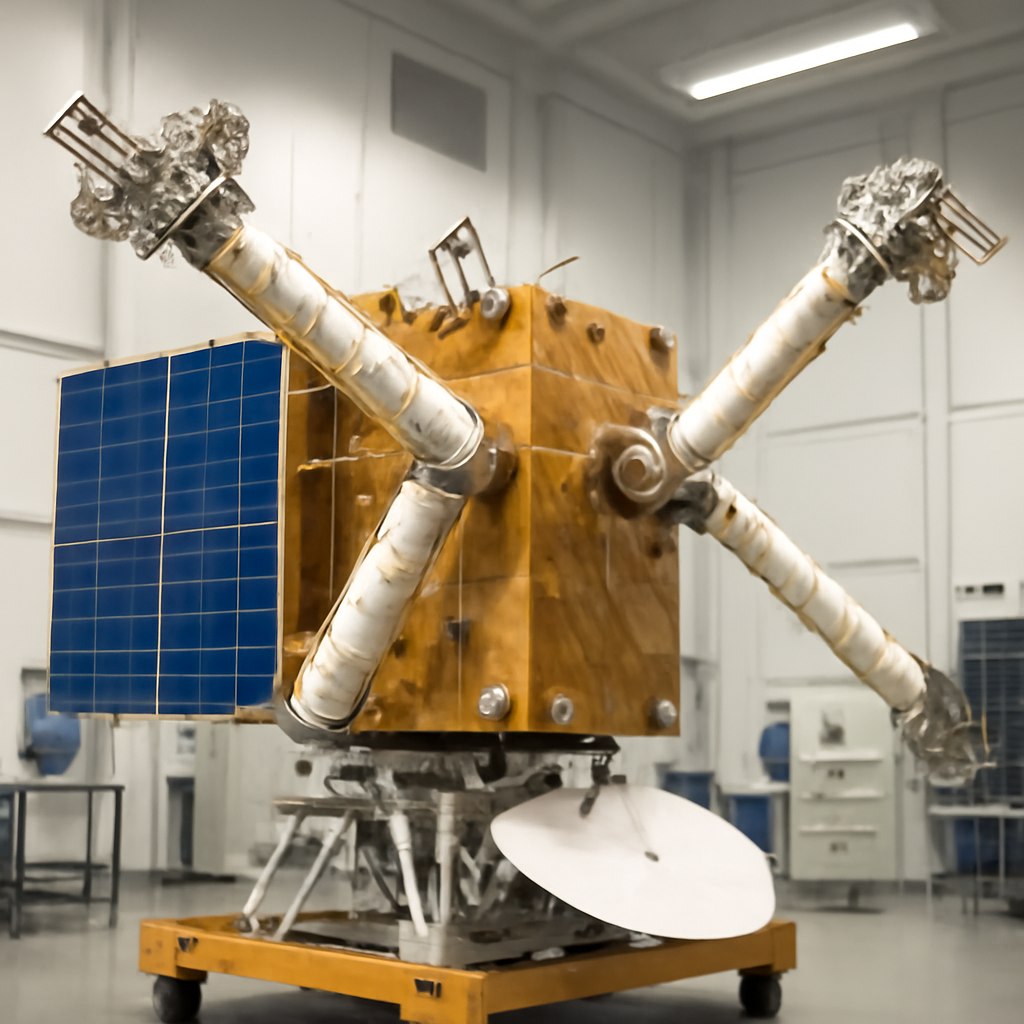
“It can also install life extension jetpacks onto other satellites for government or commercial customers, prolonging their useful life for up to eight years,” Northrop Grumman CEO Kathy Warden said on the company’s earnings call.
Northrop Grumman’s MRV and the RSGS payload
Northrop Grumman has developed a spacecraft called the Mission Robotic Vehicle (MRV) equipped with two robotic arms and intends to field a fleet of these vehicles as a commercial satellite-servicing offering. The arms form part of a payload formally called Robotic Servicing of Geosynchronous Satellites (RSGS), a system developed through a program led by the U.S. Defense Advanced Research Projects Agency (DARPA) in cooperation with the U.S. Naval Research Laboratory (NRL). According to the company, the MRV can perform on-orbit inspection and servicing tasks beyond refueling, including towing satellites and clearing debris, all of which require very close manoeuvring with other objects in space.
Earnings-call exchange on offensive potential
The question of whether the MRV or a derivative could be used offensively came up directly during Northrop Grumman’s quarterly earnings call. Scott Mikus, Director for Aerospace, Defense and Space Research at Melius Research, asked about the “potential market for an offensive version of that spacecraft that could be used to disable adversary satellites.” CEO Kathy Warden replied: “So I appreciate the question. I will leave it up to the U.S. government to decide how that capability might fulfill mission objectives that they have in that regard. But certainly, it’s our objective to offer our clients options for technology deployment, and for them to determine policy for when and how they might deploy that technology.” In her opening remarks on the call she also described the MRV as “the first commercial robotic spacecraft capable of repairing, relocating, and servicing satellites in geosynchronous orbit via two robotic arms.”

This site is the portfolio.
OSINTSights runs on Cloudflare Workers, D1, R2, and Vectorize, with an AI pipeline on Hetzner ARM. Nubivance designed, built, and operates it. We do the same for clients.
See what we buildLaunch plan and immediate commercial mission
If all goes to plan, a SpaceX Falcon 9 rocket is scheduled to launch the first MRV from Cape Canaveral in a four-hour window starting at 5:15 PM ET today, weather permitting. The vehicle will carry three Mission Extension Pods (MEPs) — the “life extension jetpacks” Warden referenced — and will rendezvous with satellites belonging to Australian firm Optus and Luxembourg-based SES to attach MEPs, according to Spaceflight Now. Those MEPs are explicitly intended to prolong other satellites’ useful life for up to eight years by providing on-orbit refueling or propulsion support.
Dual-use risks, on-orbit threats, and U.S. force posture
Robotic arms on spacecraft are an inherently dual-use capability: TWZ and others have long argued such arms could be used to damage or disable optics or solar arrays, physically drag a satellite out of operational orbit, or otherwise render a satellite inoperable. The U.S. military has publicly framed the need to pursue offensive space-based capabilities as part of protecting U.S. assets. “We’re basically responding to a warfighting domain where our adversaries have already put interceptors in space, and we want to make sure that we rebalance that in terms of deterrence,” Chief of Space Operations Gen. Chance Saltzman said at an Air & Space Forces Association roundtable, as reported in the source. A Space Force spokesperson pointed to “interceptors” including ground- and air-launched anti-satellite missiles and capabilities like the SJ-21 (the Chinese Shi Jian 21 satellite), “which has a grappling arm.”
The concern extends beyond grappling arms. The source cites a range of on-orbit attack modalities illustrated by a U.S. Defense Intelligence Agency graphic: electronic warfare jammers, directed-energy weapons, chemical sprays, small projectiles, or simply using an inspector satellite itself as a kinetic kill vehicle.
What this means for Optus, SES, and the U.S. Space Force
- Optus and SES: both commercial telecommunications providers are slated to receive MEPs from the MRV. That means their satellites will undergo close rendezvous and physically accept life-extension hardware, a process that depends on trust in the servicing vehicle’s intent and safeguards.
- The U.S. Space Force: the MRV’s refueling and servicing capabilities align with priorities the Service has voiced for sustaining freedom of maneuver in space. On-orbit refueling reduces the need for satellites to expend limited propellant to “run and hide,” preserving lifetime and responsiveness. The source also connects these capabilities to larger national plans such as the Golden Dome initiative and to a Congressional Budget Office report assessing that as many as 7,800 interceptors in orbit could be needed for that concept’s space-based missile-defence elements.
- DARPA and NRL: government-developed technology (the RSGS payload) is now being operationalized by a commercial contractor, illustrating how government R&D can transition into commercial services with potential military implications.
The first MRV launch is therefore a technical milestone with immediate commercial customers and a high-profile policy overlay: Northrop Grumman markets on-orbit servicing, the U.S. military has signalled its intent to develop offensive and defensive space capabilities, and industry and government are jointly testing where line-of-use will be drawn. Whether the MRV will be only a maintenance tool or also a platform that can be adapted to offensive tasks is, per the company, a decision for government policy — and that decision will be tested, in part, by what happens after today’s scheduled launch.
Source: TWZ — Could This New Northrop Spacecraft Use Its Robotic Arms To Attack Enemy Satellites?