$53.8 billion a year — a 41 percent jump from recent practice — is what the Congressional Budget Office says the Navy’s 2027 shipbuilding plan would cost on average, a rise the report calls “high not only compared with recent funding but also by historical standards.”
Congressional Budget Office analysis: $53.8 billion annual average
The CBO’s report, released Thursday, puts the Navy’s proposed shipbuilding pace at roughly $53.8 billion per year on average. That figure is 41 percent higher than the roughly $38.1 billion the Navy has received annually in appropriations during the last half-decade, the CBO said. The report observes that the projected level of spending would be “unprecedented” for shipbuilding.
Navy’s 2027 shipbuilding plan and the Golden Fleet initiative
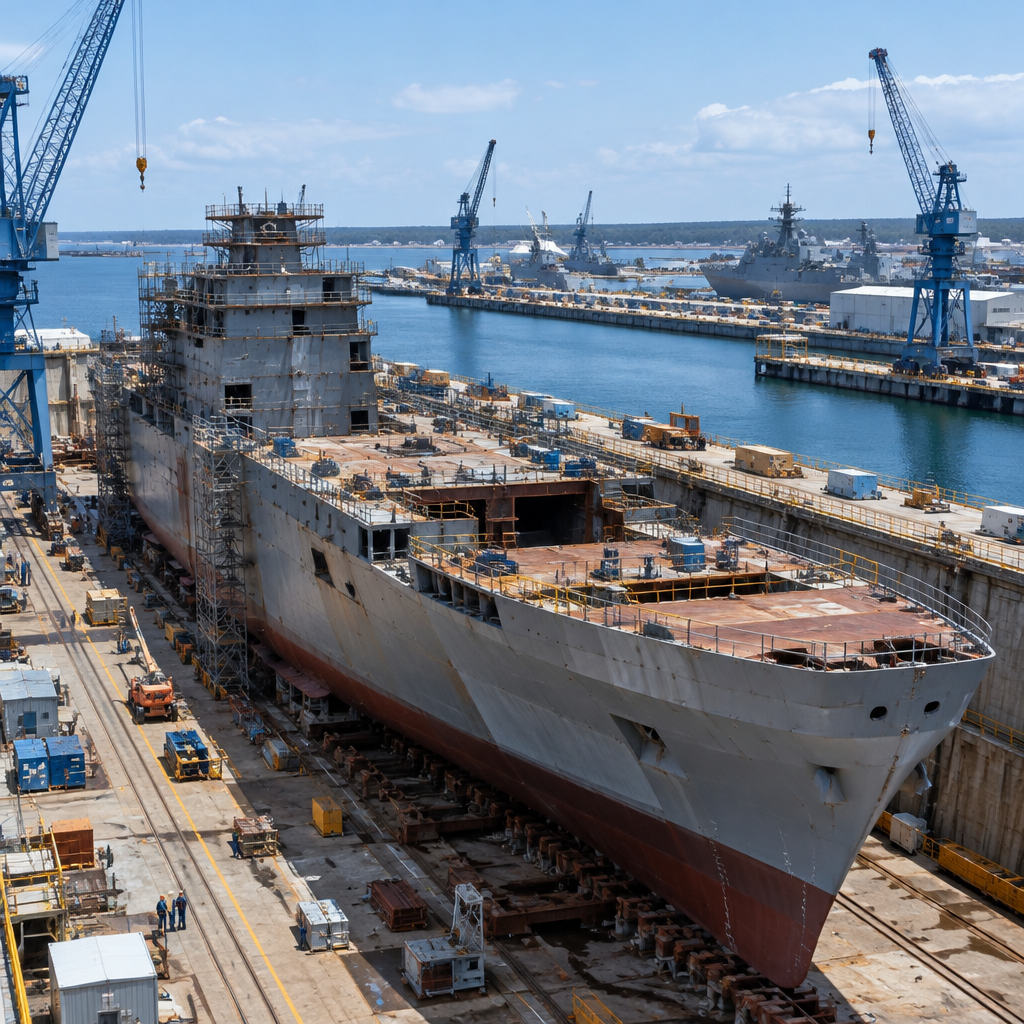
The Navy’s shipbuilding plan, released in May, seeks a FY27 shipbuilding request of $65.8 billion and aims to expand the fleet to 450 ships — including battle force ships, auxiliary ships, and unmanned vessels — by 2031 as part of the Trump administration’s Golden Fleet initiative. According to the CBO, “the pace of shipbuilding would be fastest in the next 10 years, reflecting the service’s desire to increase the size of the fleet as quickly as feasible.” Construction would then slow from the mid-2030s to the mid-2040s before ramping up again in the late 2040s and 2050s to replace smaller ships bought in the plan’s first decade.

Audit-ready is a season. It shouldn't be.
Evidence in spreadsheets, controls drifting between audits, frameworks multiplying on flat headcount. Nubivance runs continuous compliance on Rapid7 Cyber GRC - SOC 2, HIPAA, ISO 27001, PCI, CMMC.
End the scrambleThree key differences: what CBO included that the Navy’s plan did not
The CBO’s higher annual estimate includes categories of spending the Navy’s plan excludes. Specifically, CBO’s estimate factors in costs for refueling nuclear-powered ships and procuring non-battle force ships — for example, used sealift ships — items that “are typically derived from shipbuilding funding,” the report says. Those factors boost CBO’s average annual estimate by roughly $4.6 billion compared with the Navy’s own shipbuilding plan. CBO also cited different assumptions about the design and capabilities of future ships and different estimating methods, including how labor and material cost growth is accounted for, as reasons its projection of new ship construction costs exceeds the Navy’s.
Thirty-year totals: CBO’s $1.47 trillion vs. Navy’s $1.23 trillion
When restricted to only purchasing new ships, CBO calculates a 30‑year total of about $1.47 trillion in 2026 dollars; the Navy’s projection for the same category is $1.23 trillion. CBO attributes the gap to its differing assumptions and estimating methods. Separately, the CBO noted a recent pattern in appropriations: “Since 2016, lawmakers have generally appropriated an average of $2.5 billion more per year for shipbuilding than the President has requested, partly because of concerns that the fleet is too small to perform all its missions.” The report also situates current planned levels relative to history, saying funding for ship construction “has reached its highest levels since the Reagan Administration’s defense buildup in the 1980s.”
Senate Appropriations subcommittee response: an $18.5 billion reduction
The CBO report arrived days after the Senate Appropriations defense subcommittee proposed a steep reduction to the Navy’s request, trimming roughly $18.5 billion. Under that proposed spending plan, the subcommittee designated $41.6 billion for shipbuilding — a figure far below the Navy’s $65.8 billion FY27 request and also beneath CBO’s calculated $53.8 billion annual average.
What this means for the Navy, Congress, and shipbuilders
- The Navy: faces a choice over tempo and scope. The service’s plan calls for rapid expansion in the next decade to reach 450 ships by 2031; realizing that tempo would align with the Navy’s $65.8 billion FY27 request and the higher CBO averages rather than the lower Senate-proposed appropriation.
- Congress: must reconcile competing numbers. The CBO’s inclusion of refueling and non-battle force ship costs raises the estimated annual bill by about $4.6 billion versus the Navy plan, while Senate appropriators have signaled a much lower near‑term funding level by proposing $41.6 billion.
- Shipbuilders and industrial base planners: will need clarity on the program mix and timing. CBO’s higher 30‑year total — $1.47 trillion for new ships in 2026 dollars — rests on different assumptions about future ship designs and cost growth, factors that influence yard schedules, workforce planning, and supply chains.
The CBO report frames the debate in hard dollars and timelines: the Navy’s plan asks for a rapid, expensive expansion; CBO’s broader accounting raises the estimated long-term tab; and Senate appropriators have proposed a substantially lower near‑term budget. The mismatch among the Navy’s request, CBO’s estimate, and the Senate subcommittee’s allocation leaves a concrete budgetary gap that lawmakers, the Navy, and industry will have to resolve in the months ahead.