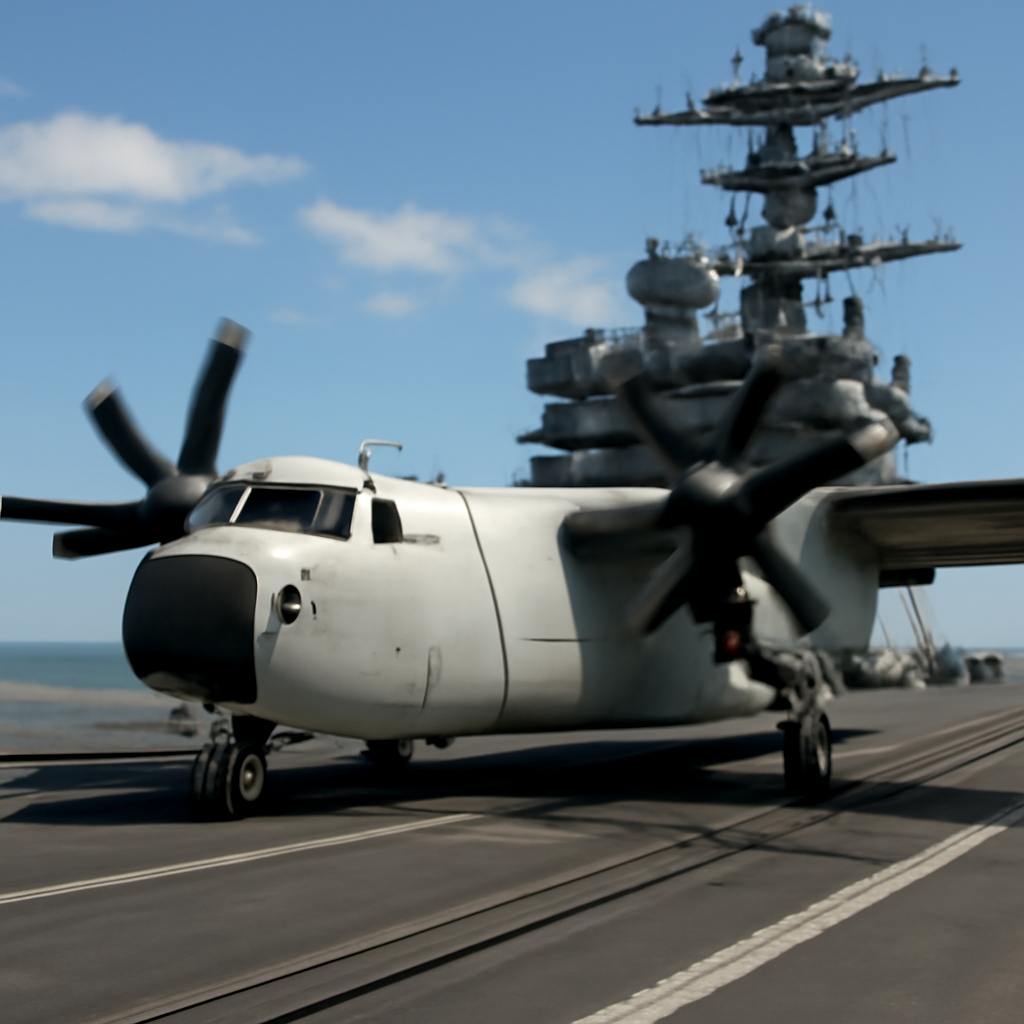
“The C-2s were catapulted off Nimitz at about 1800 local time, marking the aircraft’s final expected COD takeoff.”
The last arrested landing aboard USS Nimitz
On June 25, 2026, C-2A Greyhounds belonging to the “Rawhides” of Fleet Logistics Support Squadron 40 executed the last arrested landing and catapult launch from a U.S. Navy aircraft carrier, a Navy official confirmed to TWZ. The event took place aboard USS Nimitz as the carrier sailed north from Mayport, Florida, and the Greyhounds did not linger — their final carrier trap marked the end of nearly 60 years of the C-2 serving as the Navy’s carrier onboard delivery (COD) workhorse. Though the Greyhounds will continue flying into later 2026, they are anticipated to be fully retired this year, barring major contingencies.
From Hawkeye derivative to a fleet retiring a known quantity
The C-2A Greyhound, a derivative of the Navy’s E-2 Hawkeye airborne early warning and control aircraft, first entered service in the late 1960s and replaced the piston-engined C-1 Trader in the COD role. The U.S. Naval Academy records that original C-2A airframes were overhauled to extend service life in 1973; in 1984 the Navy contracted for 39 new C-2A aircraft (the Reprocured C-2A) with significant airframe and avionics improvements. Older airframes were phased out in 1987 and the last of the new models was delivered in 1990.

Audit-ready is a season. It shouldn't be.
Evidence in spreadsheets, controls drifting between audits, frameworks multiplying on flat headcount. Nubivance runs continuous compliance on Rapid7 Cyber GRC - SOC 2, HIPAA, ISO 27001, PCI, CMMC.
End the scrambleWhy the CMV-22B Osprey took over
The Greyhound’s replacement, the CMV-22B Osprey tiltrotor, was declared Initial Operational Capability in 2021. Vice Adm. Kenneth Whitesell described the CMV-22B as “a game-changer” for deployment because of its ability to operate at longer ranges, across distances between multi-carrier operations and from land, and to “plop down on unimproved spaces.” Technical contrasts cited by Whitesell and TWZ coverage underline the operational differences:
- CMV-22B: powered by two Rolls-Royce Liberty AE1107C engines delivering 6,200 shaft horsepower each; range about 1,150 nautical miles with a 6,000-pound internal payload; capable of aerial refueling; can perform carrier night landings, Whitesell said.
- C-2A Greyhound: powered by two Allison T56-A-425 turboprops delivering 4,600 shaft horsepower each; range about 1,000 nautical miles; pressurized and able to fly at higher altitudes over weather, while the CMV-22 is not and flies lower.
Osprey teething issues and operational limits
The transition was not seamless. TWZ reported that a 2023 fatal crash of a U.S. Air Force CV-22B off the coast of Japan prompted a roughly three-month grounding of virtually all Osprey tiltrotors worldwide. Rear Adm. Douglas ‘V8’ Verissimo said that crash “was definitely a wake-up call for many of us who are anticipating transitioning from the C-2 to the CMV-22,” and that “The C-2 crews, with some venerable old aircraft, stepped up and took care of business. An unexpected surge in the requirement to maintain carrier onboard delivery [COD] to our aircraft carriers going forward.”
In the crash’s aftermath, flight restrictions were placed on Ospreys that limited their range and therefore impacted COD missions. TWZ reports that after mechanical fixes were made, the Navy began lifting those restrictions in January; a Navy official added that “for security reasons, the specific thresholds, numbers of aircraft affected, and details of added controls are not releasable.” The Pentagon’s testing force has also issued critical reports about the CMV-22’s COD performance, even as the Navy moved closer to retiring the C-2A.
What this means for Fleet Logistics Support Squadron 40, Naval Air Forces, and carrier strike groups
- Fleet Logistics Support Squadron 40 (the Rawhides): will transition from operating a long-proven, pressurized COD platform to relying solely on CMV-22Bs as the Greyhounds exit carrier operations and then retire later in 2026.
- Naval Air Forces and NAVAIR leadership: must manage the operational trade-offs — greater range, aerial refueling and unimproved-site capability from the CMV-22 versus the C-2’s pressurization and higher-altitude transit — while overseeing the lift and removal of flight restrictions imposed after the 2023 CV-22 crash.
- Carrier strike groups: will assume logistics support provided by a newer, more flexible platform that has faced testing criticism and operational limitations; COD remains a “no-fail” mission and the CMV-22 will be expected to fill the Greyhound’s role alone once the C-2 exits service.
A quantified procurement shift and a final observation
Program numbers shifted over time in the public record: the Program of Record projected 48 CMV-22Bs, the Navy had reported plans to procure only 44, and TWZ updated the reporting on June 30 to say the service is now expected to obtain up to 53 CMV-22Bs. The Navy’s redeployment of COD duties to the CMV-22B completes a long transition—one that retires a familiar, proven aircraft and places logistics for carrier strike groups on a younger, differently capable tiltrotor fleet that is still resolving operational issues.
The final carrier trap of the Greyhound closes an era of naval aviation defined by a pressurized, high-altitude COD specialist; it also hands a no-fail mission to a platform described by senior leaders as transformational but one that carries the baggage of recent groundings, restrictions, and testing critiques. The coming months — as Greyhounds finish flying and CMV-22B procurement and operational adjustments proceed — will determine how comprehensively the Osprey can assume the responsibilities of carrier onboard delivery.