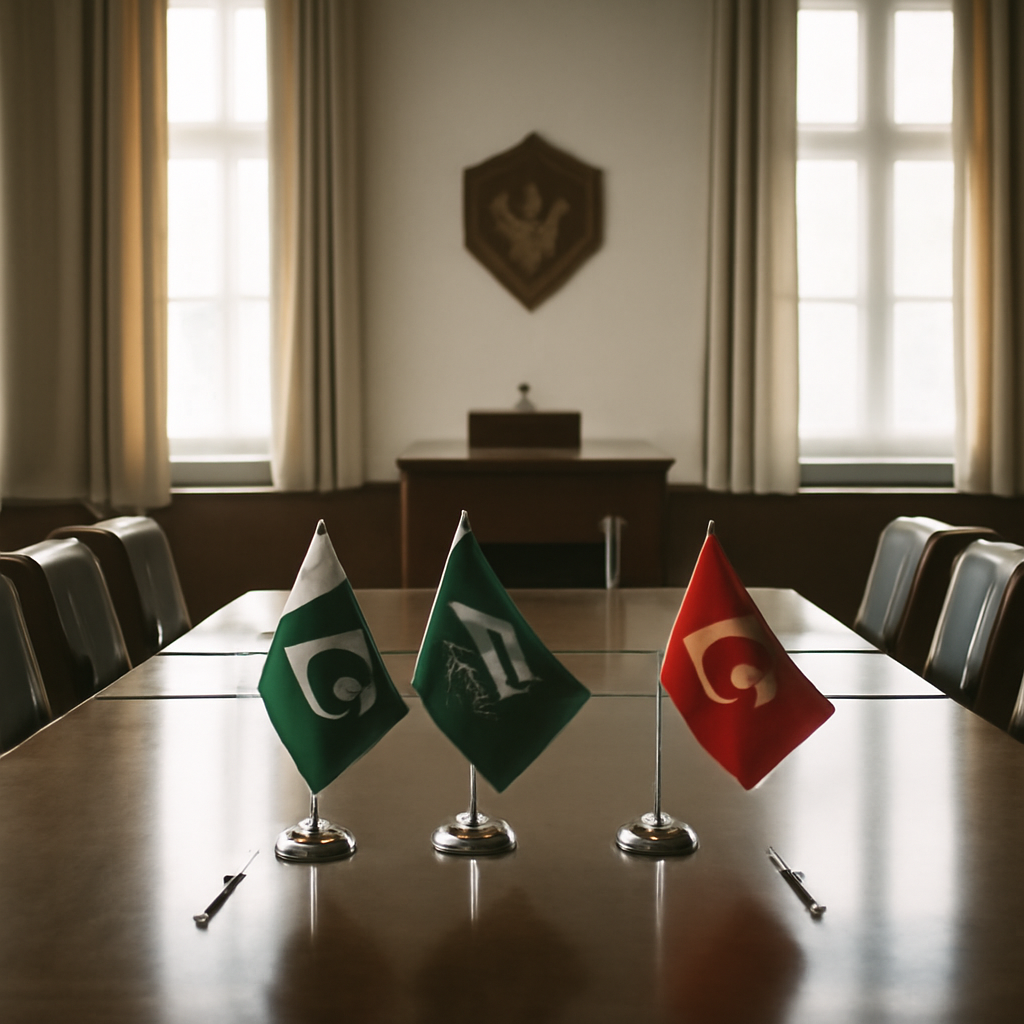
"Arslan Khan has a blunt answer on the F-16: buy more F-16s." — a line lifted from Defence Uncut's latest episode that frames a broader strategic dilemma beneath the Mecca Joint Defence Agreement.
The Mecca Joint Defence Agreement and its Article 5-style clause
On 07 Augst 2026, Pakistan, Saudi Arabia, and Türkiye signed the Mecca Joint Defence Agreement, which the hosts of Defence Uncut note includes an Article 5-style mutual defence provision. The pact creates a formal multilateral framework tying three non-contiguous states to a shared defence promise; what that promise becomes in practice will hinge on logistics, industry, and political will.
Historical precedents: SEATO, CENTO and the risk of mismatch
Defence Uncut points directly to two Cold War precedents. Pakistan previously joined SEATO and CENTO; both alliances failed. Quwa’s pod argues those groupings lacked a firm mutual defence clause, a joint command, and common weapons — shortcomings the Mecca pact must confront. CENTO’s members, the podcast adds, worried more about their neighbours than about a distant adversary; the three Mecca members do not even share land borders, a logistical and strategic constraint the agreement must address.

Audit-ready is a season. It shouldn't be.
Evidence in spreadsheets, controls drifting between audits, frameworks multiplying on flat headcount. Nubivance runs continuous compliance on Rapid7 Cyber GRC - SOC 2, HIPAA, ISO 27001, PCI, CMMC.
End the scrambleOperational constraints: movement, air defence, and the hard limits of projection
The episode underlines concrete limits. "None of them can move an army a long way," the hosts say. Pakistan "has no amphibious ships at all." Air-defence performance during recent Iranian missile attacks is cited as a cautionary example: "Greek Patriot crews in Saudi Arabia shot down more missiles than Türkiye did." Quwa also recorded a pattern in which Gulf states "called Kyiv instead of Islamabad for air defence," highlighting that operational dependencies and rapid-response arrangements have already shifted away from Pakistan in some theatres.
Industry and deterrence: money, factories, engineers — and nuclear anxieties
The three countries bring different capabilities to the table. Saudi Arabia "has money" and wants repair yards, factories built on cheap energy, and ammunition purchases without political conditions. Türkiye "has factories and finished products" and needs large, steady customers. Pakistan "has the engineers" — PAEC and NESCOM are named as employers of strong technical talent — but lacks the money to keep them busy.
Quwa documents concrete industrial moves: Global Industrial & Defence Solutions took designs to Riyadh seeking capital; a Saudi rule requires every foreign seller to take a local partner first. The podcast suggests a resilience strategy: "The three could also build the same missile in three places. One interceptor factory in Pakistan is an easy target. Three factories and a shared stockpile are much harder to destroy."
Beyond industrial cooperation, the hosts flag proliferation-adjacent concerns: "Saudi Arabia and Türkiye do not want Pakistani warheads. They want the whole nuclear fuel cycle, which lets a country build a bomb later without building one now." Political symbolism is part of the deal, too: "Each leader also sells a promise at home." Quwa notes diplomatic friction in trade and regional exclusions — for example, "American officials praised Field Marshal Asim Munir in public. Pakistan got higher tariffs anyway, and Pakistani exporters noticed. Saudi officials kept Egypt out." The podcast suggests Qatar is a likely partner for some projects, since "Qatari money already paid for an Indonesian warship from a Turkish yard."
Trainers, weapons, and software: choices that lock capability
Procurement decisions in the coming years will shape what each partner can field. India has asked industry for information on 150 lead-in fighter trainer (LIFT) aircraft; likely bidders include Leonardo, Korea Aerospace Industries, United Aircraft Corporation, Boeing and Saab. Quwa traces Pakistan’s long-felt need for a LIFT: at IDEAS 2018, Air Chief Marshal Mujahid Anwar Khan requested one with a modern radar and tactical data link. AVIC later built the L-15B to that specification — yet "eight years later, Pakistan owns no LIFT aircraft." The Pakistan Air Force still flies the Super Mushshak, the T-37, the K-8 and the FT-7P; only one FT-7P squadron performs the LIFT role, and Quwa’s demand tracker shows a significant gap.
The podcast also catalogs procurement choices and their downstream effects: Pakistan bought the J-10C with the PL-15 missile — "that was a good decision, because Pakistan never helped design that aircraft." By contrast, the JF-17 involved Pakistani design input so Pakistan could control radar, jammer, and weapon choices; the J-35 would reverse that openness. Türkiye's KAAN program, conversely, "invites partners who pay to join." Quwa recounts missed industrial doors — refusals of BriteCloud, the Grifo-E radar, an Elettronica jammer, and missile cooperation on CAMM-ER — and notes that EDGE Group hired Denel engineers after other offers dissipated. Europe’s SAFE fund and potential buys in 2030 are flagged as structural constraints and opportunities: "The PAF’s next big buy starts in 2030. What Pakistan settles now on trainers, data links and suppliers will decide what it can buy then."
What this means for Pakistan, Saudi Arabia, and Türkiye
- Pakistan: Will need money or partners to convert engineering capacity (PAEC, NESCOM) into sustained production; current equipment gaps — especially LIFT capability — and past procurement refusals have constrained options.
- Saudi Arabia: Can offer capital and market access under local-partner rules, but its preference for fuel-cycle capabilities (not Pakistani warheads) carries political sensitivity and requires careful channeling of technology and finance.
- Türkiye: Brings factories and exportable platforms, but seeks large, steady customers and access to markets; KAAN-style partnership models are a template for co-development if political barriers fall.
The Mecca pact stitches together a promising if fragile set of capabilities: Saudi capital, Turkish production, and Pakistani engineering. The agreement’s Article 5-style promise is a headline; the harder work will be building shared supply chains, interoperable systems, and redundant production distributed across three countries. Whether the partners can turn that promise into resilient capability — and whether political choices about trainers, weapons software, and fuel-cycle technologies will align with that goal — is the practical test the pact now faces.
Source: Quwa — The Risks and Potential of the Mecca Joint Defence Agreement for Its Members



