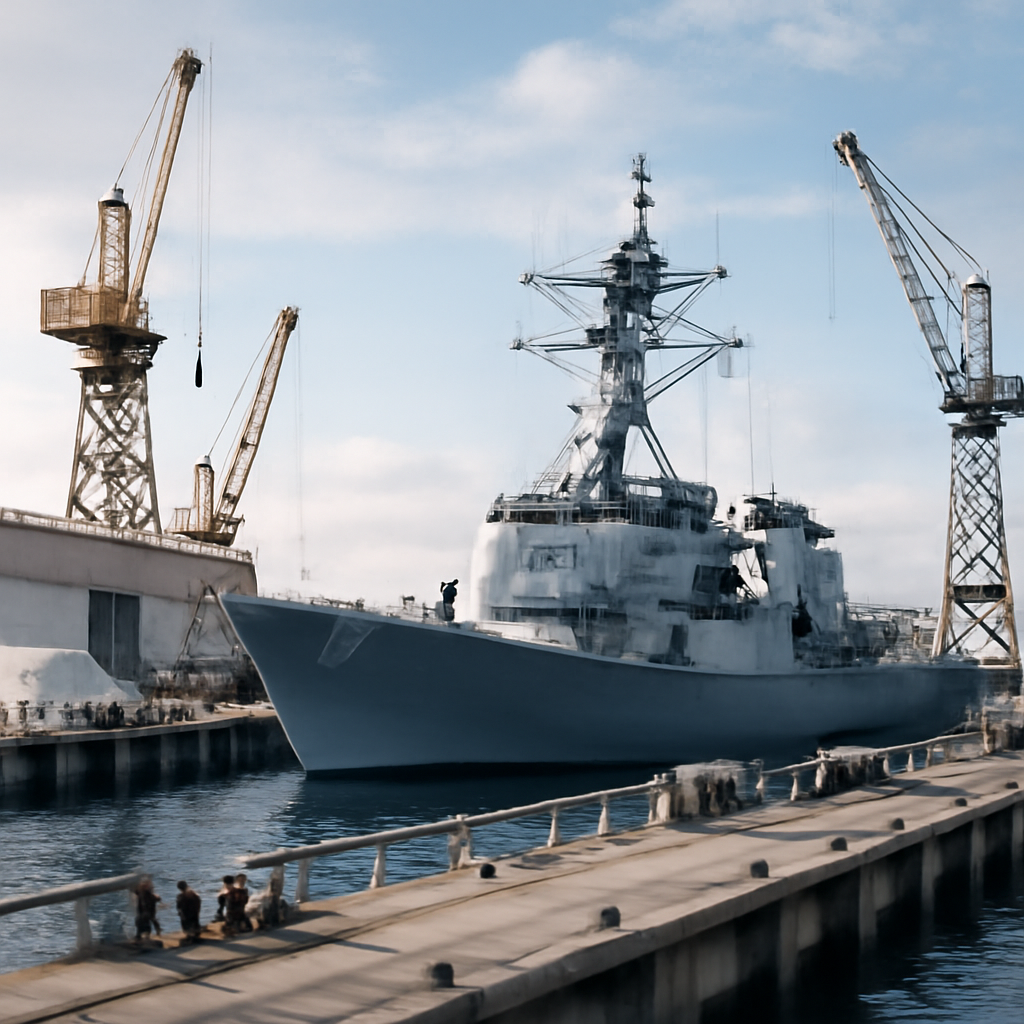
Fifteen of roughly 25 major surface combatants in Taiwan’s navy have served more than 25 years; the Chi Yang–class frigates are now over 50 years old.
Taipei’s reported interest in Japan’s Mogami design
In mid‑April 2026, Taiwanese media reported that the Republic of China (ROC) Navy is evaluating Japan’s upgraded Mogami‑class frigate — Japan’s New FFM — as a candidate for a planned 6,000‑ton next‑generation surface combatant. The reporting cited unnamed sources and suggested Tokyo had quietly relaxed restrictions on transferring warship blueprints to Taipei; Japanese officials have not confirmed the accounts.
That interest sits alongside a broader Taiwanese modernization effort. Taipei is investing in indigenous corvettes, a modernized Kang Ding fleet, and a domestic submarine program (the lead boat, Hai Kun, conducted sea trials in 2025). Yet the reporting reflects a practical problem: single‑supplier dependence, even when supplemented by U.S. systems, leaves capability gaps that Taiwan’s current ship inventory — many hulls aging past two decades — does not close.
Tokyo’s changing export rules and political backdrop
Tokyo’s legal and political architecture for defense transfers has shifted rapidly. In December 2023 the Kishida Cabinet revised the 2014 Three Principles on Transfer of Defense Equipment and Technology to permit limited exports of lethal equipment in five operational categories and to allow re‑export of licensed defense products to their country of origin. In March 2024 a Cabinet decision authorized export of the Global Combat Air Program fighter to countries holding defense equipment transfer agreements with Japan.
Political change accelerated in 2025 and 2026. Komeito, long the strongest internal brake on defense liberalization, ended its 26‑year coalition with the LDP in October 2025. Prime Minister Takaichi Sanae won a general election in February 2026 with backing from Nippon Ishin no Kai and is described in the reporting as more openly hawkish on Taiwan than predecessors. The LDP moved in February 2026 to abolish the five‑category framework and replace it with a weapons/non‑weapons classification; the Takaichi Cabinet formally approved broader liberalization in April 2026.

Audit-ready is a season. It shouldn't be.
Evidence in spreadsheets, controls drifting between audits, frameworks multiplying on flat headcount. Nubivance runs continuous compliance on Rapid7 Cyber GRC - SOC 2, HIPAA, ISO 27001, PCI, CMMC.
End the scrambleThe Australia deal as the closest available model
Canberra’s selection of the upgraded Mogami as the Royal Australian Navy’s preferred general‑purpose frigate in August 2025 — and Australia’s April 2026 contract with Mitsubishi Heavy Industries for the first three ships — provides a concrete example of how Tokyo can manage transfers. The first three frigates are valued at about A$10 billion, with the broader program expected to reach roughly A$20 billion over the decade. The ships displace about 3,900 tons, operate with a crew of around 90, and are multi‑role designs combining anti‑submarine, anti‑surface, and air‑defense capabilities.
The arrangement between Japan and Australia was not a single sale but a multi‑decade industrial partnership. Tokyo set up a dedicated joint committee, agreed to substantial intellectual property transfer, and embedded the program in a wider security relationship anchored by the Reciprocal Access Agreement. The reporting highlights that Japan’s industrial capacity now functions as a critical supplement to U.S. wartime sustainment and munitions production in a Taiwan scenario — a point that raises the strategic stakes beyond shipyards alone.
Four incremental stages toward Japan–Taiwan cooperation
The reporting lays out a staged model Tokyo and Taipei could follow without instant platform sales. First is dual‑use and coast guard cooperation: maritime surveillance sensors, oceanographic systems, communications networks, and patrol vessels. Japan’s Official Security Assistance program already supports the Philippines, Indonesia, and Bangladesh in similar ways, and Taiwan’s coast guard conducts working‑level exchanges with its Japanese counterpart.
The second stage is component‑level cooperation: sonar arrays, radar modules, electronic‑warfare elements, and unmanned vehicle subsystems that can often be transferred under current rules, especially when integrated into Taiwanese domestic shipbuilding. The report cites Japan’s UNICORN stealth‑antenna co‑production with India as a precedent. The third stage is sustainment, training, and personnel exchange — the element most directly modeled on the Australian Mogami arrangement, which depends on knowledge transfer, workforce development, and long‑term fleet support. The fourth stage — platform‑level cooperation or joint development — is described as possible only if political conditions in Tokyo change substantially, including the negotiation of a defense equipment transfer agreement that does not exist today.
What this means for Taipei, Tokyo, and Beijing
- For Taipei: incremental cooperation would offer practical ways to close capability gaps without an immediate platform purchase; Japanese sensors, components, and sustainment could complement existing U.S. systems and Taiwan’s indigenous programs.
- For Tokyo: the government must weigh political costs at home — public opinion is divided on arms exports — against industrial and strategic returns. Japanese firms are cautious about a sensitive market, but Mitsubishi, Kawasaki, and IHI already navigate complex export relationships across the region.
- For Beijing: economic and regulatory retaliation has already been employed. After parliamentary remarks in November 2025 about a possible Taiwan contingency, China tightened controls — on January 6 Beijing tightened dual‑use export controls toward Japanese military end‑users, and on February 24 it added 20 Japanese defense firms, including Mitsubishi Heavy Industries, Kawasaki, and IHI, to Beijing’s Export Control List — signaling that China treats steps toward Taipei as costly to Tokyo.
Sharing blueprints is not the same as a frigate purchase, and there is no diplomatic recognition, defense equipment transfer agreement, or Reciprocal Access Agreement between Japan and Taiwan. But Tokyo has shown it can build durable defense‑industrial partnerships when it sets out to. The remaining question is whether it will direct that capacity toward the partner whose security needs are most urgent, and toward whom restraint will not be repaid.