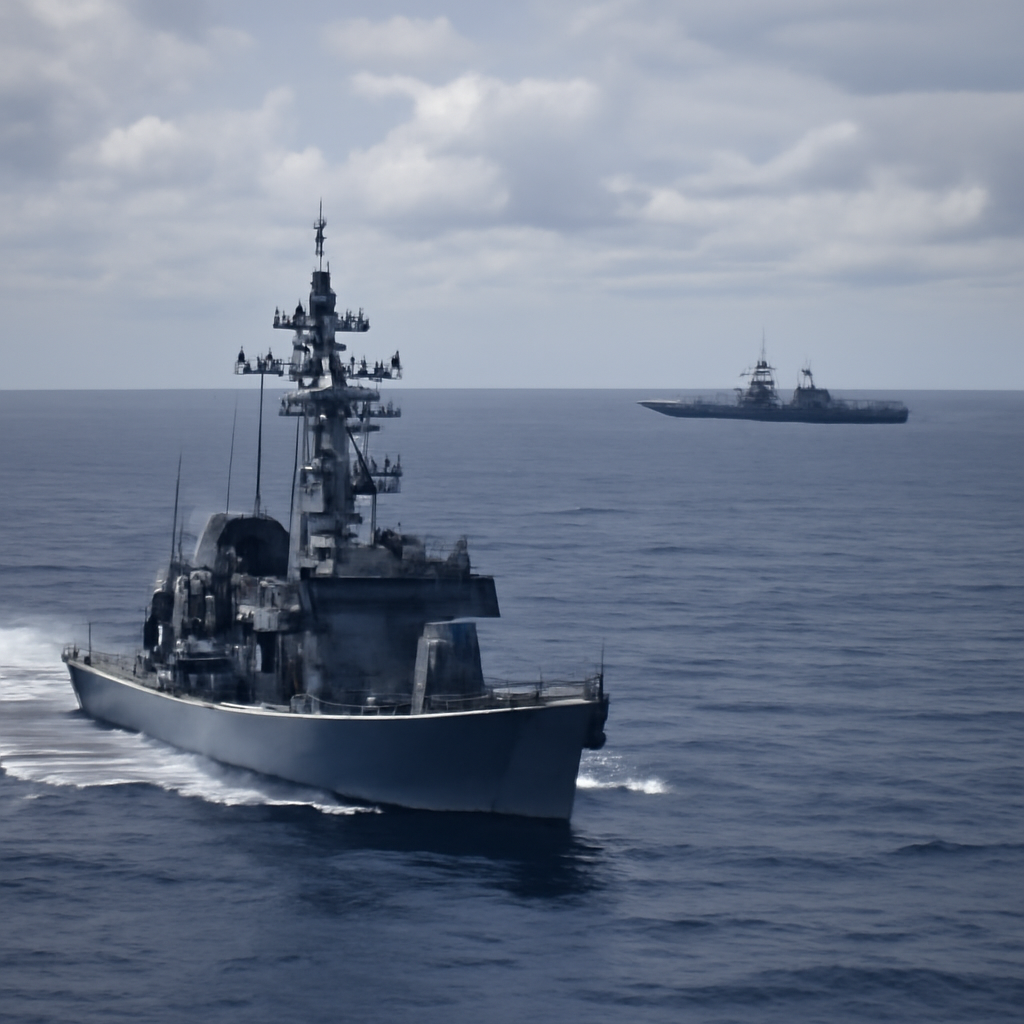
China's expanding military reach beyond the First Island Chain
On August 4, Japan's Cabinet approved Defense of Japan 2026, which frames Beijing's growing ability to project power into the Pacific as the defining feature of Japan's security environment. The paper warns that the People's Liberation Army (PLA) has become increasingly active not only in the East China Sea and the Sea of Japan but also "the western Pacific beyond the First Island Chain" — the strategic arc linking Japan's southwestern islands, Taiwan, and the Philippines. The report asserts that these operations both improve PLA combat capabilities and are intended to establish a regular presence, creating a "fait accompli." It calls repeated joint activities "obviously intended as demonstration activities against Japan" and characterizes them as a grave security concern.
Carrier operations and the Liaoning example
The white paper includes a new graphic section documenting specific long-range naval and air activities. It cites the deployment of the aircraft carrier Liaoning east of Iwo Jima in June 2025 and notes subsequent carrier operations in the Pacific, including the Liaoning's first confirmed operations beyond the Second Island Chain — the arc that stretches from Japan's Izu and Ogasawara islands to Guam and Saipan. Tokyo uses those events to underline what it sees as China's growing capacity to sustain naval and air operations further from its coastline.

Audit-ready is a season. It shouldn't be.
Evidence in spreadsheets, controls drifting between audits, frameworks multiplying on flat headcount. Nubivance runs continuous compliance on Rapid7 Cyber GRC - SOC 2, HIPAA, ISO 27001, PCI, CMMC.
End the scrambleA direct incident at sea: laser targeting over the Pacific
The report also records an incident in which a Chinese military aircraft repeatedly targeted a Japan Maritime Self-Defense Force patrol aircraft with a laser for about 30 minutes over the Pacific east of Okinawa. The white paper presents this as part of a pattern of increasingly assertive operations near Japanese forces.
China-Russia military coordination: a newly public digest section
For the first time, the Ministry of Defense's public digest contains a dedicated section illustrating the evolution of China-Russia military cooperation. The white paper documents joint naval exercises, long-range bomber patrols, coordinated naval operations and reciprocal participation in each other's military exercises, and it says the scale, frequency and geographic scope of these activities have continued to expand. Tokyo frames this development as eroding the assumption that security trends in Europe and the Indo-Pacific can be viewed separately.
North Korea, Russia, and the medium- to long-term risks
The report turns a spotlight on North Korea's ties with Russia since 2023, asserting that Pyongyang has continued providing Russia with ballistic missiles, artillery ammunition and other military equipment, and that North Korean troops have participated in combat operations following their deployment to Russia. While the ministry does not currently assess that Russian assistance has already strengthened North Korea's military capabilities, it warns that continued cooperation could eventually lead to technology transfers and capability improvements. The white paper also notes that North Korean forces could gain valuable battlefield experience from the war in Ukraine.
Japan's industrial base, the "new way of warfare," and defense exports
Drawing lessons from the wars in Ukraine and the Middle East, the report devotes a new section to what it calls the "new way of warfare," emphasizing the growing role of drones, artificial intelligence and the need for adequate stockpiles to sustain prolonged combat operations. Reflecting those lessons, the white paper elevates Japan's defense production and technological base from a chapter to a full part of the report and stresses the need to reinforce that industrial foundation. It also notes the easing of Japan's defense equipment export rules earlier this year, arguing that defense exports can bolster partner deterrence while building mutual-support environments among allies and like-minded nations. Taken together, the document argues Japan must respond with higher defense spending, closer cooperation with allies and partners, and stronger comprehensive national power.
What this means for the Japanese government, allies, and the Japan Maritime Self-Defense Force
- Japanese government — The white paper frames a policy package: higher defense spending, industrial-base strengthening, and deeper cooperation with allies and partners to counter an expanded PLA presence.
- Allies and like-minded partners — Tokyo presents eased export rules and strengthened defense industrial ties as tools to create reciprocal deterrence and mutual support among partners.
- Japan Maritime Self-Defense Force — The report points to sustained PLA activity and specific incidents, such as the reported laser targeting episode, as drivers for operational readiness, awareness of longer-range Chinese naval and air operations, and logistics for protracted missions.
Defense of Japan 2026 ties together longer-range carrier operations, closer China-Russia military coordination, and widened transfers and deployments involving North Korea and Russia to depict a security landscape in which activities once confined close to China now reach well into the Pacific. The white paper's prescription is similarly comprehensive: shore up industrial capacity, revise posture and partnerships, and prepare for a "new way of warfare" in which drones, artificial intelligence and stockpile resilience matter. Whether those steps — and the higher spending the report calls for — will match the scale and tempo Tokyo describes is the central question the document leaves for policymakers and partners to answer.
Original report: Japan’s 2026 Defense White Paper Warns of China’s Expanding Military Reach in the Pacific



