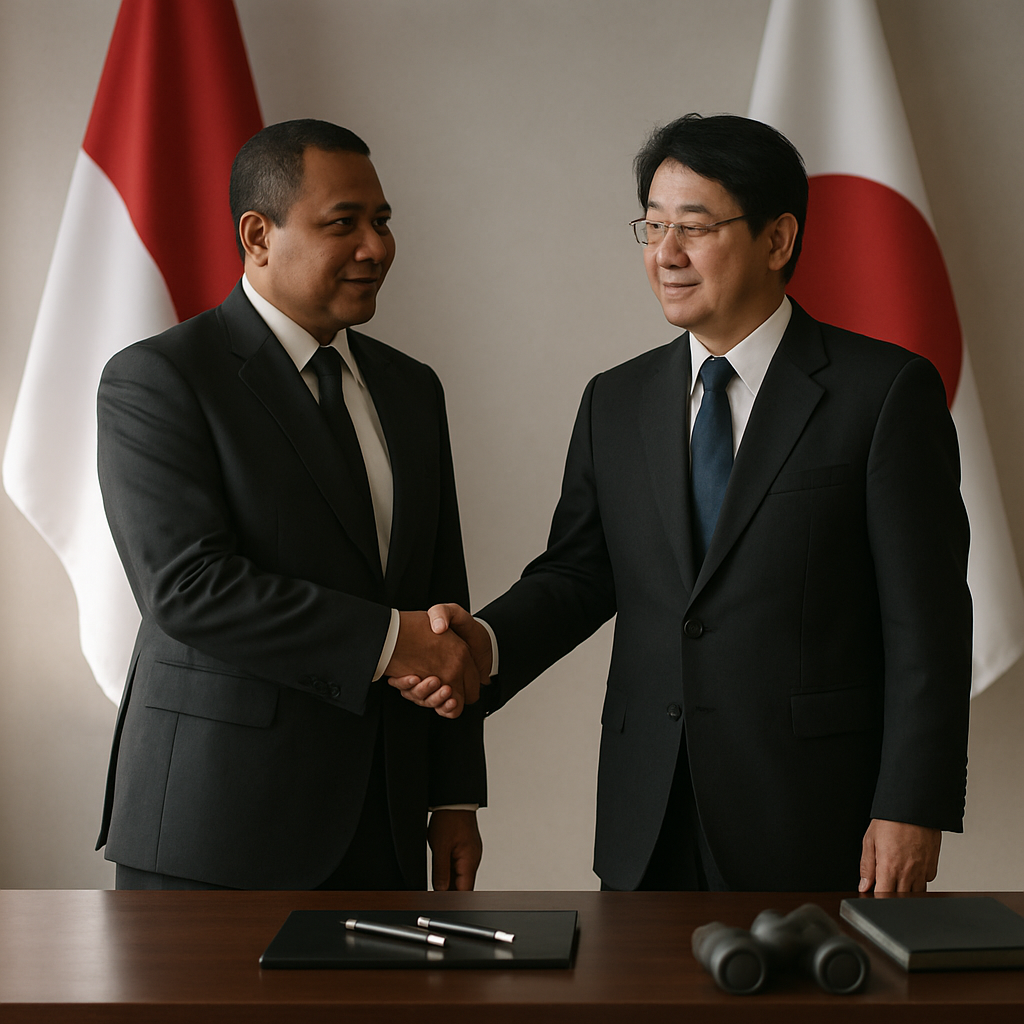
"We have both agreed to promote substantive cooperation in the defense industry and development of our personnel, whilst taking into account our respective national interests," Indonesian Defense Minister Sjafrie Sjamsoeddin said before signing a new defense cooperation agreement with his Japanese counterpart Koizumi Shinjiro, according to Reuters. The ceremony in Jakarta formalized a set of institutional steps that could broaden Tokyo's role as an arms supplier and add new options to Jakarta’s military-modernization plan.
Integrated Defense Dialogue Mechanism: institutionalizing regular talks
The agreement establishes an Integrated Defense Dialogue Mechanism to institutionalize regular discussions between vice minister-level officials and military officers from both sides. Jakarta and Tokyo also agreed to form a working-level group to enhance cooperation on possible defense equipment purchases. The ministers said the accord will advance cooperation in joint exercises and defense industrial development, although the text of the agreement has not been made public.
Tokyo’s policy shift: lifting the long-standing ban on lethal arms exports
The deal follows a recent change in Japanese policy: the government lifted its longstanding ban on the export of lethal arms, described in the agreement reporting as an important pillar of its postwar pacifist constitution. Under the change, Japan will now be permitted to sell five categories of defense equipment to countries with which it has defense equipment and technology transfer agreements. Japan has said the resumption of arms sales is intended to support the defense of allies and other "like-minded" nations.

This site is the portfolio.
OSINTSights runs on Cloudflare Workers, D1, R2, and Vectorize, with an AI pipeline on Hetzner ARM. Nubivance designed, built, and operates it. We do the same for clients.
See what we buildAreas of cooperation flagged by the ministers
Koizumi Shinjiro characterized both countries as "maritime nations" that "share the same values," adding their cooperation will "contribute to defense and peace, not just in our countries, but the region as a whole," as quoted by Nikkei Asia. The two ministers also discussed joint military exercises, further collaboration on maritime security, and military hardware and defense technology. Koizumi later posted on X that "it's frustrating that I can't go into details," underscoring that many operational specifics remain under negotiation or classified.
Indonesia’s modernization program and procurement posture
Indonesia has earmarked 337 trillion rupiah ($19.4 billion) for military modernization in 2026. Under President Prabowo Subianto, Jakarta has signed new defense agreements with Australia and the United States and is pursuing upgrades to its jet fighter force through deals with a number of countries. At the same time, Indonesian officials have publicly sought to avoid overreliance on any single power: while strengthening ties with Western countries, Jakarta has also pursued closer relations with Russia and China. Late last year, Indonesian officials aired the possibility that they might purchase China's J-10 jet fighter.
The new agreement with Japan preserves an additional procurement option. Although the text of the accord has not been published and specific purchase plans remain unclear, the reporting notes Jakarta has previously shown interest in sourcing used Oyashio-class submarines from Japan’s Maritime Self-Defense Force.
What this means for Indonesian defense planners, the Japanese defense industry, and regional security policymakers
- Indonesian defense planners: The Integrated Defense Dialogue Mechanism and working-level group give Jakarta a formal channel to evaluate Japanese systems — including the previously noted interest in used Oyashio-class submarines — alongside potential purchases from the United States, Australia, Russia, and China, reflecting Jakarta’s stated desire for a diversified procurement strategy.
- Japanese defense industry: With Tokyo now allowed to export specified categories of lethal equipment to partners with transfer agreements, Japanese firms gain a clearer path to compete in Southeast Asia; the agreement with Indonesia positions Japan to become a more active defense-industry player in the region.
- Regional security policymakers: Both ministers framed the accord as contributing to regional stability. Koizumi specifically pointed to Indonesia's "significant influence and responsibility" for stability in its region as reasons cooperation has grown more critical amid rising international tensions, a point reported by Nikkei Asia.
The agreement marks a formal opening for deeper defense ties between Jakarta and Tokyo, but several practical questions remain: the text has not been released, the five export categories and the precise list of equipment Japan will offer to Indonesia are not public, and Indonesian buying choices remain fluid as it balances suppliers. What is clear from the ministers’ statements is that both governments intend to institutionalize channels for ongoing dialogue — vice minister-level exchanges and a working-level procurement group — creating a structured path for potential arms transfers and joint industrial development.
Original reporting: Indonesia, Japan Sign New Defense Agreement, Eye Possible Arms Transfers — The Diplomat