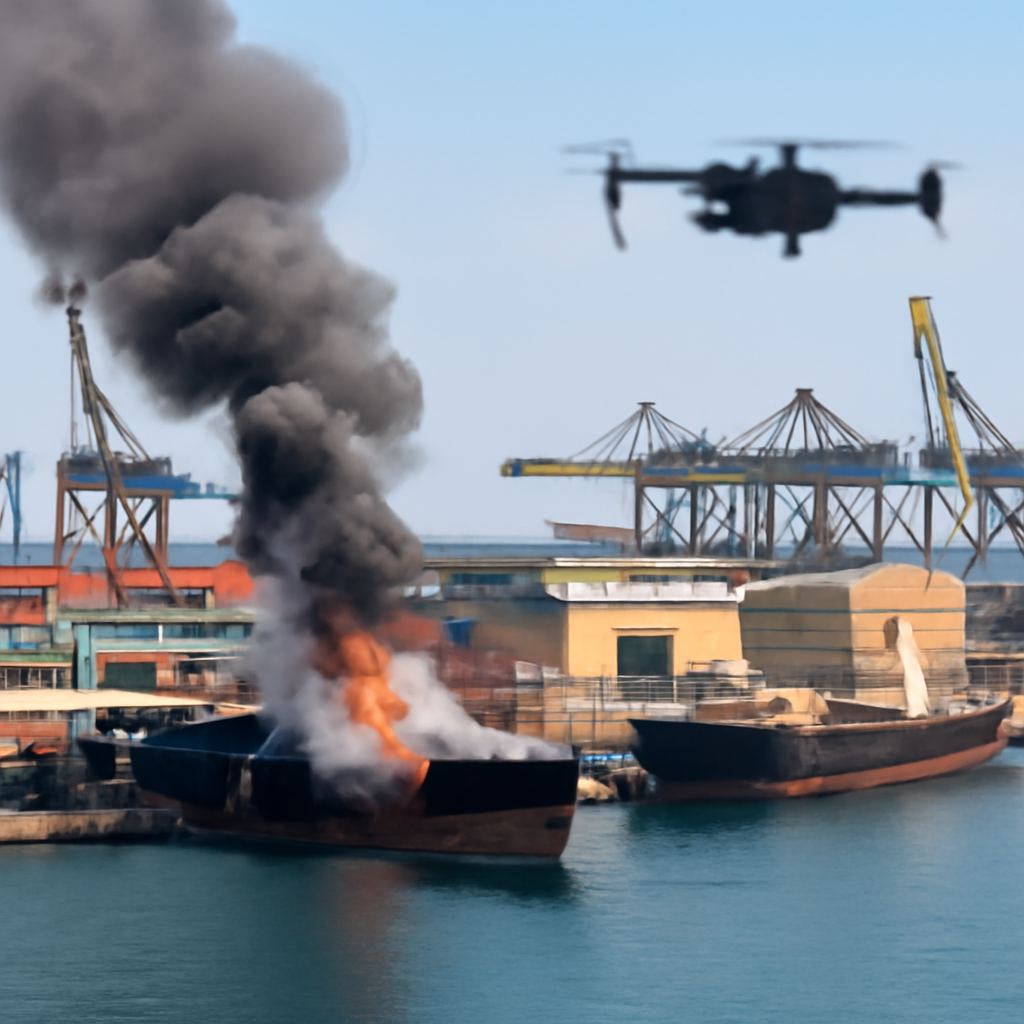
“Following the successful containment of the fire, the relevant authorities conducted initial investigations into the incident, which indicated that a drone was responsible,” the Egyptian cabinet said on Thursday, marking Cairo’s first public confirmation that its Mediterranean port of Damietta was struck on July 29.
Damietta: what Cairo confirmed and what was hit
Egypt’s official statement, carried by the state-funded Middle East News Agency, said preliminary investigations found a drone was responsible for a July 29 incident at Damietta Port involving two vessels. The government added that “no party has claimed responsibility for the attack” and that investigators are continuing work “to determine the full circumstances” and to safeguard national security. Independent maritime reporting cited by the source identified the two vessels as the U.S.-owned and operated, Marshall Islands-flagged floating storage and regasification unit ENERGOS WINTER and the Greek-owned, Bermuda-flagged LNG tanker GASLOG SALEM.
Attribution, public claims, and competing narratives
No group officially claimed the strike. U.S. President Donald Trump publicly hinted at Iranian responsibility during a press conference, saying “it’s a little more of the same” and warning “we are going to be hitting them very hard.” The New York Times, cited in the reporting, quoted two unnamed Iranians saying the explosion was “a drone attack designed to show that global shipping and energy supplies could be more deeply disrupted if Iran chose to escalate,” though those sources did not specify whether Iran or an Iran-aligned militia carried out the strike.
The Iranian-backed Houthi movement denied involvement on Telegram, saying “There is no truth to the rumors about Yemen targeting a ship in the port of Damietta” and that its stated policy “only targets the Saudi regime.” Iran’s foreign minister, Abbas Araghchi, in a post on X, hinted at possible Israeli involvement and urged vigilance against “Israeli schemes and ‘false flag’ operations,” without explicitly denying Iranian involvement.

Audit-ready is a season. It shouldn't be.
Evidence in spreadsheets, controls drifting between audits, frameworks multiplying on flat headcount. Nubivance runs continuous compliance on Rapid7 Cyber GRC - SOC 2, HIPAA, ISO 27001, PCI, CMMC.
End the scrambleRegional fighting, parallel fronts, and maritime chokepoints
Analysts and maritime intelligence firms warned the Damietta strike could widen a conflict that has already pressured two critical sea arteries. Windward called the attack “a third front, separate from the Gulf and the Red Sea,” noting that Iranian state television had named Damietta as a retaliation target two days earlier. The report placed the port about 33 miles west of Port Said, the Suez Canal’s northern entrance — a geographic fact that underlines the potential consequences to Suez traffic.
The source reports that Iran has largely closed the Strait of Hormuz and the Houthis have imposed a blockade on Saudi transit through the Bab al‑Mandeb Strait (BAM). Those disruptions prompted Saudi use of pipelines to Yanbu and a subsequent boost of exports through the Suez Canal; Kpler data cited in the reporting showed Suez-route exports rose 106% to 1.06 million barrels per day for the week after the BAM embargo announcement, up from the week starting July 13. Closure of the canal, or a sharp drop in traffic, would further strain global energy flows already affected by hostilities in the Gulf and Red Sea.
Military responses and maritime security efforts
U.S. Central Command deferred questions about Damietta to Egypt, and has denied certain Iranian Revolutionary Guard Corps (IRGC) claims about unrelated strikes. CENTCOM issued a rebuttal thread on X addressing what it said were false IRGC assertions. The Wall Street Journal, cited in the reporting, said CENTCOM commander Adm. Brad Cooper had prepared an option for a “punishing air campaign” against Iran that could last 10–14 days; the newspaper added the president would decide the scale of any response.
On the maritime security front, the European-led Operation Aspides said it was monitoring reports that the Houthis might impose fees on Bab al‑Mandeb transits but that “at this moment, there has been no official statement from the Houthis confirming such a measure.” Aspides posted imagery of the Italian frigate Bergamini escorting merchant vessels, underscoring that multinational escorts are operating to protect commercial shipping in the region. Ambrey, a maritime security firm, provided the vessel identifications used in reporting.
What this means for maritime operators, regional militaries, and energy exporters
- Maritime operators and LNG companies: vessels such as the ENERGOS WINTER and GASLOG SALEM were directly affected — operators will watch the Egyptian investigation, adjust routing and security measures, and factor elevated risk into operations near Damietta and the Suez approaches.
- Regional militaries and multinational task forces: CENTCOM, Operation Aspides and other forces will balance escort and defensive missions against political decisions about escalation; the CENTCOM planning options reported in the source highlight how military planning exists alongside diplomatic choice.
- Energy exporters and trade planners (Saudi authorities, Egypt): already shifting crude via pipelines to Yanbu and increasing Suez transit, exporters face a calculus in which damage at Damietta or closures of the Suez Canal would amplify supply disruptions and force further rerouting or output decisions.
Damietta’s confirmed hit by a drone, the absence of a claim of responsibility, and contrasting public statements from U.S., Iranian, Houthi and Egyptian sources together make the next phase of this crisis depend less on single actions than on choices: who the investigators say struck Damietta, whether retaliatory strikes proceed, and whether maritime chokepoints remain contested. Egyptian authorities continue their probe; meanwhile military and commercial actors are already repositioning to limit disruption — and watching to see if this Mediterranean strike becomes another front in a widening regional confrontation.