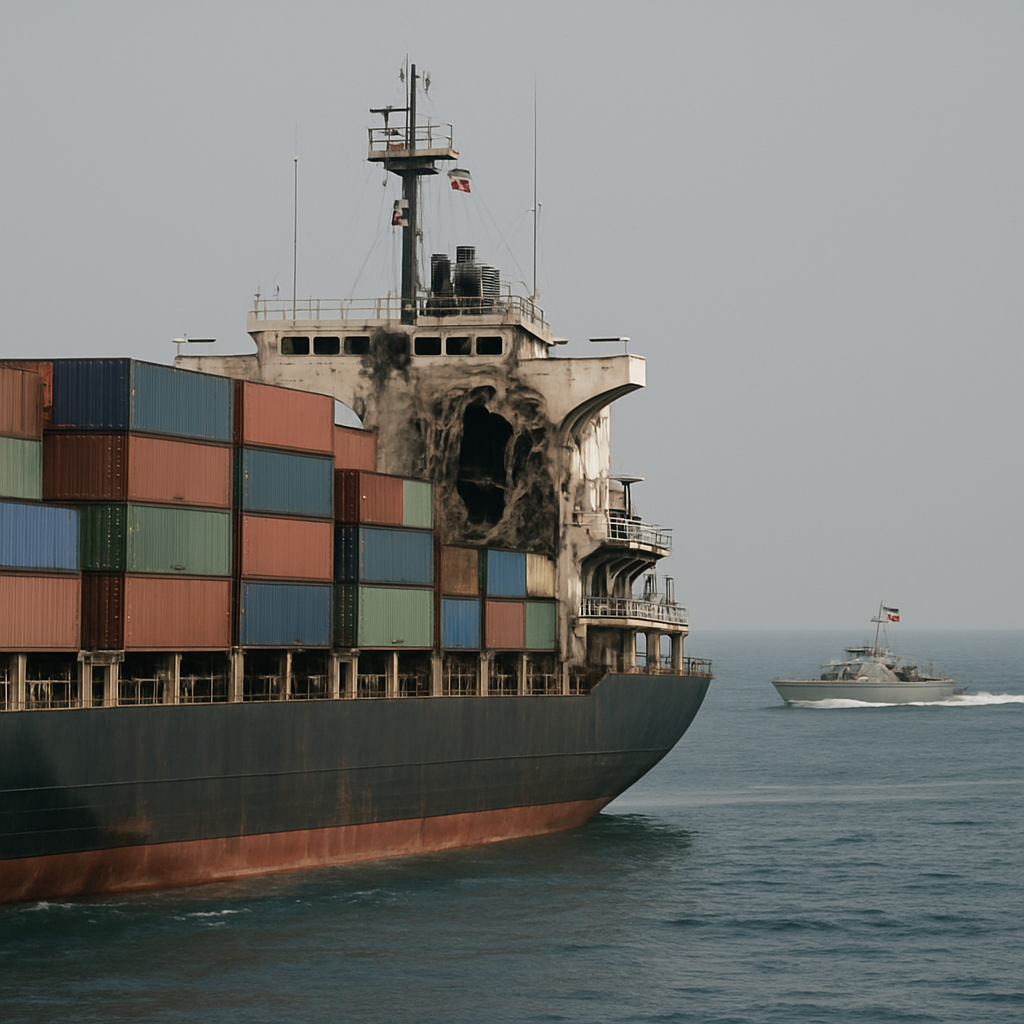
"The Master of a Container Ship reported that the vessel was approached by 1 IRGC gun boat, no VHF challenge that then fired upon the vessel which has caused heavy damage to the bridge. No fires or environmental impact reported. All Crew reported safe,” the United Kingdom Maritime Trade Operations (UKMTO) said in an alert on April 22, 2026.
Two reported attacks in the Strait of Hormuz
UKMTO issued two separate warnings on April 22 describing attacks in the Strait of Hormuz. The first, just before midnight EDT, said a container ship about 15 nautical miles northeast of Oman was approached by an Islamic Revolutionary Guard Corps (IRGC) gun boat and fired upon, causing “heavy damage to the bridge” but no fires or environmental impact, and with all crew reported safe. A second alert, roughly three hours later, noted an outbound cargo ship eight nautical miles west of Iran had been fired on and was stopped in the water; UKMTO said crew were “safe and accounted for” but did not name that vessel.
Iranian statements, vessel identities, and seizures
Iranian outlets and the IRGC provided a different, more specific account. Nour News and other Iranian sources said the IRGC opened fire on the Epaminodes; MarineTraffic lists Epaminodes as Liberian-flagged. Iranian officials also claimed strikes on the Euphoria and the MSC‑Francesca, which MarineTraffic identified as Panamanian-flagged container ships. The IRGC said the Epaminodes and MSC‑Francesca were seized for “endangering maritime security by operating without the necessary permits and tampering with navigation systems” and “directed to the coast of Iran.” Iran’s state broadcaster IRIB later posted that the two vessels were “currently in the territorial waters of the Islamic Republic of Iran for inspection of their cargo, documentation, and related records.”

The cyber insurance questionnaire just landed. Now what?
SOC 2, HIPAA, insurance renewals - someone has to own security strategy. Nubivance provides fractional CISO leadership without the full-time salary.
Get a security leadU.S. and coalition actions: interdictions, denials, and military posture
U.S. Central Command told The War Zone it could not confirm the Iranian accounts. Separately, U.S. forces boarded the Iranian‑linked oil tanker M/T Tifani in the Indian Ocean on April 21; The Washington Post reported the U.S. had “seized” the vessel, but a Pentagon official told The War Zone “seized wouldn’t be accurate at this time,” noting a 96‑hour interagency period to determine next steps, during which State, DHS/Coast Guard, DOE, Treasury and Justice may become involved.
The Pentagon has also told Congress that clearing Iranian‑deployed mines from the Strait of Hormuz could take six months and is unlikely to be undertaken until the U.S. war with Iran ends, The Washington Post reported. On the operational front, news reporting notes that the aircraft carrier USS George H. W. Bush was slated to arrive in the Middle East in about three to five days after sailing around Africa, timing that reporters said matched a presidential extension of a ceasefire timeline.
Force posture and munition expenditures
Reporting cited by The War Zone and attributed to CNN estimates substantial U.S. munitions expenditure during the campaign named Epic Fury: roughly 50% of THAAD interceptors, 50% of Patriot interceptors, 45% of Precision Strike Missiles, 30% of Tomahawk Land Attack Missiles, 20% of JDAM munitions, and 20% of Standard Missiles (SM‑3 and SM‑6). Reuters reported that U.S. forces have introduced a Ukrainian counter‑drone command‑and‑control system called Sky Map at Prince Sultan Air Base in Saudi Arabia; Reuters sources said the deployment followed drone attacks that “destroyed aircraft and buildings, and killed at least one service member.”
Telecommunications cables and asymmetric signals
Iranian‑linked media and the IRGC raised the vulnerability of undersea communications in the Strait of Hormuz. The IRGC‑linked Tasnim news agency noted that “at least 7 main communication cables of the Persian Gulf countries pass through this route,” naming cables including FALCON, AAE‑1, TGN‑Gulf, and SEA‑ME‑WE, and asserting that “more than 97% of the world’s internet traffic is transferred via these fiber optic cables laid under the sea.” The same day, open‑source investigator Mehdi H. shared a Sentinel‑2 satellite image that he said showed a flotilla of at least 33 IRGC fast attack craft north of the Strait near the Kargan coast (geo‑location 26.899,56.824), an image accompanying claims of a show of force enforcing a strait closure.
What this means for maritime operators, U.S. policymakers, and network engineers
- Maritime operators and ship masters: UKMTO’s warnings, the reported damage to a container ship’s bridge, and at least two vessels being taken into Iranian territorial waters underline operational risk in the Strait; UKMTO “encourages vessels to report any suspicious activity.”
- U.S. policymakers and military planners: The Pentagon’s six‑month mine‑clearing estimate, the high reported expenditure of defensive munitions, and the interagency complexity around interdicted vessels such as the Tifani mean logistical and political decisions in Washington will shape how — and when — sea lanes are reopened.
- Network engineers and infrastructure planners: Tasnim’s public focus on submarine cables—naming FALCON, AAE‑1, TGN‑Gulf, and SEA‑ME‑WE—signals that Iran is foregrounding asymmetric targets beyond shipping; organizations that rely on regional connectivity have a named list of links to consider when assessing routing and redundancy.
The facts on April 22 leave two clear threads to watch: whether Iran will accept talks while pressing for the U.S. to lift its naval blockade—a demand Iran’s U.N. ambassador said must be met before negotiations—and how the United States and partners will address the tangible hazards to shipping, undersea infrastructure, and munitions supply lines identified by recent reporting. The disposition of the seized vessels and their crews, and the pace at which mines and small‑boat threats are neutralized, remain immediate, concrete determinants of how fast commercial traffic can resume full operations in the Strait.
Source and further reading: https://www.twz.com/news-features/iran-ramps-up-attacks-on-ships-in-the-strait-of-hormuz-after-trump-ceasefire-extension