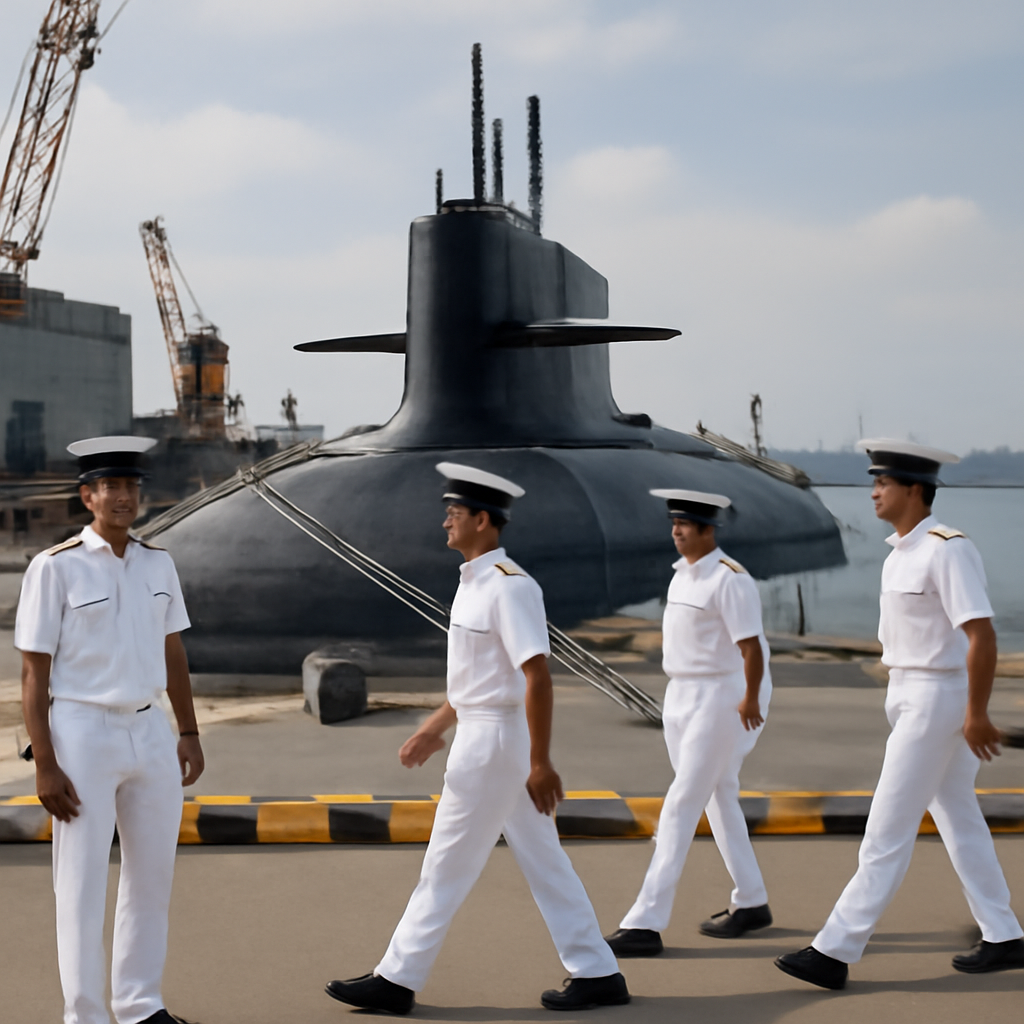
India currently has three operational nuclear-powered ballistic missile submarines — INS Arihant, Arighaat, and Aridhaman — with a fourth, INS Arisudan, scheduled to join the fleet in 2027, a shift that the source describes as central to New Delhi’s move toward a continuous at-sea deterrence posture.
Fleet size and near-term timeline
The program that began visibly with the commissioning of INS Arihant in 2016 has expanded: the article reports three operational Arihant-class SSBNs today and a fourth planned arrival in 2027. After four Arihant-class boats are completed, India will proceed to build the next-generation S5-class submarines. The report frames the arrival of a fourth boat as the operational hinge point for maintaining at least one SSBN on deterrent patrol year-round.
Bastion versus continuous at-sea deterrence (CASD)
The source contrasts two distinct approaches. The bastion strategy, originating with the Soviet Navy, keeps SSBNs inside a heavily defended maritime zone near the coast and relies on layered anti-submarine defenses. CASD, associated historically with the United States, United Kingdom, and France, requires keeping at least one fully armed SSBN on patrol at all times — a posture that typically needs a fleet of three or more boats for realistic rotations. The article traces India’s early posture — when Arihant was largely a technological demonstrator and shore-based replenishment constrained operations — to a presumed bastion approach centered in the Bay of Bengal.
But the piece reports three developments that it says point to an operational shift toward CASD: the growth to four SSBNs by 2027; an overseas replenishment facility at Mauritius’ Agalega Island inaugurated in February 2024 (usable for replenishment but not for loading SLBMs); and a Stockholm Institute of Peace and Research Institute (SIPRI) report indicating a limited number of nuclear warheads deployed aboard Indian SSBNs. Together, the article interprets these facts as evidence that New Delhi is already sustaining a continuous patrol.

This site is the portfolio.
OSINTSights runs on Cloudflare Workers, D1, R2, and Vectorize, with an AI pipeline on Hetzner ARM. Nubivance designed, built, and operates it. We do the same for clients.
See what we buildOperational control: Navy versus Strategic Forces Command
The source sets out a dual-control model. Day-to-day operations — crew selection, maintenance and routine command — remain with the Indian Navy. Custody of nuclear warheads, their mating with submarine-launched ballistic missiles (SLBMs), the physical loading and offloading of those warheads, and command of the submarine during deterrent patrols fall under the Strategic Forces Command (SFC). Crucially, authorization to launch nuclear payloads is described as remaining the SFC’s responsibility, operating under the Nuclear Command Authority.
What this means for Pakistan, the Indian Navy, and the Strategic Forces Command
- Pakistan (Islamabad): The article states Pakistan has no operational SSBN and has not initiated construction of one; it recommends Pakistan accelerate SSBN development, harden and disperse land-based nuclear facilities, and expand intelligence, surveillance, and reconnaissance (ISR) capacity — including launching more satellites — to monitor Indian strategic assets.
- The Indian Navy: With responsibility for crewed operations and maintenance, the navy will manage daily SSBN readiness, replenishment at home and via Agalega, and the patrol rotations that a four-boat force enables.
- The Strategic Forces Command: As keeper of warhead custody, SLBM mating, and launch authorization under the Nuclear Command Authority, the SFC is framed as the decisive authority over the nuclear employment of sea-based forces during deterrent patrols.
Deterrence dynamics and regional implications
The article argues that the deployment of nuclear warheads on SSBNs — SIPRI is cited as reporting 12 warheads deployed, which the piece interprets as indicating warheads are mated on SLBMs from a single SSBN — marks a qualitative change in India’s second-strike capability. It warns this gives New Delhi an edge over Islamabad while placing pressure on Pakistan’s doctrine of credible minimum deterrence and Full Spectrum Deterrence response. The piece also links India’s broader programmatic efforts — including land-based canisterized missiles such as Agni-P and a program named Mission Sudarshan Chakra to intercept incoming airborne projectiles — to a wider strategy to both deliver and absorb strikes.
The article further notes past cross-border military actions — strikes in 2019 and 2025 attributed to India — and suggests those events, together with maritime and missile-defence ambitions, feed strategic concerns in Pakistan about the risk of a first strike in crisis scenarios.
Conclusion: With four SSBNs expected by the end of 2027 and the Agalega replenishment facility operational since February 2024, the reporting links India’s force posture to an operational CASD. SIPRI’s reporting of 12 warheads aboard SSBNs is framed as evidence that at least one submarine is on continuous nuclear deterrent patrol; the remaining factual question the piece highlights is the pace at which the rest of the SSBN fleet will be mated with nuclear warheads and how Islamabad will respond.
https://thediplomat.com/2026/07/indias-expanding-ssbn-force-and-what-it-means-for-pakistan/