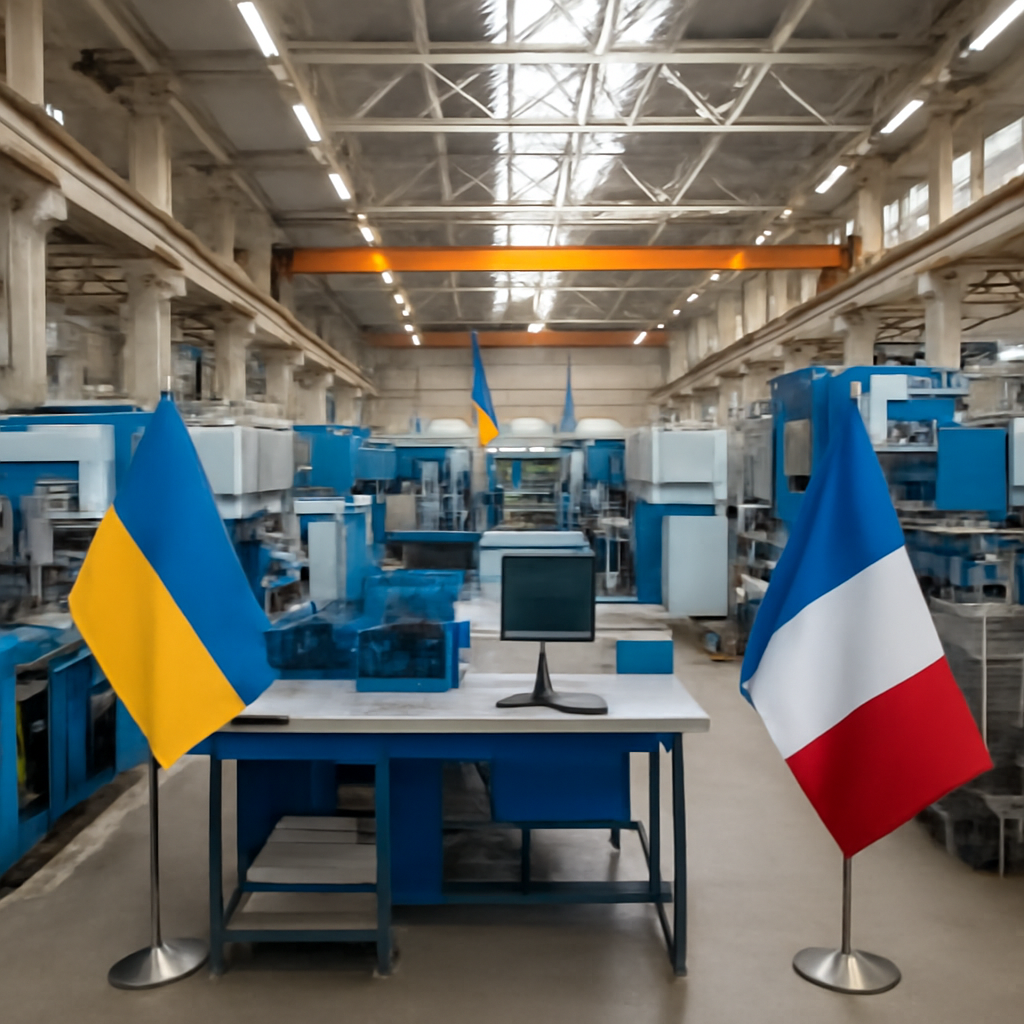
“Earlier this afternoon [Ukrainian] President Zelenskiy and I agreed on a roadmap between our two countries, implementing what had been agreed in principle last November regarding our bilateral defense cooperation,” President Emmanuel Macron said at a press conference in Paris on July 13, 2026.
Macron and Zelenskiy: licensed production and new deliveries
At a Coalition of the Willing summit in Paris attended by 25 world leaders, President Macron announced that Ukraine will receive licenses to produce Aster 30 anti-aircraft missiles for the SAMP/T air defense system, plus AASM Hammer precision-guided bombs and SCALP cruise missiles. France has already supplied tranches of all three munitions to Ukraine. Macron also discussed planned deliveries of SAMP/T and SAMP/T NG surface-to-air systems beginning at least later this year and reiterated plans to deliver the first 16 Rafale fighters in the 2028–2029 timeframe. The press conference featured Ukrainian President Volodymyr Zelensky, British Prime Minister Keir Starmer, and German Chancellor Friedrich Merz.
Aster 30, SAMP/T, and SAMP/T NG: capability notes and current Ukrainian inventory
The Aster 30 is the interceptor used in the Franco‑Italian SAMP/T surface‑to‑air missile system, which is often compared to the U.S. Patriot and offers anti‑ballistic missile capability. Ukraine currently fields two baseline SAMP/T systems—one supplied by France and one by Italy. The SAMP/T NG is an upgraded variant designed to expand engagement altitude and maximum range primarily through new radars; the French and Italian NG versions differ in the radar fitted, with France using the Thales GF 300 and Italy using the Kronos Grand Mobile HP. Improved Aster 30 variants are also in development. The missile has wider demand beyond SAMP/T ground sites: it is deployable from warships in navies of France, Italy, the United Kingdom (as part of Sea Viper), and others, and SAMP/T operators include Singapore.

This site is the portfolio.
OSINTSights runs on Cloudflare Workers, D1, R2, and Vectorize, with an AI pipeline on Hetzner ARM. Nubivance designed, built, and operates it. We do the same for clients.
See what we buildSupply realities: timelines, lead times, and operational security
Macron’s licensing announcement opens a pathway to a domestic Ukrainian production line, but the source stresses significant practical hurdles. Higher‑end anti‑air missiles typically have production lead times measured in months if not years; Ukraine must finalize agreements with relevant defense contractors, build a production line, and stockpile brand‑new subsystems. Where initial funding will come from is not clear, although the source notes that new financial aid from France and other countries could be a possibility. Domestic production may create export opportunities for Ukraine but also raises operational‑security risks: Russia or other adversaries could gain insights if they recover full interceptors or critical subcomponents, and establishing local manufacturing requires sharing intellectual property and manufacturing know‑how, increasing potential vectors for compromise.
Integrated Anti‑Ballistic Missile Coalition and allied posture
At the same summit, the governments of Ukraine, Denmark, France, Germany, Italy, the Netherlands, Norway, Spain, Sweden, and the United Kingdom announced creation of an Integrated Anti‑Ballistic Missile Coalition to pool resources to develop new anti‑ballistic missile capabilities. The coalition’s formation reflects a growing demand across Europe and beyond for higher‑end systems and interceptors, driven in part by recent regional conflicts. The source highlights that the United States also featured in related policy moves: U.S. President Donald Trump said last week he would approve a license for Ukraine to domestically produce Patriot interceptors. French Air Force Gen. Fabien Mandon has claimed that SAMP/T is proving more effective than Patriot against certain Russian ballistic threats, saying in a quoted comment that “Today, the Patriot system is struggling to intercept them, but the SAMP/T is intercepting them.”
What this means for Ukraine, France, and the United States
- Ukraine: A domestic pipeline for Aster 30 would hedge against shortages and delays of foreign interceptors and support long‑term air‑defense capacity, but it does not address immediate shortfalls. President Zelensky warned after a July 6 attack that Ukrainian forces had intercepted drones and cruise missiles but not ballistic missiles, blaming insufficient interceptor supplies and calling for stronger allied support.
- France: Licensing production and continuing deliveries—SAMP/T systems, missiles, and Rafale—extend France’s role as a primary supplier and partner, while committing it to share technology and support for building Ukrainian manufacturing and sustainment capabilities.
- The United States: The source records parallel U.S. developments, including a recent statement by President Trump about licensing Patriot production in Ukraine and concerns over Patriot interceptor shortages and broader U.S. stockpile strain. Those pressures are a driver for allied measures such as the new coalition and for Ukraine’s pursuit of domestic production options.
Macron’s announcement marks a tactical shift from sole reliance on allied stockpiles toward creating a local production pathway for high‑end interceptors. The move promises longer‑term resilience for Ukraine’s growing SAMP/T fleet, but the facts in the record make clear that legal licenses are only the opening step: contractor agreements, production lead times, funding, and security safeguards remain unresolved. The next measurable milestones will be finalized contracts with manufacturers, the start date for physical production, and the timeline for first domestic deliveries—none of which were specified at the Paris summit.