“Regarding airborne anti-drone operations, it is not sustainable to use MICA air-to-air missiles costing over a million euros to shoot down a drone worth a few thousand dollars,” Chief of Staff of the French Air and Space Force Gen. Jérôme Bellanger told a parliamentary hearing, framing the economic and operational logic behind a new, low-cost option now being added to the Rafale fighter.
Directorate General of Armaments and the LADAC program
The Directorate General of Armaments (DGA) announced successful live-fire integration of 68 mm laser-guided rockets on the Rafale, under a program named Lutte anti-drone sur avion de combat (LADAC). Development began as an urgent task on December 31, and the DGA reported that the time from contract award to initial operational capability was less than eight months. Head of the DGA Patrick Pailloux briefed the National Assembly that integration is ongoing and expected to be ready for operational fielding “this summer.”
How the package is built: Aculeus‑LG, JF12 pods, RBE2 and Talios
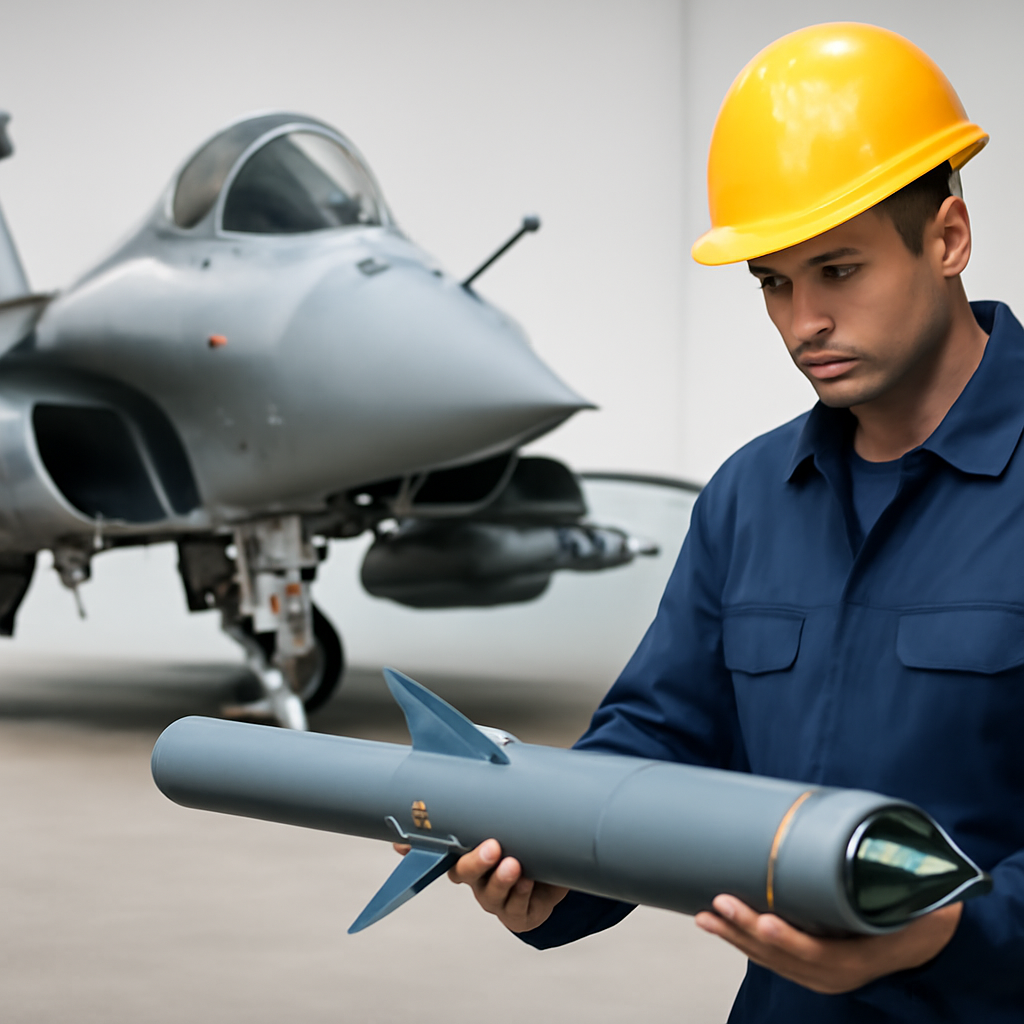
The solution adopted is primarily French in composition. Rockets understood to be the Aculeus‑LG—reported to have a stated range of 3.7 miles—are loaded into Thales Telson JF12 12‑round rocket pods. Integration work was carried out jointly by the DGA and the French Air and Space Force’s Centre d’expertise aérienne militaire (CEAM), supported by Dassault Aviation and Thales. The Rafale’s RBE2 radar received modifications for the role, and the Talios electro‑optical/targeting pod is used for target tracking and laser designation.

Audit-ready is a season. It shouldn't be.
Evidence in spreadsheets, controls drifting between audits, frameworks multiplying on flat headcount. Nubivance runs continuous compliance on Rapid7 Cyber GRC - SOC 2, HIPAA, ISO 27001, PCI, CMMC.
End the scrambleOperational drivers: missile expenditure during Operation Epic Fury
The LADAC push follows a period in which Rafales expended large numbers of high‑value missiles against one‑way strike drones. By the end of February, French Rafales were protecting the United Arab Emirates from Iranian drone attacks during Operation Epic Fury and fired several dozen MICA IR/EM missiles in only a few weeks. That operational experience reinforced Bellanger’s point that using million‑euro missiles against inexpensive drones is unsustainable, and prompted the decision to adopt rockets as a lower‑cost intercept option.
Cost, precedent, and international context
The move places France alongside other countries that have added laser‑guided rockets to combat jets for counter‑UAS missions. The source describes the U.S. adoption of the APKWS 70mm rocket for air‑to‑air use, and notes the Eurofighter Typhoon and the U.K. Royal Air Force have also fielded APKWS in recent years. The article contrasts missile prices—reporting a single MICA round at around $2 million and citing MICA’s order‑of‑magnitude cost compared with a Shahed drone’s approximate unit cost of $50,000—and suggests the Aculeus‑LG’s cost is likely similar to APKWS, where the laser guidance section can cost $15,000–$20,000 with modest additional sums for motor and warhead components. Those figures underpin the rationale for a weapon that increases “magazine depth” by allowing multiple rocket rounds per pylon instead of a single missile.
What this means for the French Air and Space Force, Rafale export customers, and Ukrainian Mirages
- French Air and Space Force: The service will receive LADAC‑equipped Rafales by the end of the month, offering a cheaper, scalable option for countering large salvos of one‑way attack drones and subsonic cruise missiles without drawing down stocks of high‑value missiles such as the MICA.
- Rafale export customers in the Middle East (Qatar, United Arab Emirates): The DGA noted LADAC could be provided to export Rafale customers. Given an active Rafale operating community in the region and recent attacks that prompted the capability’s development, those operators are likely candidates to adopt the rocket pods.
- Ukrainian Mirages: The Chief of Staff had previously suggested equipping Rafale and/or Mirage 2000D RMV aircraft with laser‑guided rockets to counter long‑range one‑way drones like the Iranian Shahed‑136 and Russian Geran series. Ukrainian Mirages are mentioned as potential candidates for integration, and Ukraine already uses APKWS on its F‑16s.
Two practical questions remain visible in the record. First, the LADAC timetable is compressed—the program moved from urgent start on December 31 to operational rollout within months—but the report notes uncertainty over whether the Rafale’s onboard 30mm cannon will be specifically modified for anti‑drone use, an adaptation Bellanger had earlier proposed to reduce risk from debris. Second, while the Aculeus‑LG’s stated 3.7‑mile range and the JF12 pod’s twelve rounds offer a clear increase in magazine depth, the ultimate operational trade‑offs—engagement envelopes, rules of engagement in congested airspace, and logistics for export customers—will determine how widely and quickly this capability becomes a routine part of combat aircraft arsenals.