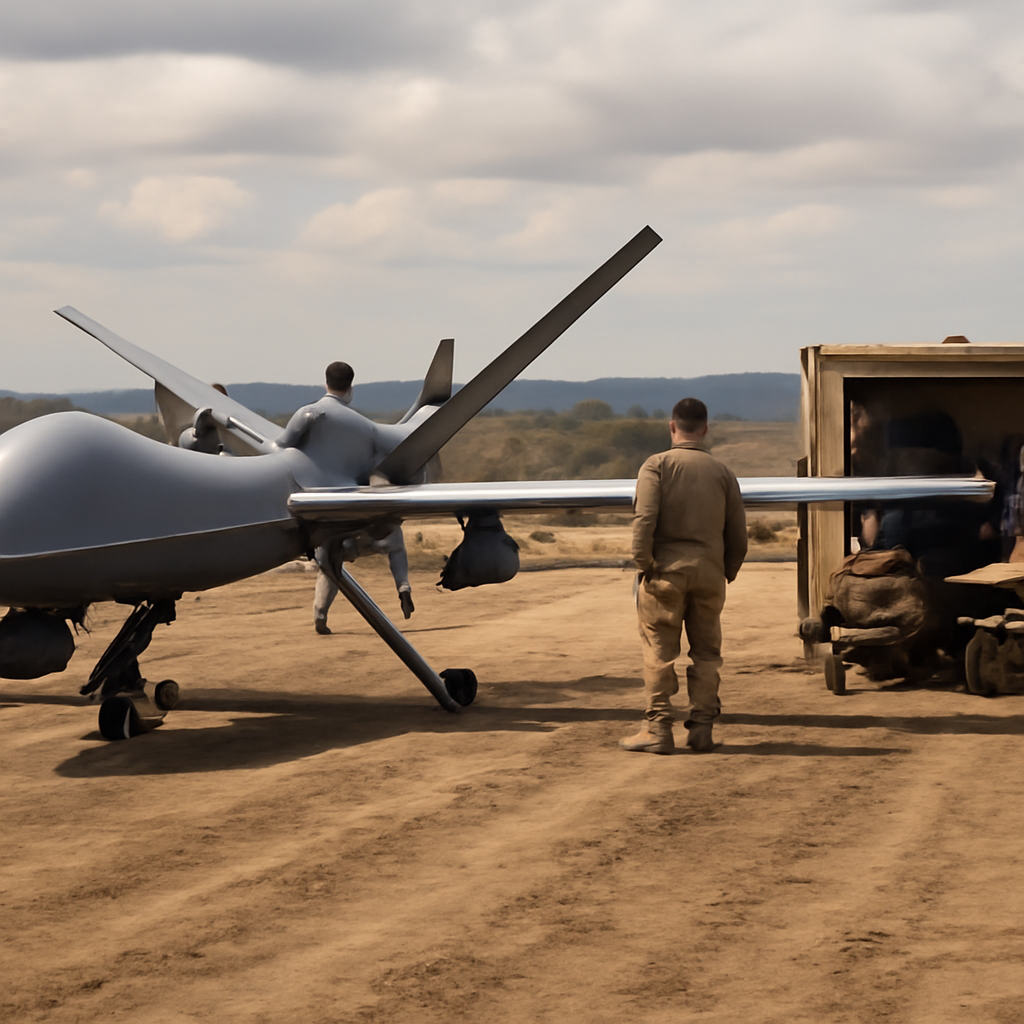
The Indian joint air defense doctrine was released on May 29 by Chief of Defense Staff General Anil Chauhan, a day before his retirement.
Why the timing matters: a doctrine and a personnel milestone
The doctrine’s public debut on May 29 by General Anil Chauhan — immediately prior to his retirement — came in the wake of the May 2025 crisis between India and Pakistan, called “Operation Sindoor” by New Delhi and “Marka-e-Haq” by Islamabad. Its release both codifies recent operational thinking and signals an institutional push to accelerate tri-service integration under the growing theater-command project. The document is one in a sequence of joint doctrines issued by the Headquarters Integrated Defense Staff to institutionalize “jointness” across the services.
Core features: a layered architecture, a linked “kill-web,” and the threat set
The doctrine frames an integrated, layered air defense architecture aimed at countering a wide spectrum of aerial threats: drones, loitering munitions, precision-guided weapons, cruise missiles, ballistic missiles, and saturation attacks. It places explicit emphasis on a synchronized “kill-web” designed to compress decision timelines and link tracking systems to weapons “across all domains.” The text says this approach draws on lessons from recent conflicts around the world and specifically from the May 2025 crisis, reflecting an effort to detect, track, and neutralize large volumes of incoming aerial threats.

This site is the portfolio.
OSINTSights runs on Cloudflare Workers, D1, R2, and Vectorize, with an AI pipeline on Hetzner ARM. Nubivance designed, built, and operates it. We do the same for clients.
See what we buildMission Sudarshan Chakra: an Indian “Iron Dome-like” blueprint
The doctrine is described as integral to Mission Sudarshan Chakra — referred to in the source as an Indian Iron Dome project — intended to protect civilian infrastructure, strategic assets, and military installations. The source material notes that the doctrine was unveiled within a year of Prime Minister Narendra Modi’s announcement of the Sudarshan Chakra initiative, and later references Mission Chakra as announced in August 2025. According to the doctrine’s framers, it provides the operational blueprint for integrating air defense systems, long-range surveillance radars, command-and-control networks, and ballistic missile defense (BMD) assets into a networked, multi-layer system that can operate across land, air, and sea.
Systems on the shelf and under development: S-400s, PAD, AAD, Akash and SPYDER
The doctrine sits atop an existing mix of acquired and indigenous systems. India has purchased five batteries of the Russian S-400 BMD system and has approved buying an additional five batteries, a step that would bring the total to ten. Indigenous BMD assets named in the doctrine include the Prithvi air defense (PAD) system, with interception capability at exo-atmospheric altitudes between 50 and 180 kilometers, and the Ashwin advanced air defense (AAD) system, with a range of 20–40 kilometers. Short-range air defense systems already deployed include Akash and SPYDER. The doctrine explicitly seeks to extend Indian defenses beyond aircraft, drones, and loitering munitions to encompass cruise and ballistic missile threats and thus strengthen non-contact warfare capabilities.
What this means for India, Pakistan, and regional crisis stability
- India — The doctrine and the Sudarshan Chakra project are presented as enablers of integrated theater-level air defense and faster, joint decision-making. The source warns this enhanced defensive posture could increase Indian decision-makers’ confidence in protecting critical assets from retaliatory strikes, and thereby potentially raise their willingness to undertake limited conventional military actions, a dynamic already evident, the source says, during the May 2025 crisis.
- Pakistan — The source argues that New Delhi’s doctrinal and technological developments will reinforce Pakistani concerns about India’s strategic posture. Over the past decade, developments in missile defense, precision-strike capabilities, advanced ISR platforms, and counterforce-enabling technologies contribute to Pakistan’s perception that India is shifting away from what Islamabad views as credible minimum deterrence; that perception will likely affect Pakistan’s threat assessments and could prompt decisions to preserve the credibility of its retaliatory capabilities.
- Headquarters Integrated Defense Staff and theater command ambitions — The doctrine is explicit about its role as a doctrinal foundation for future theater-level air defense operations. Doctrinal harmonization is framed as a prerequisite for theaterization because integrated commands require common concepts of operations and shared command-and-control frameworks.
The document is simultaneously technical manual and strategic signal. It seeks to tie sensors, shooters and command nets into a single layered shield; it also reframes how crisis decision-making may unfold by altering perceptions of vulnerability and immunity. As the source puts it plainly, “the greater danger is not that India will achieve strategic immunity, but that it could develop the false confidence that it has.” In a region where mistrust shapes choices, that psychological effect may matter as much as radar coverage and interceptor counts.
Original story: https://thediplomat.com/2026/06/indian-joint-air-defense-doctrine-implications-for-south-asian-stability/