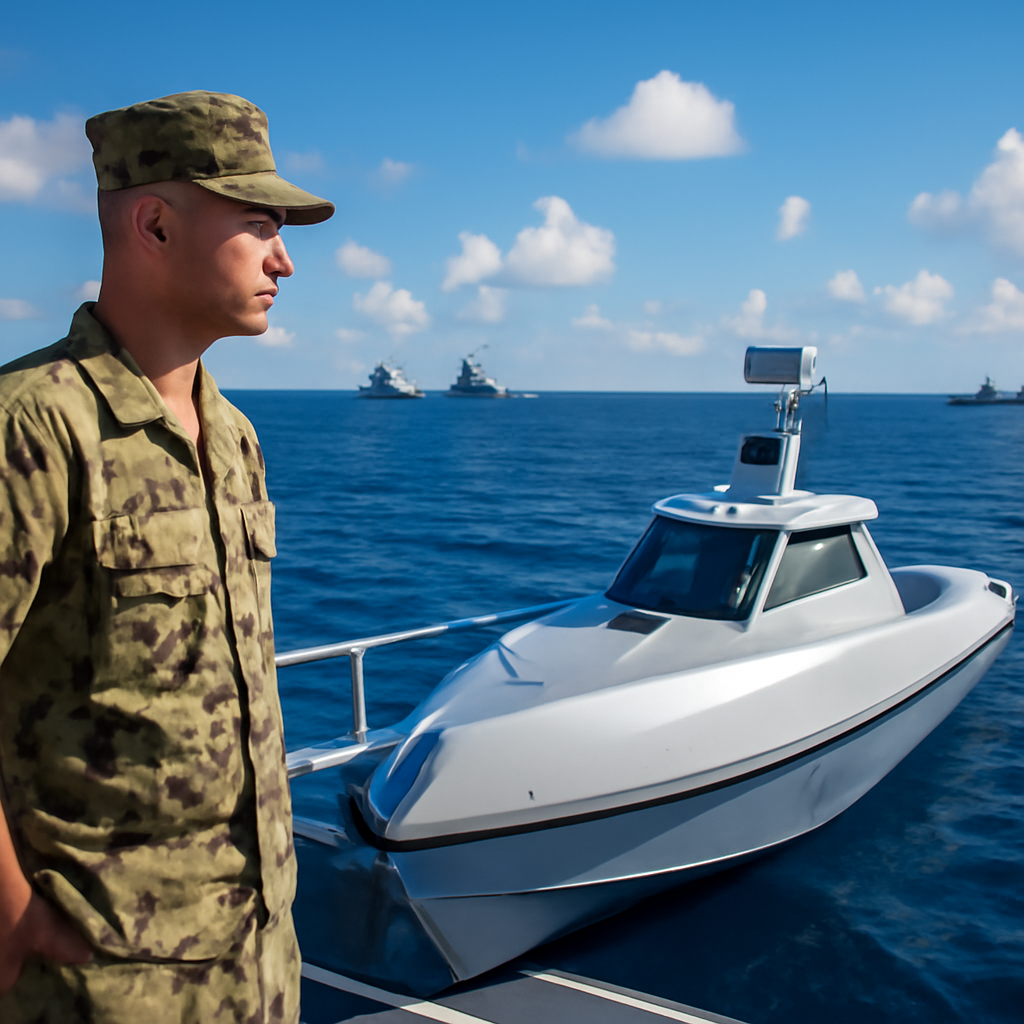
“RIMPAC provides the real-world operational environment where all of our participating forces can develop technologies and innovate their current technologies and improve interoperability,” Rear Adm. Suzanne M. Bailey said during a media call on July 6.
Rear Adm. Suzanne M. Bailey on operationalizing new platforms
Bailey, deputy commander of the US 3rd Fleet and commander of the RIMPAC Combined Exercise Control Group, framed this year’s Rim of the Pacific exercise as more than a multinational warfighting contest: she described it as “our primary laboratory for operationalizing these platforms and concepts.” She emphasized integrating uncrewed systems alongside manned forces to increase complexity and unpredictability for potential adversaries and to gather early warfighter feedback on emerging capabilities.
Fleet Experimentation (FLEX) and roughly 40 initiatives
RIMPAC’s Fleet Experimentation (FLEX) program was the vehicle for roughly 40 separate experimentation initiatives, each sponsored by an office in either the Department of War or the Department of the Navy, according to the Naval Postgraduate School. Those initiatives ranged from large-scale advanced manufacturing demonstrations to lethal weapons tests involving uncrewed surface vessels. Organizers expected most experiments to be completed by the time RIMPAC ended late last month.

Audit-ready is a season. It shouldn't be.
Evidence in spreadsheets, controls drifting between audits, frameworks multiplying on flat headcount. Nubivance runs continuous compliance on Rapid7 Cyber GRC - SOC 2, HIPAA, ISO 27001, PCI, CMMC.
End the scrambleAdvanced manufacturing demonstration led by CAMRE
One headline experiment was described by the Naval Postgraduate School and PACOM as “the largest advanced manufacturing demonstration ever conducted by the U.S. Department of War.” The Naval Postgraduate School’s Consortium for Advanced Manufacturing Research and Education (CAMRE) and program manager Chris Curran outlined an expeditionary manufacturing workflow: commanders would “submit a digital request, identify the nearest qualified manufacturer, produce the part near the operational area, and deliver it directly to forces in the field.”
PACOM’s news release emphasized that the demonstration would not focus on a single technology but on the complete workflow — from a digital order to distributed production and delivery — and that the scale of RIMPAC would expose the effort to “the logistical constraints, coordination challenges, and operational demands they would face during real-world missions.” CAMRE and NPS researchers planned to use the at-sea environment to identify challenges that cannot be replicated in laboratory settings.
Uncrewed systems and counter-unmanned-aircraft experiments
RIMPAC’s experimentation suite included multiple uncrewed systems tests. A Saildrone executive had said in April that one expected experiment would see Lockheed Martin AGM-179 Joint Air-to-Ground Missiles equipped on a Saildrone Surveyor uncrewed surface vessel. Separately, personnel from the Naval Postgraduate School’s CAMRE and the Naval Information Warfare Center Pacific planned tests and a demonstration of spectral imaging unmanned aircraft detection sensors and 3D-printed rockets for potential counter-unmanned aircraft system applications.
Bailey framed these sorts of tests — combining manned and unmanned platforms — as a way to learn with partner nations how to “combine manned and unmanned platforms into a single, cohesive, and formidable fighting and defensive force.”
The exercise’s scale and at-sea operations
RIMPAC began June 24 and, according to Navy figures provided at the end of the exercise, involved 30 nations, 30 surface ships, five submarines, “more than nearly 200 aircraft,” and more than 30,000 personnel. During the at-sea phase, participating forces executed combined and joint training across a broad set of missions: anti-submarine warfare, maritime strike, integrated air and missile defense, amphibious operations, and logistics. The exercise concluded with a free-play scenario in which opposing forces reacted dynamically to one another to evaluate the force’s combined maritime capabilities.
What this means for Naval Postgraduate School researchers, commanders, and partner nations
- Naval Postgraduate School researchers: The at-sea scale gives NPS an opportunity to see distributed manufacturing and spectral imaging sensors operate under operational constraints that cannot be replicated ashore, helping identify real-world technical and logistical limits.
- Commanders and operational forces: The CAMRE workflow aims to shorten the supply chain by enabling commanders to request parts digitally and source production near the operational area, testing whether distributed nodes can respond to operational demand.
- Partner nations and fleet operators: Participating countries gain exposure to integrating uncrewed platforms and manufacturing workflows, and provide early warfighter feedback that program sponsors can use to refine concepts before wider fielding.
RIMPAC’s organizers cast the exercise as both a test of high-end maritime warfighting and a sweeping field experiment in platforms, sensors, and logistics. As Bailey put it, the goal was to expose the fleet and partners to emerging capabilities and to obtain “real-world warfighter feedback very early in the process.” Whether the FLEX demonstrations will change how commanders request and receive parts, or how uncrewed systems are armed and integrated, will turn on the post-exercise evaluations that the Naval Postgraduate School, PACOM, and the sponsoring services now must complete.