“Building the Arsenal of Freedom requires robust, dynamic supply chains at every level of the industrial base,” Michael Duffey, the Pentagon’s top acquisition official, said in a statement today.
Northrop Grumman’s $3 billion, seven-year framework agreements
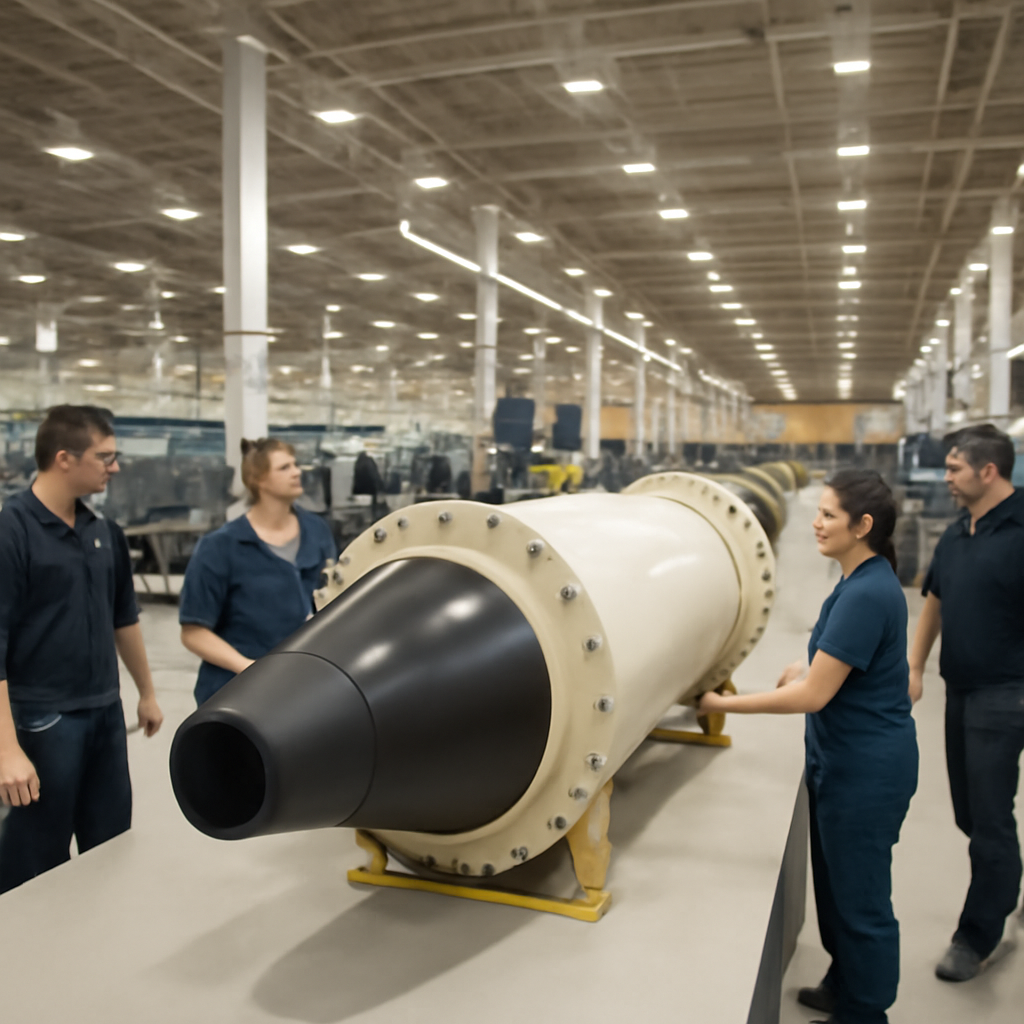
Northrop Grumman has signed two multiyear framework agreements with the Pentagon worth a combined $3 billion to expand solid rocket motor (SRM) production for two widely used interceptors. Northrop said the PAC-3 agreement is valued at $2 billion and the THAAD agreement at $1 billion. Each agreement spans seven years, the company said in a news release.
The deals mark the first time Northrop has entered a framework agreement with the Pentagon since the department began encouraging multiyear instruments designed to entice defense firms to invest their own capital to scale munitions production, Northrop said.
PAC-3 SRM work at Allegany Ballistics Laboratory; THAAD at San Diego plant
Under the agreements, Northrop’s Allegany Ballistics Laboratory in West Virginia will “stand up production” for solid rocket motors for the PAC-3 interceptor, Northrop said. Additional THAAD motor production will take place at Northrop’s San Diego plant, the company added. The source materials provide those two facilities as the designated production sites for the newly contracted motor work.

Audit-ready is a season. It shouldn't be.
Evidence in spreadsheets, controls drifting between audits, frameworks multiplying on flat headcount. Nubivance runs continuous compliance on Rapid7 Cyber GRC - SOC 2, HIPAA, ISO 27001, PCI, CMMC.
End the scrambleHow this fits the Pentagon’s multiyear framework push
The Northrop agreements are part of a broader Pentagon strategy launched earlier this year to use multiyear framework agreements to accelerate production of in-demand munitions and components. Since the beginning of the year, the department has signed roughly a dozen framework agreements aimed at boosting rates for munitions such as the Tomahawk cruise missile and for components such as solid rocket motors and seekers, the source reports.
One of the first such arrangements was a January deal with PAC-3 prime contractor Lockheed Martin to triple production of the interceptor over seven years and raise production capacity to 2,000 a year by the end of 2030. Lockheed also signed an agreement to quadruple THAAD production a few weeks later, according to the same record. Michael Duffey framed the approach as essential to “accelerating the tripling of PAC-3 and quadrupling of THAAD interceptor production.”
What this means for L3Harris, Lockheed Martin, and the Pentagon
- L3Harris: The company signed a similar agreement with the Pentagon last week to boost THAAD and PAC-3 solid rocket motor production and—importantly—was identified as the current sole producer of PAC-3 SRMs. The Northrop deal creates a second supplier for PAC-3 motors, changing the supplier landscape noted in the source.
- Lockheed Martin: The Pentagon’s January framework with Lockheed set explicit scaling targets—tripling PAC-3 production over seven years and reaching a capacity of 2,000 a year by the end of 2030—benchmarks that the new motor agreements are intended to support by increasing component throughput.
- The Pentagon: The department is using these multiyear frameworks to motivate private capital investment and expand the industrial base for munitions and components; the Northrop deals represent another step in that multiyear, multi-company effort to scale capacity.
Other framework agreements and low-cost munitions efforts
The Pentagon has not limited framework agreements to legacy primes and motor producers. The department has also entered into arrangements with newer defense tech firms: Anduril and Zone 5 were named as recipients of production-boosting deals to increase output of new, low-cost munitions under the Low Cost Containerized Munitions program and related efforts, according to the reporting.
Taken together, the contracts with Lockheed Martin, L3Harris, Northrop Grumman, Anduril, and Zone 5 reflect a continuing departmental push to broaden suppliers and raise throughput for both established interceptors and newer, low-cost systems.
Northrop’s two seven-year framework agreements commit the company to expand motor production at specified facilities and add a second PAC-3 SRM supplier to the market. The contracts reinforce a Pentagon strategy of using multiyear frameworks to drive private investment and scale capacity—an approach the department’s top acquisition official described as central to accelerating planned production increases for PAC-3 and THAAD interceptors.