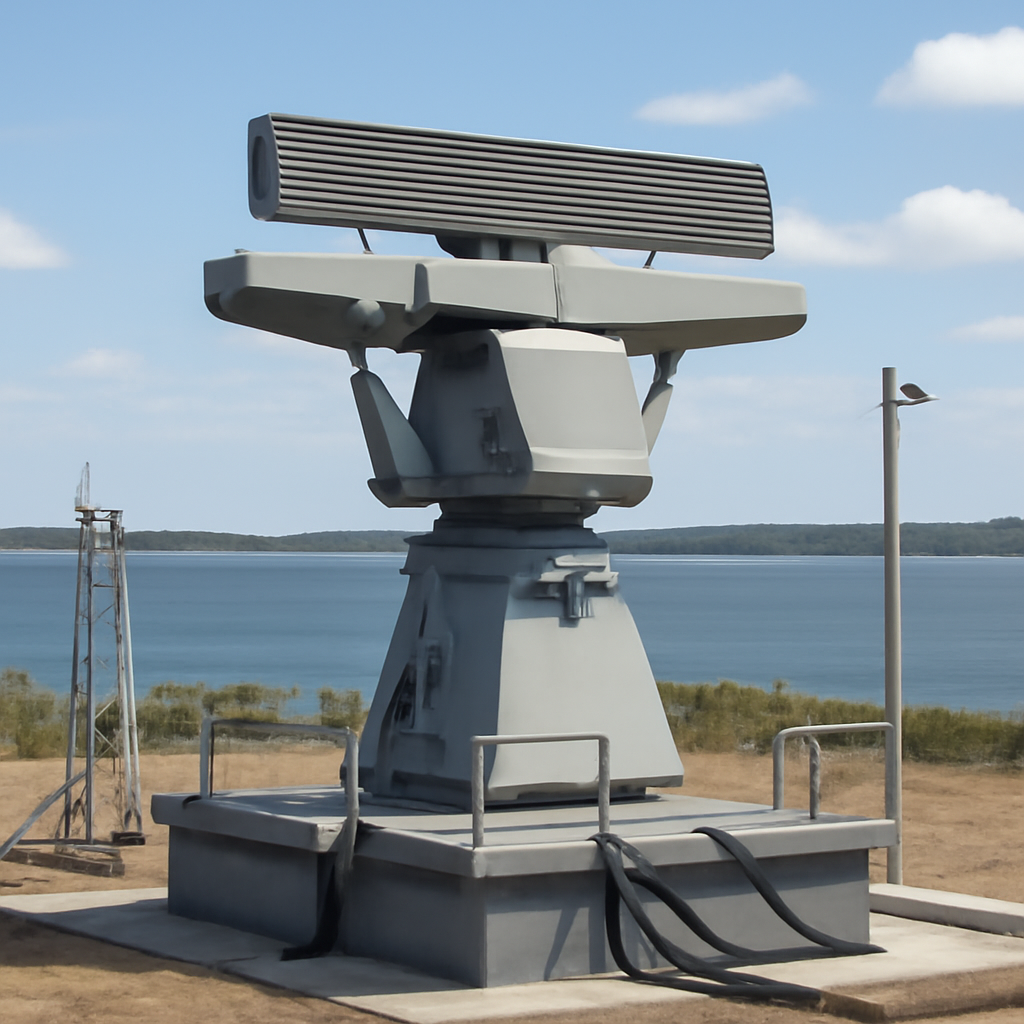
"By leveraging the Wallops test site, we’ll be able to integrate SPY‑6(V)4 with its dedicated power system before it reaches the ship, reducing the amount of testing needed on DDG 91," Barbara Borgonovi, president of Naval Power at Raytheon, said in a statement.
AN/SPY-6(V)4 arrives at Wallops Island for land‑based testing
The AN/SPY-6(V)4 radar has been installed at the U.S. Navy’s land-based test site at Wallops Island, Virginia, a facility Raytheon describes as "situated over an open‑water environment." Raytheon said initial testing will begin later this year and continue through mid‑2028. That land‑based phase will exercise the radar and its power and combat system interfaces before the radar is fitted aboard the Arleigh Burke class destroyer USS Pinckney (DDG‑91).
What the AN/SPY-6(V)4 (AMDR Backfit) is and how it differs from other SPY-6 variants
The AN/SPY-6(V)4—also called the Air and Missile Defense Radar Backfit (AMDR Backfit)—is a scaled‑down member of the AN/SPY-6 family. Like its full AMDR cousin, it uses four fixed‑face arrays; each AMDR Backfit array contains 24 Radar Modular Assemblies (RMAs), for a total of 96 RMAs. The larger AN/SPY-6(V)1 AMDR has 37 RMAs per array (148 total). Each RMA is a two‑foot‑by‑two‑foot‑by‑two‑foot cube containing an independent active electronically scanned antenna.
The modular RMA architecture allows single modules to be used independently or combined, providing focused energy, higher‑fidelity tracks at extended ranges, and the ability to replace individual modules for repair or upgrade. The AN/SPY-6(V)4 therefore delivers a step change in capability for Flight IIA Arleigh Burkes, which currently carry the AN/SPY-1D.

Audit-ready is a season. It shouldn't be.
Evidence in spreadsheets, controls drifting between audits, frameworks multiplying on flat headcount. Nubivance runs continuous compliance on Rapid7 Cyber GRC - SOC 2, HIPAA, ISO 27001, PCI, CMMC.
End the scrambleDestroyer Modernization 2.0: phased upgrades and the role of Aegis Baseline 10
The AN/SPY-6(V)4 is a central element of the Navy’s Destroyer Modernization 2.0 (DDG MOD 2.0) effort for Flight IIA destroyers. The full upgrade package comprises the AN/SLQ-32(V)7 SEWIP Block III electronic warfare suite, Aegis Combat System improvements (Aegis Baseline 10), additional thermal management "chillers," and the AMDR Backfit radar. The program has proceeded in phases: SEWIP Block III, Aegis Baseline 10, and chiller upgrades were integrated first, with the AN/SPY-6(V)4 slated to follow.
A past Navy contracting notice described the pairing of the AN/SPY-6(V)4 with Aegis Baseline 10 as providing "volume search, tracking, BMD [ballistic missile defense] discrimination, and missile communications in a wide diversity of environments and conditions."
USS Pinckney, prior work, and schedule to full integration
USS Pinckney (DDG‑91) was the first ship to receive the SEWIP Block III installation under the DDG MOD 2.0 plan and will be the first to be backfit with the AN/SPY-6(V)4. Raytheon said work to integrate the radar onto Pinckney will start this year and wrap up in 2028. The SEWIP Block III fit noticeably changed the ship’s outward appearance; observers gave the modified Pinckney nicknames such as the "muffin top" destroyer and the "USS Thickney" after substantial structural changes to the bridge wings that house parts of the new electronic warfare suite.
Progress across the Flight IIA fleet and program constraints
- The Navy has 75 Arleigh Burke class destroyers in service, of which 34 are Flight IIA versions, plus another 12 Flight IIA Restart and Flight IIA Technology Insertion subtypes. Production is transitioning fully to the Flight III subvariant.
- Other Flight IIA ships have recently completed or been slated for DDG MOD 2.0 elements: SEWIP Block III upgrades were completed on USS Chung‑Hoon (DDG‑93) and USS James E. Williams (DDG‑95); USS Halsey (DDG‑97) and USS Sterett (DDG‑104) were identified as next in line for AN/SLQ-32(V)7 and the broader package; Sterett had been slated to be the first ship to get all new capabilities in one in‑port availability.
- The Navy has previously said that about 20 destroyers could be brought up to the new standard, but the total number that will receive the full DDG MOD 2.0 package remains unclear. The service has cited lessons learned from challenges—especially the hurdles encountered on USS Pinckney—and noted guardrails informed by the troubled Ticonderoga‑class cruiser modernization program.
What this means for technologists, policymakers, and ship crews
Technologists and integration teams will watch Wallops closely: land‑based testing will exercise power, combat system interfaces, and the AMDR Backfit’s modular RMAs before shipboard installation, reducing shipyard testing time.
Policymakers and planners must weigh pace versus scale: Raytheon and the Navy are sequencing upgrades to limit time in depot periods, but how many Flight IIA hulls ultimately receive the full package—and at what cost and schedule—remains an open program decision.
Ship crews and operators gain capability over legacy AN/SPY-1D radars: the AN/SPY-6(V)4 paired with Aegis Baseline 10 promises expanded search, tracking, BMD discrimination, and missile comms—though the backfit is less capable than the larger AMDR installed on Flight III ships due to fewer RMAs.
The arrival of the first AN/SPY-6(V)4 at Wallops Island is a tangible milestone for Destroyer Modernization 2.0: it shifts the program from preparatory systems work toward active radar testing and ship integration through 2028. The practical question the record leaves is scale—how many Flight IIA hulls will receive the full AMDR Backfit and Aegis Baseline 10 treatment—and that answer will determine how broadly the capability spreads across the destroyer force.