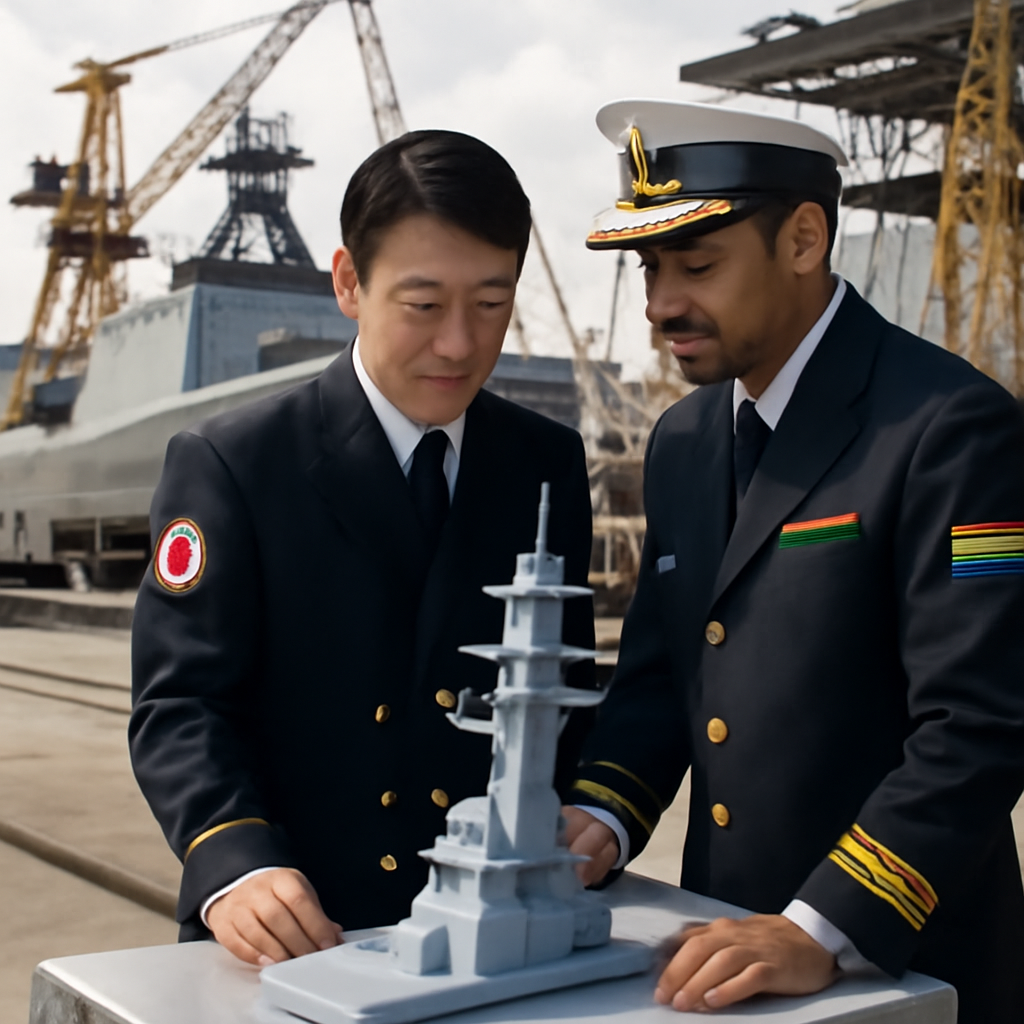
Why the UNICORN transfer matters
The UNICORN mast is described in the source as an integrated system that combines multiple communications, radar, and electronic-warfare functions into a single mast. Beyond consolidating sensors and antennas, it is said to improve operational efficiency and reduce a warship’s radar signature. Japan’s decision to transfer this technology to the Indian Navy in November 2024 is presented as an “important milestone” that signals a level of strategic trust and a willingness by Tokyo to share sophisticated defense technology with New Delhi.
The Mogami-class proposal and shipbuilding logic
Japan has proposed co-developing and producing Mogami-class frigates with India. The Mogami class is described as “one of the most advanced multi-mission frigates currently in production,” featuring stealth characteristics, high automation, anti-submarine-warfare capability, and modular mission flexibility. For India, the source argues, partnering on such a platform could mean more than acquiring hulls — it could accelerate technology transfer, strengthen domestic manufacturing, and feed India’s ambition for Aatmanirbhar Bharat (self-reliance) by enhancing design, automation, and integrated systems on future indigenous platforms.

Audit-ready is a season. It shouldn't be.
Evidence in spreadsheets, controls drifting between audits, frameworks multiplying on flat headcount. Nubivance runs continuous compliance on Rapid7 Cyber GRC - SOC 2, HIPAA, ISO 27001, PCI, CMMC.
End the scrambleEconomic incentives: scale, supply chains, and industrial resilience
The source frames shipbuilding as an intersection of national-security and economic-security aims discussed during Japanese Prime Minister Takaichi Sanae’s visit to India in July 2026 for the 16th annual summit. Both governments emphasized defense industrial cooperation, resilient supply chains, and trusted technologies. From Japan’s perspective, a relatively small domestic defense market constrains industry scale; partnering with India could provide greater production scale and strengthen supply-chain resilience. From India’s perspective, Japan’s expertise in automation and maritime electronics is complementary to expanding indigenous shipbuilding capabilities.
Constraints: export rules, politics, procurement, and IP
The source cautions that strategic convergence does not automatically produce industrial outcomes. It cites several specific challenges that will have to be navigated: Japan’s evolving defense export regime and domestic political sensitivities; differences in procurement systems; and intellectual-property arrangements. The piece emphasizes that sustained political support and closer engagement between government and defense industries will be required to convert political intent into joint production on a complex platform like a frigate.
What this means for Indian shipyards, Japanese defense companies, and policymakers
- Indian shipyards: A path to absorb Japanese systems and automation could accelerate indigenous capabilities in destroyer- and frigate-level design and production, while building a maintenance and sustainment ecosystem tied to advanced electronics and propulsion systems.
- Japanese defense companies (and industrial partners like Suzuki, Mitsubishi, and Honda cited in the source): Access to Indian scale offers a route to sustain advanced maritime technology lines and to diversify production footprints beyond a limited domestic market.
- Policymakers in both capitals: They must reconcile export controls, procurement rules, and IP regimes — and create institutional frameworks to manage joint research, workforce exchanges, and long-term supply-chain resilience if the relationship is to move beyond transfers to co-production.
The source places this industrial agenda within a broader strategic frame: both countries share support for a Free and Open Indo-Pacific, occupy key positions along critical sea lanes, and see naval shipbuilding as a way to harden deterrence, interoperability, and the protections that underpin maritime trade. It also links the effort to the Quad’s broader focus on critical technologies and resilient supply chains, suggesting bilateral production would produce concrete capabilities alongside diplomatic coordination.
If UNICORN “demonstrated what is possible,” the source argues, joint work on Mogami-class frigates could establish a new benchmark for defense industrial cooperation between the two democracies. Yet the path sketched is conditional: it requires a dedicated India-Japan defense-industrial framework for naval platforms, joint R&D, and workforce collaboration to translate summit pronouncements into shipyard reality. The question the facts leave is practical and immediate — will the political will and institutional arrangements keep pace with the technical promise?
https://thediplomat.com/2026/07/india-and-japans-emerging-shipbuilding-partnership/