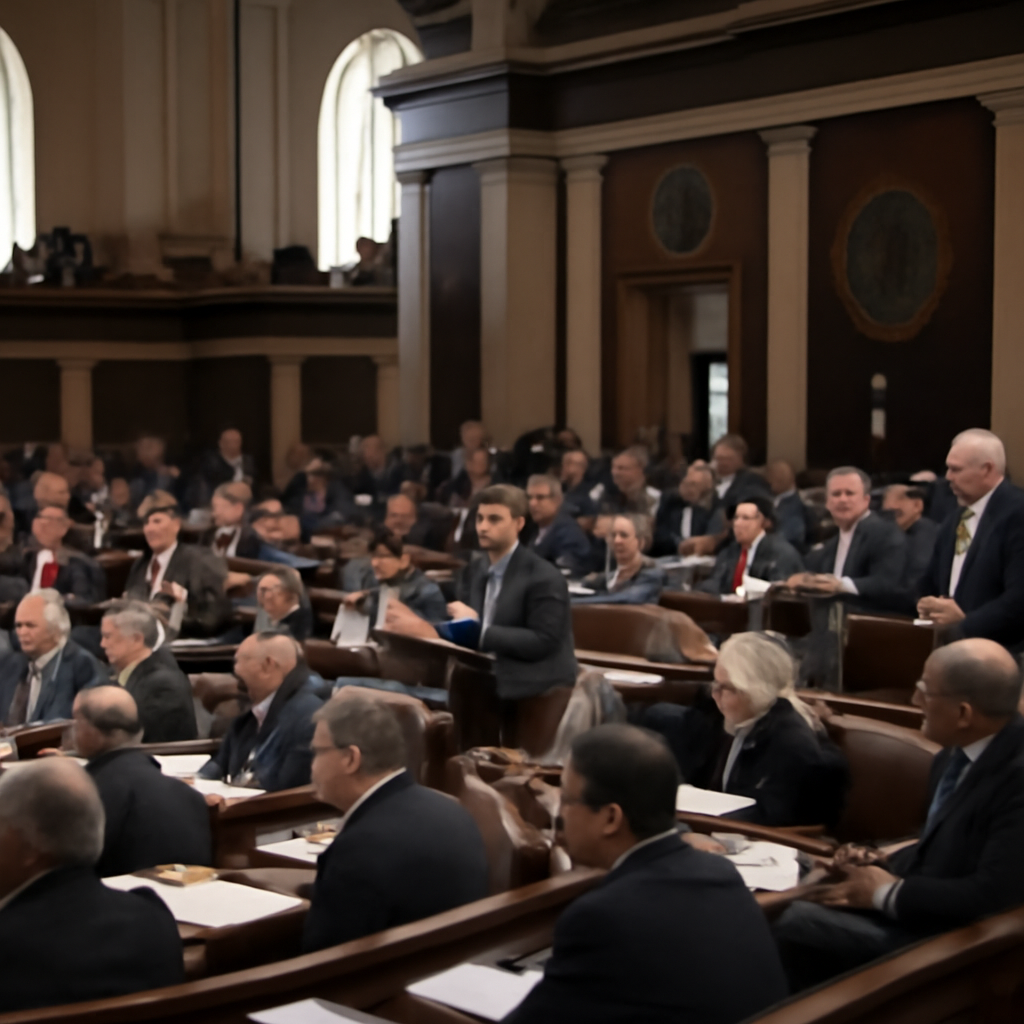
"[There are] provisions in this bill that some folks disagree with, but understand that this is just a single step in a long process," House Armed Services Committee Chairman Mike Rogers, R-Ala., said on the chamber floor today.
House passage and the final vote
The House approved its version of the fiscal 2027 National Defense Authorization Act on a 216-to-212 vote, largely along party lines. The chamber's final roll call saw seven Republicans oppose the measure and six Democrats support it. House GOP leaders also signaled a plan to later merge the defense bill with a controversial voter eligibility measure.
Major policy additions attached on the floor
Members attached several consequential provisions during debate. The bill establishes a so-called "presumption of approval" to allow U.S. service members and civilian employees to carry firearms on military bases. It extends reauthorization of the Defense Production Act through 2031. The text also prevents TRICARE from covering "certain gender related" medical procedures and treatments for uniformed personnel. Lawmakers included "right to repair" language and authorized $500 million for a second destroyer. At the same time, the House rejected multiple amendments — including an overwhelmingly defeated bid to restrict Ukraine Security Assistance funding.

Audit-ready is a season. It shouldn't be.
Evidence in spreadsheets, controls drifting between audits, frameworks multiplying on flat headcount. Nubivance runs continuous compliance on Rapid7 Cyber GRC - SOC 2, HIPAA, ISO 27001, PCI, CMMC.
End the scrambleBudget arithmetic: Pentagon request versus the House authorization
The NDAA is a policy vehicle that also authorizes base-budget spending levels. For fiscal 2027 the Pentagon requested a $1.5 trillion defense package split into a $1.15 trillion base budget and an additional $350 billion in a reconciliation pot. The House-approved version authorizes $1.15 trillion in base budget spending for next year.
Senate progress and objections from Senate Democrats
In the Senate, the Armed Services Committee approved its own FY27 defense policy bill in June, authorizing $1.14 trillion. That committee-approved measure has not reached the Senate floor; Senate Democrats have blocked floor action citing opposition to the war with Iran and concerns about the growth in defense spending. If the Senate eventually approves a policy bill, the House and Senate will need to reconcile differences before each chamber votes on a final conference text.
How US service members, the Pentagon, and Senate Democrats are affected
- US service members and civilian employees: The House bill would change on-base firearms policy via a "presumption of approval" and alter TRICARE coverage by barring coverage of certain gender-related procedures and treatments for uniformed personnel.
- The Pentagon: The department would receive authorization to spend $1.15 trillion under the House measure, plus targeted investments such as $500 million for a second destroyer and the continued availability of the Defense Production Act through 2031.
- Senate Democrats: Members of the Senate Democratic conference have used procedural tools to keep the committee-approved $1.14 trillion bill off the floor, explicitly citing opposition to the war with Iran and worry over defense spending increases as the reasons for the hold.
Chairman Rogers framed the House bill as an intermediate step toward a final compromise, saying lawmakers "will continue to work in a bipartisan manner" in conference. The calendar now turns to the Senate floor and the conference that follows: a familiar, often blunt process that will decide which of the House's attached provisions survive, which the Senate will insist on, and whether the two chambers can reconcile differences on spending totals and policy riders before the fiscal year begins.