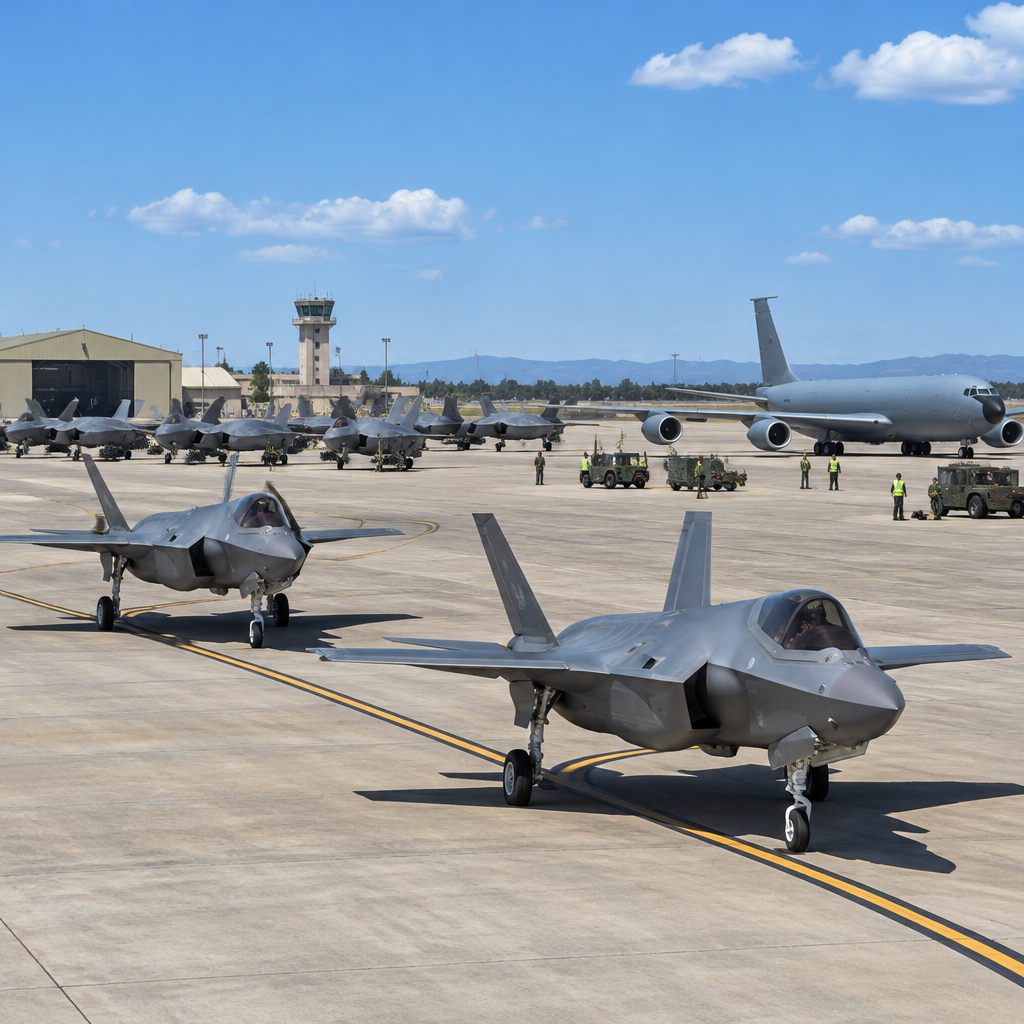
"American airpower has arrived in Jodhpur!" — U.S. Ambassador Sergio Gor.
The F-35 deployment: units, timing, and visible firsts
For the first time, F-35s from any nation operated from Indian soil in an exercise with the Indian Air Force (IAF). Six F-35A jets of the 13th Fighter Squadron from Misawa, Japan, together with more than 200 airmen and KC-135R support from Kadena, touched down at Jodhpur on September 26 and participated through the Tarang Shakti 2026 window that ran from September 26 to October 12. The deployment marked a visible milestone: the stealth jet operating from an Indian airbase during the IAF’s largest multinational air exercise to date.
Tarang Shakti 2026: scale, participants, and what flew
Tarang Shakti returned as a continuous, biennial fixture centered on Jodhpur and adjoining bases in Rajasthan. Seven foreign air forces sent flying detachments. France, the United Arab Emirates, and the United States sent fighters; Australia, Bangladesh, Germany, and Sri Lanka contributed transport or special-mission types.
The IAF reported the exercise logged over 800 sorties and some 600 flying hours, with up to 80 aircraft airborne in the most intense large-force employment (LFE) missions. The IAF fielded its entire combat fighter inventory — Rafale, Mirage 2000, Jaguar, Tejas, MiG-29, and Su-30MKI — and incorporated night operations and beyond-visual-range scenarios set against long-range air defense threats.
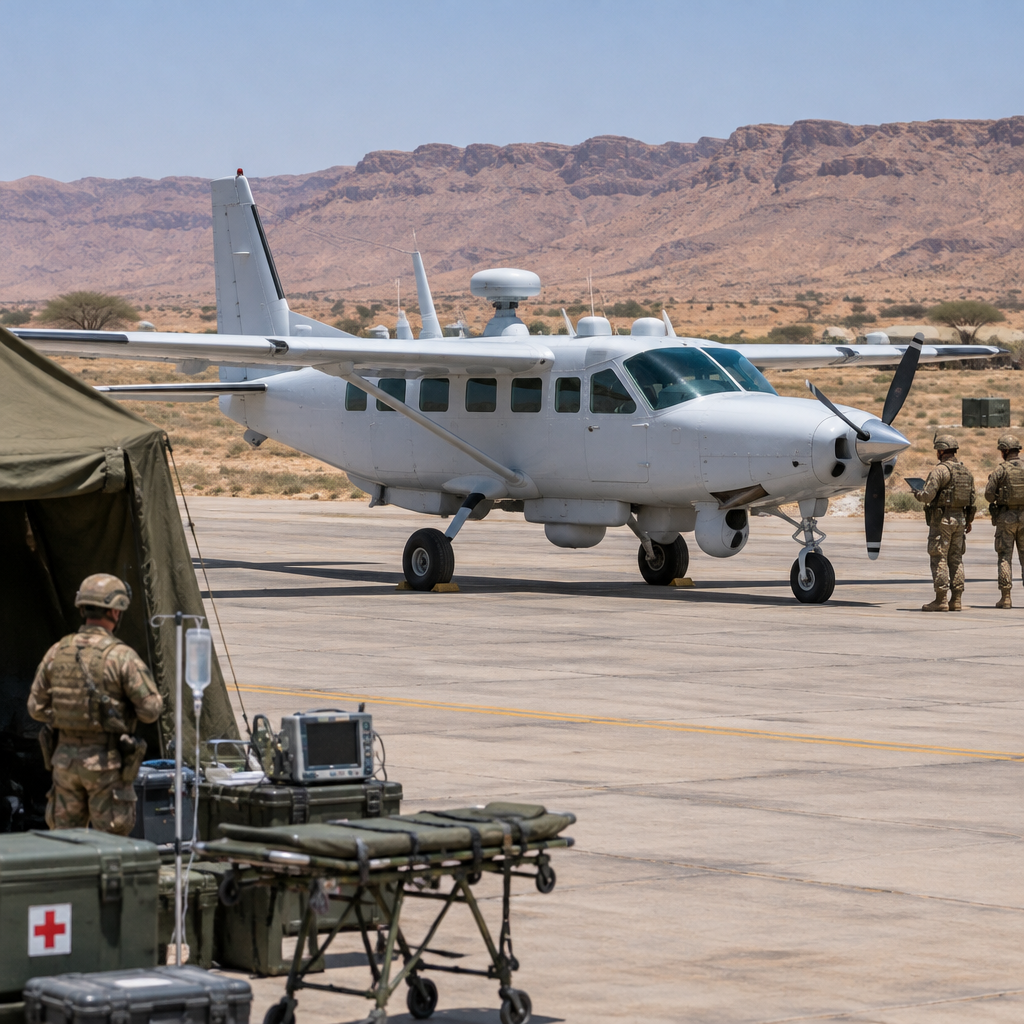
France brought around 300 personnel under Mission Pégase 26: seven Rafales (four from France and three from a UAE detachment), three A330 MRTT Phénix tankers, and two A400Ms. Germany substituted its 2024 Eurofighters for an A400M and folded transport crews into large-force engagements. The Bangladesh Air Force flew a C-130J (a former U.K. Royal Air Force Hercules C5), and Sri Lanka attended with a King Air 360ER.

Audit-ready is a season. It shouldn't be.
Evidence in spreadsheets, controls drifting between audits, frameworks multiplying on flat headcount. Nubivance runs continuous compliance on Rapid7 Cyber GRC - SOC 2, HIPAA, ISO 27001, PCI, CMMC.
End the scrambleIAF messaging, Operation Sindoor, and capability development
The IAF presented a deliberately measured public stance on the F-35 activities. Vice-chief Air Marshal Ashutosh Dixit acknowledged interest but declined to discuss operational specifics at the exercise’s curtain-raiser. Dixit emphasized that aircraft generation alone does not determine combat outcome, asserting that training, networks, and weapons are equally important. He said the IAF is developing means to detect fifth‑generation aircraft and reiterated Indian backing for its domestically developed Advanced Medium Combat Aircraft (AMCA).
Tarang Shakti also served as a platform for sharing combat lessons. The IAF briefed visiting forces on Operation Sindoor, the May 2025 clash the service described as brief combat with the Pakistan Air Force. Exercise Director Air Vice Marshal A. Raj Thakur said visitors were keenly interested in those lessons, and PACAF Commander Gen. Kevin Schneider noted Sindoor featured in his discussions during a week spent as a guest of Air Chief Marshal A.P. Singh.
What this means for the Indian Air Force, the U.S. Air Force, and visiting partners
- The Indian Air Force: Gains two weeks of hands‑on exposure to a genuine stealth fighter operating in Indian airspace and in combined missions, while continuing to develop detection means and push forward the AMCA program.
- The U.S. Air Force (13th Fighter Squadron and PACAF): Used the deployment to exercise interoperability, tactics, and basing from an Indian airfield — a practical demonstration of the bilateral relationship that followed years of Cope India and other exchanges.
- Visiting partners (France, UAE, Bangladesh, Sri Lanka, Germany): Tested multinational refueling, transport integration, and combined large-force employment; France highlighted cross-refueling successes and the Rafale’s shared operational lessons with the IAF.
Procurement context and a symbolic finish
The F-35 appearance exists alongside an unresolved procurement conversation. The report notes that, in February 2025, President Donald Trump announced Washington was paving the way to offer the stealth fighter to India, and that some U.S. officials have previously suggested a sale. But no formal sale negotiations have begun; the source lists technology security concerns, India’s continuing Russian equipment ties, and New Delhi’s preference for domestic production as significant hurdles.
Tarang Shakti closed with ceremony and symbolism. An open-house day on October 8 drew over 20,000 visitors. Distinguished Visitors’ Day featured Defense Minister Rajnath Singh, the Chief of Defense Staff, and all three service chiefs; the exercise’s ‘Tarang’ formation put an American F-35 flying alongside an IAF Tejas in an arrowhead led by a Su-30MKI. On October 12, Air Chief Marshal A.P. Singh flew his last fighter sortie in a Tejas, marking a formal bookend to the edition that cemented Jodhpur’s role as host and advanced the exercise’s ambition to be a ‘Red Flag of the East.’
Tarang Shakti 2026 delivered operational exposure and political signaling in equal measure: an operational testbed for multinational tactics and a public demonstration that the IAF can host fifth‑generation systems in combined training. The central open question left on the table by the facts reported is concrete — will the practical, on‑the‑ground interaction with F-35s translate into formal negotiations, and if so, will New Delhi’s detection programs and AMCA timetable move in step with any wider policy decisions?