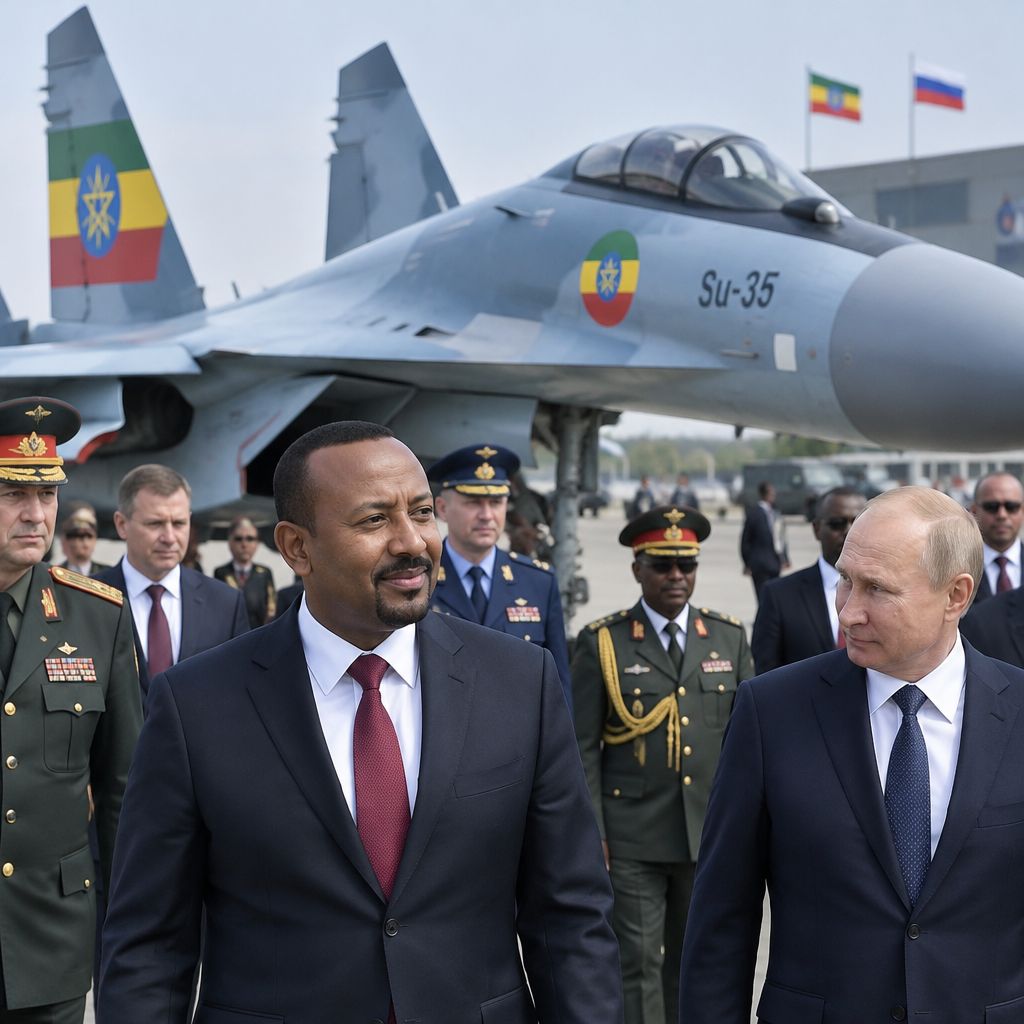
Ethiopia has received 12 Russian Su-35 multirole fighters, Prime Minister Abiy Ahmed announced, and the agreement also includes four batteries of Russia’s S-400 surface‑to‑air missile system, though the timeline for those batteries remains unclear.
What arrived, and how it was announced
Prime Minister Abiy Ahmed publicly announced the arrival of the 12 Su‑35s on his X account, posting photos and a video that show him and other Ethiopian and Russian officials alongside two Ethiopian‑marked jets. Abiy said the fighters arrived a year ahead of schedule under an agreement with Moscow and thanked Russian President Vladimir Putin for facilitating the accelerated delivery. The images appear to have been shared from the third Russia‑Africa Summit in Moscow on October 28–29.
How the Su‑35 changes Ethiopia’s air capability
The Su‑35 is described in the reporting as a heavily modernized derivative of the Soviet‑era Su‑27 (NATO reporting name Flanker). It combines twin thrust‑vectoring engines for high maneuverability, advanced radar and sensors, and the ability to carry a range of air‑to‑air and air‑to‑surface weapons. The jet’s radar and long‑range air‑to‑air missile capability are highlighted as a notable improvement for Ethiopia’s ability to detect and engage hostile aircraft, while its multirole design allows for a broad strike mission set.
Ethiopia already operated a fleet of Russian‑designed Flanker variants prior to this delivery: roughly 10 (perhaps as many as 15) secondhand Su‑27s, including two‑seat versions, and two Su‑30K fighters delivered in 2024 after refurbishment from storage in Belarus. That existing experience with the Flanker family may ease parts of the transition, but the Su‑35 will nonetheless require specialized pilot training, additional maintenance infrastructure, weapons integration work, and a dependable supply of spare parts—areas where the source notes challenges.

Audit-ready is a season. It shouldn't be.
Evidence in spreadsheets, controls drifting between audits, frameworks multiplying on flat headcount. Nubivance runs continuous compliance on Rapid7 Cyber GRC - SOC 2, HIPAA, ISO 27001, PCI, CMMC.
End the scrambleS‑400 batteries: capability promised, schedule unclear
The acquisition agreement reportedly includes four batteries of the S‑400, a mobile air‑defense system designed to engage aircraft, cruise missiles, and certain ballistic missile threats. If delivered, the systems would substantially expand Ethiopia’s ability to protect military installations, critical infrastructure, and strategic sites from aerial attack. The reporting is explicit that the delivery schedule for those batteries has not been disclosed.
Ethiopia–Russia defense ties, financing, and sustainment questions
Key practical details of the deal were not released: the financial terms, basing locations for the new jets, whether more aircraft are included in the agreement, and the cost or financing arrangement remain unspecified. The source highlights an operational risk: Moscow has not always been able to guarantee a dependable spare‑parts flow in practice, and Russia’s need to prioritize its own forces amid its war in Ukraine, combined with international sanctions, has complicated long‑term in‑service support.
The story also notes a pattern in recent Russian‑Africa defense trade: Russian exports to the continent have included combat aircraft, helicopters, armored vehicles, and ground‑based air‑defense systems. The Su‑35s delivered to Algeria, which reportedly originated in a batch built for Egypt but never transferred, are cited as an example of how aircraft initially intended for one buyer have been redirected to another.
What this means for Ethiopia, Russia, and Washington
- Ethiopia (military and policymakers): The Su‑35s and a potential S‑400 deployment are being presented by the prime minister as tools to deter aggression and strengthen national sovereignty. Operationalizing the jets will require investment in training, infrastructure, weapons integration, and a sustained supply chain for parts.
- Russia (defense industry and diplomacy): The transfer is a visible example of continued defense cooperation with an important Horn of Africa country. For Moscow, any export success amid wartime production pressures and sanctions is significant—especially if jets delivered were originally built for another customer.
- Washington (policy and sanctions authorities): The report notes CAATSA (the Countering America’s Adversaries Through Sanctions Act) and past U.S. warnings regarding transfers of Su‑35s and S‑400‑related equipment. Washington previously threatened sanctions over an Egyptian Su‑35 deal and invoked CAATSA against China for similar acquisitions; the source is explicit that any sanctions action regarding Ethiopia would require a separate U.S. determination.
Ethiopia’s strategic neighborhood figures in the account: the country borders Eritrea, Djibouti, Somalia, South Sudan, and Sudan; the reporting underscores lingering tensions with Eritrea and ongoing disputes over the Nile with Egypt and Sudan. The prime minister framed the acquisitions as defensive measures amid those persistent domestic and regional security pressures.
The transfer raises two concrete questions that the published record leaves open: whether Moscow will complete delivery of the four S‑400 batteries, and whether Russian industry can provide the long‑term in‑service support and spare parts needed to sustain the Su‑35s—particularly given Russia’s prioritization of its own forces and the complications posed by international sanctions. How those uncertainties are resolved will determine whether the acquisition strengthens Ethiopia’s air forces as promised or strains operational readiness over time.