"If the service tells you who they are and what they're going to do, and you choose not to try to meet the requirements of how they're going to fight—that's going to be a problem," Gen. Xavier Brunson warned, framing a blunt requirement for technology in contested Pacific operations.
Gen. Xavier Brunson on fighting "on the edge"
Speaking at TechNet Indo-Pacific in Honolulu, Gen. Xavier Brunson, commander of U.S. Forces Korea, argued that future conflicts will demand systems that function when networks are degraded or under sustained attack. Brunson said the force must be able to "operate disaggregated and distributed" because "our networks will be fully under attack" and events may unfold so rapidly "we won't know sometimes what's happening to us." He added that plans may change "before we even get in the theater," and concluded bluntly: "If your product can't operate on the edge, then it's not a product that's going to be able to help the Army fight the way the Army's going to fight, much less the joint force."
Gen. Ronald Clark on the 2027 Davidson window and budget constraints
Gen. Ronald Clark, commander of U.S. Army Pacific Command, placed the force posture in calendar terms: "There are 157 days between today and 2 April." He described that marker as a horizon to ensure forces are postured to deter aggression in a period some call the Davidson window, a 2027 timeline referenced in the conference reporting. Clark emphasized that while the military does not expect war next year—"it's not a date that we think that conflict will happen"—the command will "continue to prepare. We'll continue to modernize. We'll continue to posture ourselves for the business of deterred war well beyond [2027]."
Clark also warned that operating under continuing resolutions is slowing new starts and experiments. He described working under stopgap funding as the "biggest challenge" for funding "plans for new starts and being able to fund some of the programs that we know are going to yield benefit to the soldier," noting, "You can't start that contract if you don't have new money."

The cyber insurance questionnaire just landed. Now what?
SOC 2, HIPAA, insurance renewals - someone has to own security strategy. Nubivance provides fractional CISO leadership without the full-time salary.
Get a security leadPACFLEET's Richard Williams on continuous monitoring needs
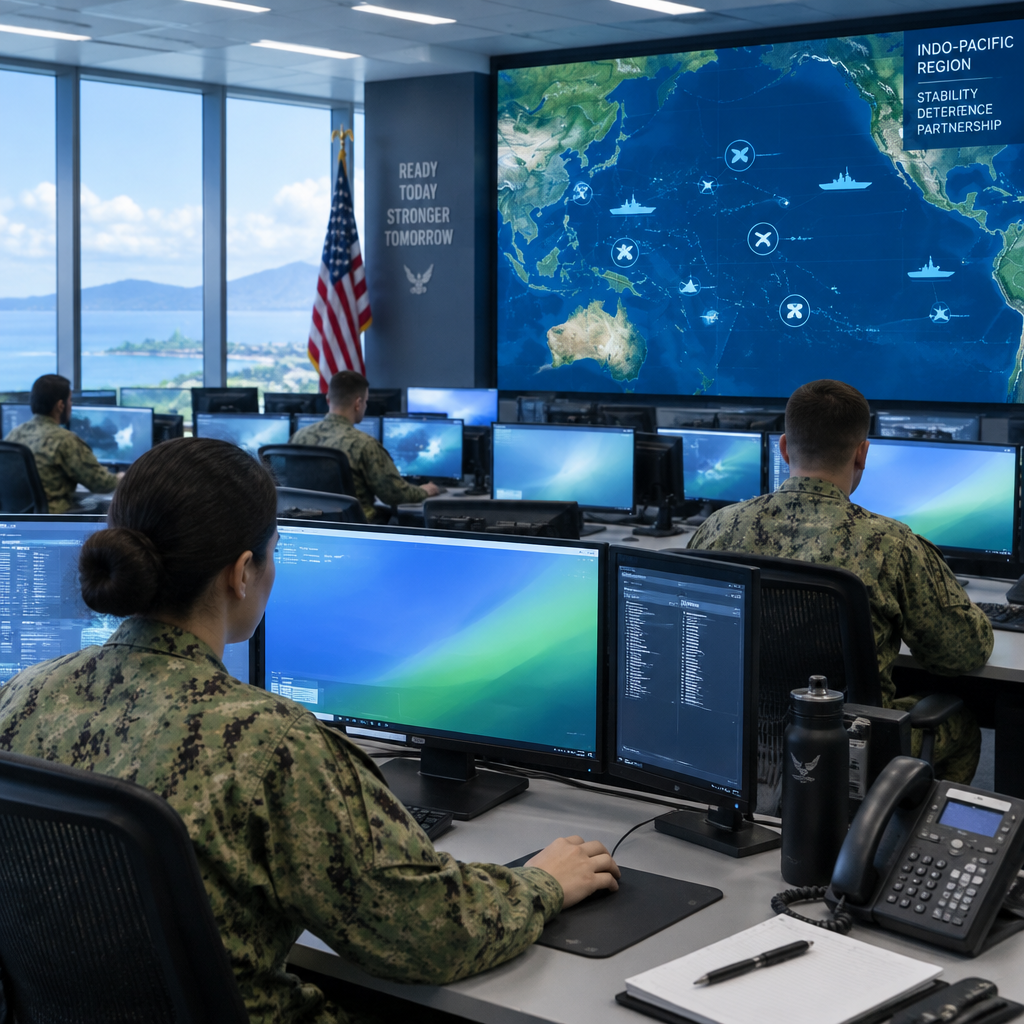
Richard Williams, who manages command, control, communication, computers, and intelligence platforms for the U.S. Pacific Fleet, told a panel the navy is short on continuous monitoring capabilities both ashore and at sea. "I would offer that we are in a zero day today. We do need more continuous monitoring, both at the shore and our ship nodes," Williams said, calling out struggles with "scanning and patching vulnerabilities within our networks."
Williams further urged industry and academia partnerships to accelerate vulnerability scanning, patching, and tailored cybersecurity for different ship classes, noting that "destroyers and aircraft carriers have very various mission sets" and that solutions must account for those mission differences.
Allies, LLMs, and an unsettled question about poisoned models
Speakers at the conference underscored that allied approaches to artificial intelligence and large language models (LLMs) vary significantly, complicating coalition planning. Australian army Brig. Chris Alder, vice director for intelligence at Indo-Pacific Command, said: "We've got different approaches to LLMs in our respective countries," and urged starting with engagement to "understand how [an ally’s] respective partners are approaching their own challenges."
Scott Brunstetter, U.S. Indo-Pacific Command’s chief AI officer, added that nations in the Pacific show "varying levels of AI adoption and implementation" and that many are not using frontier models; some are building "their own smaller capabilities." He asked companies to "circle back with us" as they engage partners so the U.S. can better understand where partners stand and what "cheaper options" they may pursue.
On the risk side, Brad Christ, the University of Hawai’i’s chief information officer, posed a pointed operational question about trust in models: "How would they know if the models and AI systems that they are using have been poisoned? And it's giving them subtle and incorrect answers over time—how would you detect that? ... And I don't think that there's an answer."
Making moves: drones, quantum, and venture bets
- The Army is expanding testing sites for commercial drone use.
- SAIC has a quantum portfolio.
- General Atomics completed flight testing with Saab’s LoyalEye advanced early warning system on the MQ-9B Reaper drone.
- Energetics and propulsion startup Firehawk is now valued at more than $1.4 billion after closing a Series D funding round of $150 million, led by Advent and Rochefort Asset Management.
- Beacon AI’s autonomous pilot tech took flight with KC-46 tankers.
What this means for technologists, lawmakers, and fleet operators
Technologists and security teams: Expect prioritized demand for continuous monitoring, vulnerability scanning, and tailored patching solutions that can operate both ashore and at shipboard nodes—across varied mission profiles from destroyers to carriers, as Richard Williams described.
Lawmakers and budget officials: Gen. Ronald Clark framed a clear sequencing risk: without a full 2027 appropriation by December, new contracts and experimentation intended to "yield benefit to the soldier" may be delayed or deferred while the services operate under continuing resolutions.
Fleet commanders and sailors: Operational leaders are explicitly preparing to "operate disaggregated and distributed" in contested environments and to posture forces ahead of the 2 April marker; they will seek systems that function with degraded connectivity and under active cyber pressure.
Brunson's plain condition—that edge-capable systems will be the only tools useful in future contested fights—was matched by budget and coalition realities discussed across panels. The technical and fiscal choices made in the coming months will determine whether those tools arrive in time to match the operational timelines commanders described.