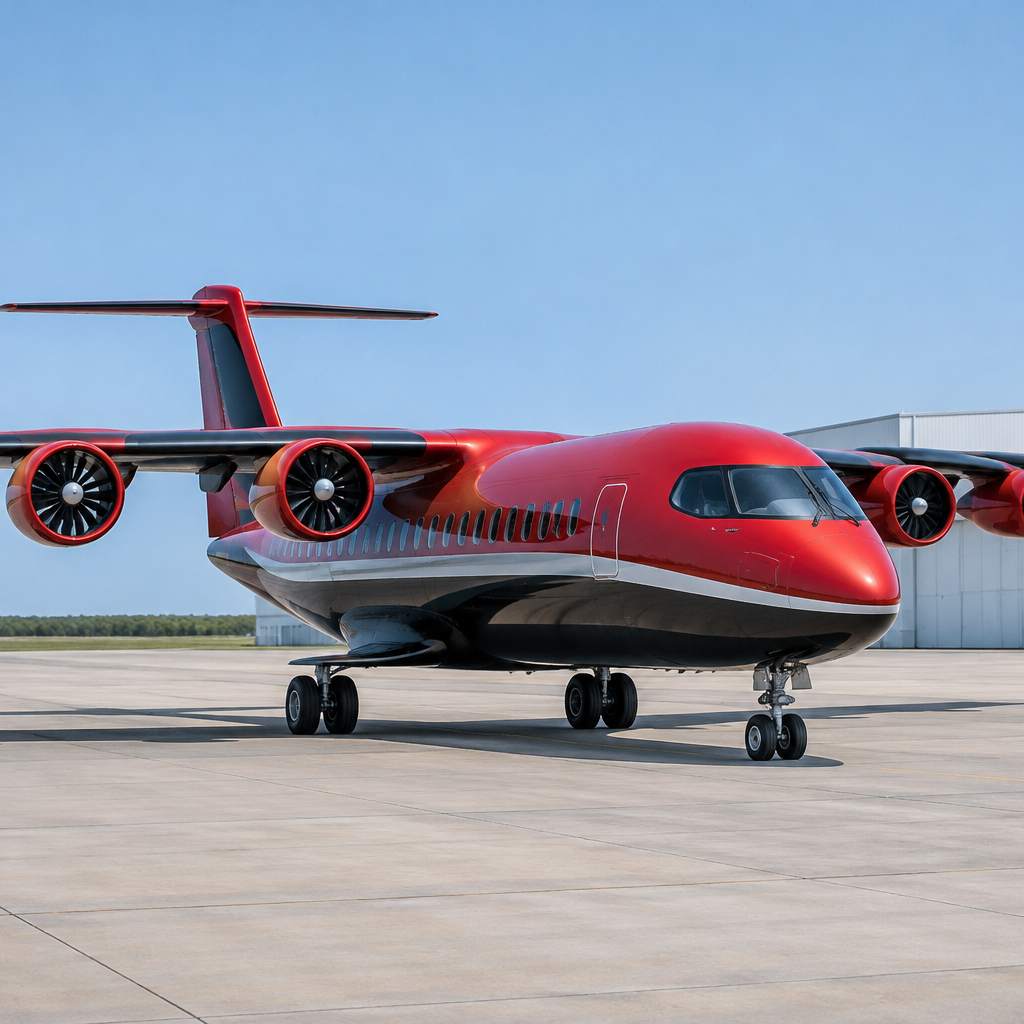
“The design uses 10 electrically driven ducted fans integrated into its wing structure.”
What the newly surfaced photos show
Photographs that surfaced online on October 28 appear to show a full-sized demonstrator of COMAC’s CE-25A, a 19‑seat, all‑electric commuter aircraft concept. The images—reported to have been first shared by Chinese automotive blogger Han Lu (韩路)—depict a red-and-black airframe with a silver cheatline bearing COMAC and CE-25A markings and a Chinese civilian registration of B-0EFH. The War Zone’s own examination using multiple AI image‑analysis models found no major indications that the images were artificially generated, though the publication noted it could not establish with certainty that the imagery is legitimate.
COMAC’s stated design and where the demonstrator sits
COMAC first presented the CE-25A concept at the China International Import Expo in Shanghai in November 2023, describing it as a 19‑seat, all‑electric commuter aircraft intended for short‑ and medium‑distance passenger transportation and business aviation. Published specifications cited a cruising speed of approximately 400 kilometers per hour and a range of around 400–500 kilometers. The new photos show what appears to be a full‑sized demonstrator, which contrasts with COMAC’s earlier references in 2023 to experimental verification work involving a scaled demonstrator—raising the possibility of an intermediate, unseen subscale demonstrator already having flown.

This site is the portfolio.
OSINTSights runs on Cloudflare Workers, D1, R2, and Vectorize, with an AI pipeline on Hetzner ARM. Nubivance designed, built, and operates it. We do the same for clients.
See what we buildDistributed electric propulsion: advantages and engineering hurdles
The CE-25A’s most distinctive feature is its distributed electric propulsion architecture: the design uses 10 electrically driven ducted fans integrated into the wing. Distributed propulsion can allow designers greater flexibility in thrust distribution and integration with the airframe, and—depending on configuration—offer aerodynamic benefits in specific flight regimes. Electric motors can also simplify certain aspects of propulsion‑system design compared with turbine engines.
But the program faces clear, documented constraints: batteries remain far less energy‑dense than aviation fuel, limiting range, payload, and endurance; high‑power electrical systems demand careful thermal management; and integrating multiple propulsion units introduces questions about reliability, maintenance, and flight controls—challenges that the CE-25A program would need to overcome before any commercial entry into service.
How the CE-25A compares to parallel efforts
The CE-25A joins a handful of international research and development efforts exploring distributed or hybrid electric propulsion for regional aircraft. The European UNIFIER-19 research effort has examined 19‑seat, zero‑emission regional concepts that include distributed electric ducted fans and explored hydrogen fuel cells as an alternative to batteries, though it is framed as research rather than a production proposal.
In the United States, NASA’s X‑57A Maxwell investigated distributed electric propulsion using 14 electric motors and propellers in a specially designed wing. The X‑57 was much smaller than the CE-25A and used open propellers rather than ducted fans; that program was canceled in 2023 after propulsion‑system safety issues proved impossible to resolve within available budget and schedule and it did not progress to its planned piloted flight configuration.
France’s AURA AERO is developing ERA, a 16–19 seat hybrid‑electric regional aircraft based on eight electric motors and two turbogenerators, with the company advertising a range of approximately 1,500 kilometers—substantially above the CE-25A’s published target. Sweden’s Heart Aerospace pursued a 19‑seat battery‑powered ES‑19 with a proposed range of roughly 400 kilometers before moving away from the ES‑19 concept toward larger hybrid‑electric designs.
What this means for COMAC, CATL, and aviation regulators
- COMAC: The appearance of a full‑sized demonstrator suggests the company is advancing experimental work into physical prototypes. How the demonstrator maps to previously announced scaled verification work is unclear; COMAC will face the technical task of translating distributed electric propulsion concepts into reliable operational systems if it intends to proceed beyond demonstration.
- CATL and Shanghai Jiao Tong University: COMAC announced cooperation with battery manufacturer CATL and Shanghai Jiao Tong University on battery‑powered aircraft research in 2023. The precise relationship between that research and the CE‑25A demonstrator—whether they share specific battery chemistries, power electronics, or thermal management approaches—has not been publicly clarified, making integration and certification questions central to ongoing development.
- Aviation regulators: Earlier programs have highlighted safety and maturation risks—NASA’s canceled X‑57A is explicit evidence from the record that propulsion safety can halt projects. Regulators will need test evidence on thermal management, redundancy, and failure modes for distributed electric systems before any certification path can be defined.
The photographs sharpen a concrete question the program has left open: has the CE-25A demonstrator flown, and how does it link to COMAC’s previously announced scaled verification plan and to CATL‑backed battery research? Whether the CE‑25A becomes a viable civilian type, a testbed for broader electric‑propulsion advances, or a line of inquiry whose lessons migrate into other designs—crewed or uncrewed—will depend on answers to those technical and programmatic unknowns.
Source: The War Zone — China’s CE-25A Electric Commuter Airliner Demonstrator Emerges