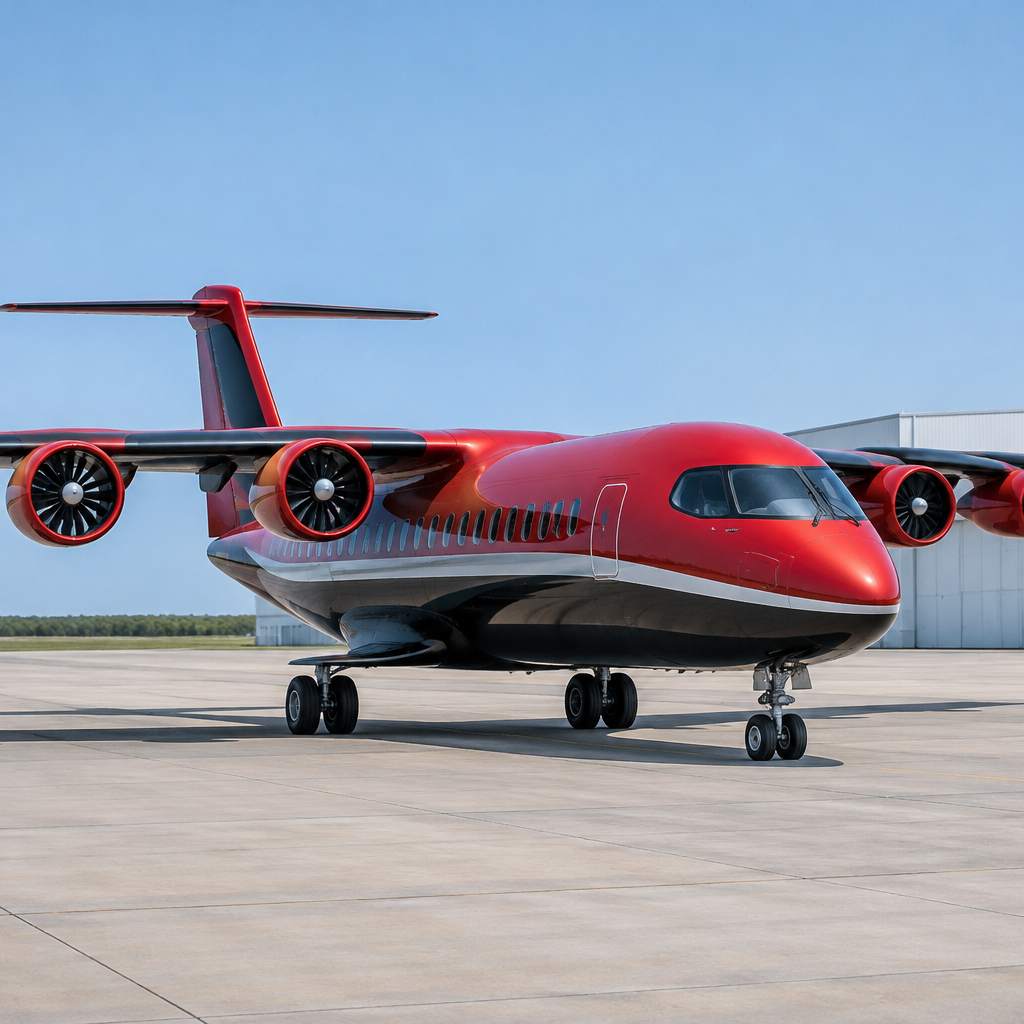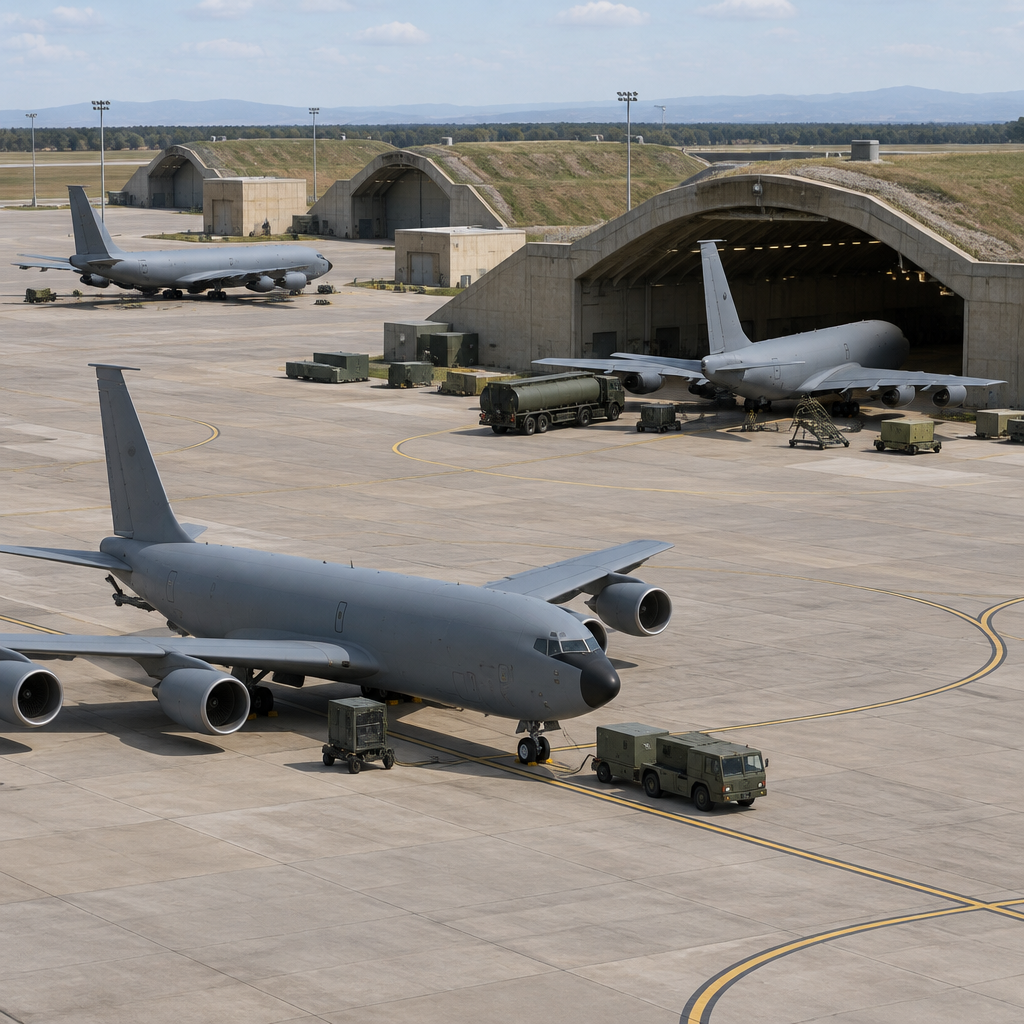
"Aerial refueling is an unmatched United States military advantage, but it currently depends on vulnerable forward bases and medium-range tankers that could be neutralized," Hudson’s report states.
Hudson Institute’s three priorities for aerial refueling
The Hudson Institute’s new analysis, Resilient Reach: Redesigning Aerial Refueling for Contested Global Operations, sets out three core themes: boost surface infrastructure resilience, incorporate adaptive mission systems into existing tankers, and pursue a next-generation blended wing body (BWB) tanker. The report argues surface infrastructure improvements — including hardened shelters large enough for tankers — may deliver greater increases in employable tankers than procurement alone.
Hardened shelters: scope, cost, and technical assumptions
The report calls for at least 60 large hardened aircraft shelters to be distributed across global bases, estimating a total construction cost of $3.06 billion. Hudson’s costing assumes an average Area Cost Factor of 1.87, a 10‑year construction program, and 10 percent portfolio efficiencies from replicating similar projects. The shelters are described as similar to the Andersen Air Force Base Air Expeditionary Force Forward Operating Location Aircraft Maintenance Hangar, and the report notes that less-secure or concealment-only structures would be cheaper.
Hudson frames hardened shelters as a way to shield tankers from observation and weather, to force adversaries to employ more numerous unitary weapons rather than a small number of submunition-armed munitions, and to protect tankers that cannot get airborne on warning of incoming attack. The report concedes large hardened shelters can be expensive — Hudson gives a range of $30–$150 million depending on scope and location — but argues even modest hardening or concealment complicates enemy targeting and increases opponents’ munition costs.

Audit-ready is a season. It shouldn't be.
Evidence in spreadsheets, controls drifting between audits, frameworks multiplying on flat headcount. Nubivance runs continuous compliance on Rapid7 Cyber GRC - SOC 2, HIPAA, ISO 27001, PCI, CMMC.
End the scrambleRecent attacks and operational impact
The report cites operational precedents to underline vulnerability. Five USAF KC-135 tankers were damaged on the ground at Prince Sultan Air Base in March during an Iranian attack; that strike also destroyed one E-3 Sentry AWACS. Lt. Gen. Linda Hurry, head of Air Force Materiel Command, confirmed repairs were still ongoing on some KC-135s damaged in that attack. The report also notes Iranian damage to F-15E and A-10 aircraft on the ground at Muwaffaq Salti Air Base in Jordan during an attack on the night of September 9–10.
Hudson also references Ukraine’s Operation Spiderweb — near-simultaneous near-field drone attacks that destroyed at least 10 Russian bombers and other aircraft — to illustrate how parked aircraft on open flightlines are exposed to concentrated, unexpected strikes. The report uses these events to warn that dispersion alone can be insufficient in an era of persistent surveillance and precision targeting.
USAF leadership pushback and competing approaches
Hudson’s hardening recommendations come amid visible resistance from senior Air Force leadership. Chief of Staff of the Air Force Gen. Kenneth Wilsbach told Breaking Defense in July, "I don’t want to spend a lot of money on hardening shelters. Unless you’re going to send something 100 feet or more underground, we can blow it up, and so can they," and added, "the economics favor defending your airspace, defending your ground space with systems that can defeat the incoming rounds, versus building a shelter."
The report does not dismiss active defenses; it explicitly calls for active counter-C5ISRT and air and missile defenses alongside passive measures. It also acknowledges the Air Force has been upgrading networking architecture and fielding new defensive systems for existing KC-135 and KC-46 tankers, and that the service is exploring next-generation concepts — including stealthy and uncrewed options — under the Advanced Tanker Systems (ATS) program.
What this means for NATO and other allies, the U.S. Air Force, and Pacific operations
- NATO and other allies: Hudson urges the Air Force to pursue access to more airfields, including large commercial ones, and to nurture relationships with NATO and other allies that provide tanker airfield access. The report also recommends constructing lower-capacity hardened fuel stores and fielding airfield and over-the-shore fuel distribution systems, potentially using maritime tankers to improve bulk fuel resilience.
- The U.S. Air Force (procurement and base planners): The report urges weighing investments in surface infrastructure — shelters, fuel hardening, passive defenses, decoys, and reconstitution units — against tanker procurement. Hudson argues infrastructure investments could yield a greater increase in employable tankers even at the cost of fewer new aircraft.
- Pacific operations and contingency planners: Hudson warns the People’s Liberation Army (PLA) could already, in 2025, deliver thousands of munitions per day against targets near its territory and roughly 400 munitions per day against targets in the Second Island Chain, the Middle East, and Central Asia, with even greater reach by 2035. The report therefore highlights tanker airfields as likely prime targets in any high-end conflict with the PLA.
Hudson’s argument is stark: sustainment of the U.S. aerial refueling advantage depends not only on platforms and sensors but on the protection and resilience of the ground architecture that enables tanker operations. The Air Force faces a clear budgetary and doctrinal choice between deeper investment in active-area defenses and broader investment in hardened and concealment infrastructure — a choice the report frames as decisive for the survivability of aerial refueling in contested operations.
Original story: Hardened Shelters Critical To Survival Of USAF’s Tanker Fleet: Study