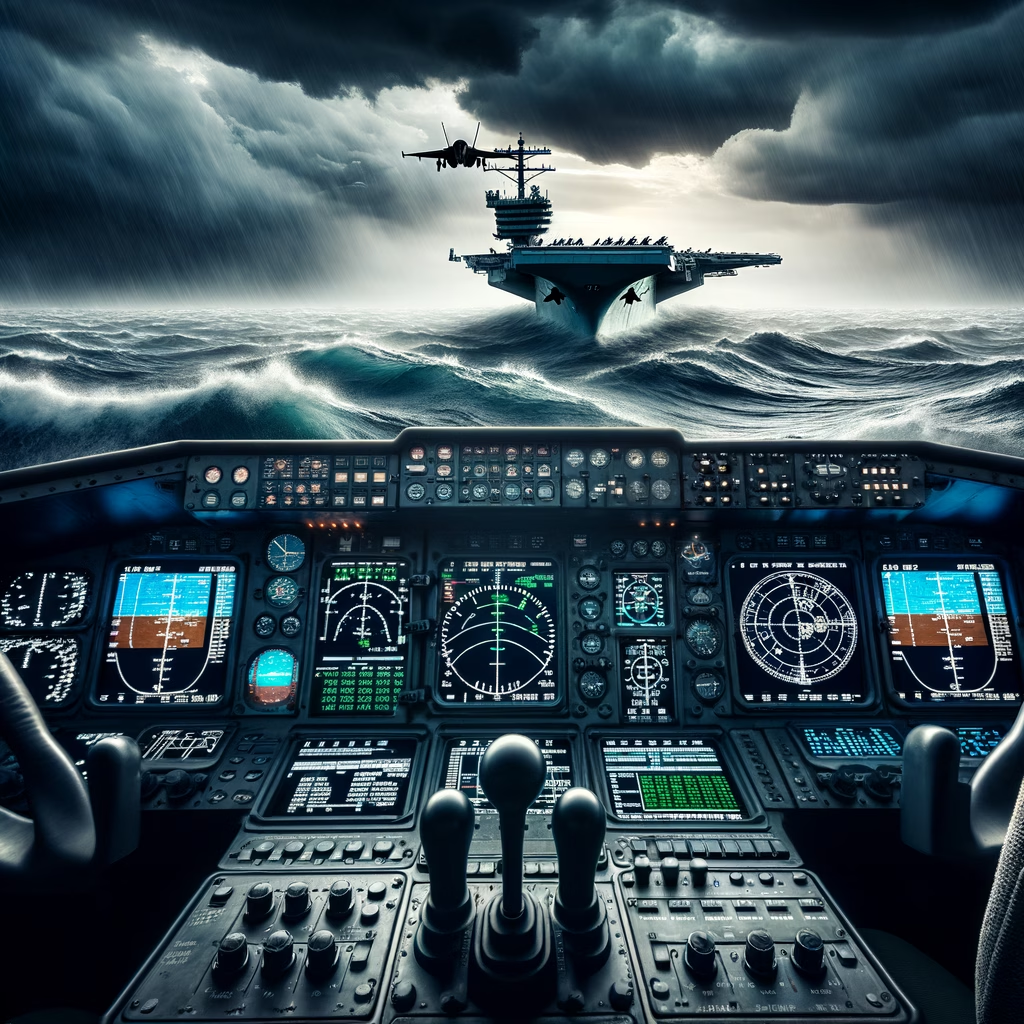
Sims at Sea Fast-Tracks E-2D Simulation to Carriers
The U.S. Navy faced a persistent training gap: how to keep carrier strike group airborne early warning crews current when the high-fidelity E-2D simulation assets they need are fixed ashore. The solution—bringing deployable, realistic E-2D simulation aboard carriers—has arrived far faster than traditional acquisition cycles would predict. By packaging the software, hardware, and networking necessary to reproduce sensor outputs and data flows in the shipboard environment, the Sims at Sea effort eliminated a readiness choke point and let naval flight officers and pilots rehearse mission-critical decision making while deployed.
Why E-2D simulation matters at sea
The Northrop Grumman E-2D Advanced Hawkeye is more than an aircraft: it’s the fleet’s airborne sensor and battle-management node. Its radar, communications, and data-fusion systems extend the carrier’s situational awareness and enable coordinated responses across a strike group. When crews can only access full-fidelity training ashore, long deployments degrade proficiency. E-2D simulation aboard carriers preserves training continuity, enabling crews to practice under the real rhythms and constraints of shipboard operations, and reducing the time and operational friction associated with returning to port for refresher training.
The fidelity of simulation is critical. Trainees must experience realistic sensor cue timing, data-link latencies, and the procedural tempo of carrier-controlled airspace. Those elements determine whether lessons learned in the sim translate to usable skills in live flight operations. By reproducing those characteristics afloat, the Navy ensures that practice mirrors operational reality rather than offering a simplified or sanitized version of the mission.
What Sims at Sea achieved
Sims at Sea bundled a modular simulation stack that tolerates the power, cooling, and electromagnetic idiosyncrasies of carrier environments. Rather than building a crude cockpit mock-up, the program delivered credible, sensor-level representations of E-2D outputs and the tactical data flows that inform decisions. That required more than software porting: engineers had to address weight, footprint, power draw, and electromagnetic compatibility while preserving functional fidelity.
Operationally the benefits are clear. Crews gain more training hours without returning to shore, shore-based simulators remain available for advanced or specialized scenarios, and lessons from live operations can be iteratively integrated into the simulator faster. Those improvements translate into measurable readiness dividends—shorter qualification cycles, reduced logistical burdens, and more resilient carrier air wings able to maintain proficiency across extended deployments.

This site is the portfolio.
OSINTSights runs on Cloudflare Workers, D1, R2, and Vectorize, with an AI pipeline on Hetzner ARM. Nubivance designed, built, and operates it. We do the same for clients.
See what we buildTechnical and acquisition approaches that enabled rapid fielding
Sims at Sea reflects several contemporary defense modernization trends: virtualization of legacy systems, commercial off-the-shelf compute, and modular architectures that enable incremental delivery. Making those approaches work afloat required applied systems engineering to balance performance with shipboard constraints and cybersecurity.
Key enablers included tight industry–program office partnerships, concurrent testing, and an appetite to accept iterative afloat improvements in lieu of waiting for a single, perfect product ashore. This adaptive acquisition approach aligns with Pentagon guidance meant to accelerate useful capability into operators’ hands. Implementing it within the naval environment—where ship schedules, spatial limits, and strict electromagnetic compatibility rules complicate fielding—was an achievement in pragmatic engineering and program management.
Operational tradeoffs and sustainment risks
Deployable E-2D simulation introduces sustainment and cyber risks that commanders must manage. Hardware failures at sea are harder to remedy: spare parts and specialty technicians are less available than on homeport, and repairs can be constrained by shipboard access and schedule. Software updates must be validated to avoid unintended impacts on operational networks, and classified scenarios require robust enclave protections. Cybersecurity thus becomes an operational front—training systems that travel with the fleet demand continuous monitoring and rapid response plans.
There is also a strategic angle: adversaries observe and adapt. While realistic E-2D simulation sharpens U.S. training advantages, it could speed rivals’ efforts to develop countermeasures and tactics. The result may be a more dynamic contest in sensor employment and network maneuvering, heightening the need for continuous tactical innovation.
Users decide the value
Ultimately, aviators and naval flight officers determine whether the system is worth its cost. A portable simulator that fails to replicate sensor timing, network latency, or carrier airspace procedures will offer limited benefit. Conversely, a system that enables crews to run realistic mission profiles during quiet transits or between flight evolutions multiplies learning opportunities and preserves critical skills across deployments. Early feedback shows that when E-2D simulation accurately mirrors operational data flows, crews trust and use it—producing the intended training outcomes.
Institutional lessons and future outlook
Sims at Sea is a practical case study in aligning operational need with acquisition agility and pragmatic engineering. It does not replace shore-based, full-spectrum training centers, but it complements them in ways that support distributed maritime operations and persistent readiness. To convert short-term success into a long-term capability will require sustained logistics planning, formal certification paths for afloat training devices, and continuous cyber hardening. Policy and procurement processes must keep evolving so that rapid fielding becomes standard practice, not an exception.
Conclusion: embedding E-2D simulation aboard carriers reframes readiness—training now rides with deployment instead of interrupting it. If sustainment strategies, cybersecurity measures, and acquisition policies scale to match this faster tempo, at-sea simulation will evolve from a workaround into a persistent enabler of fleet lethality and resilience.



