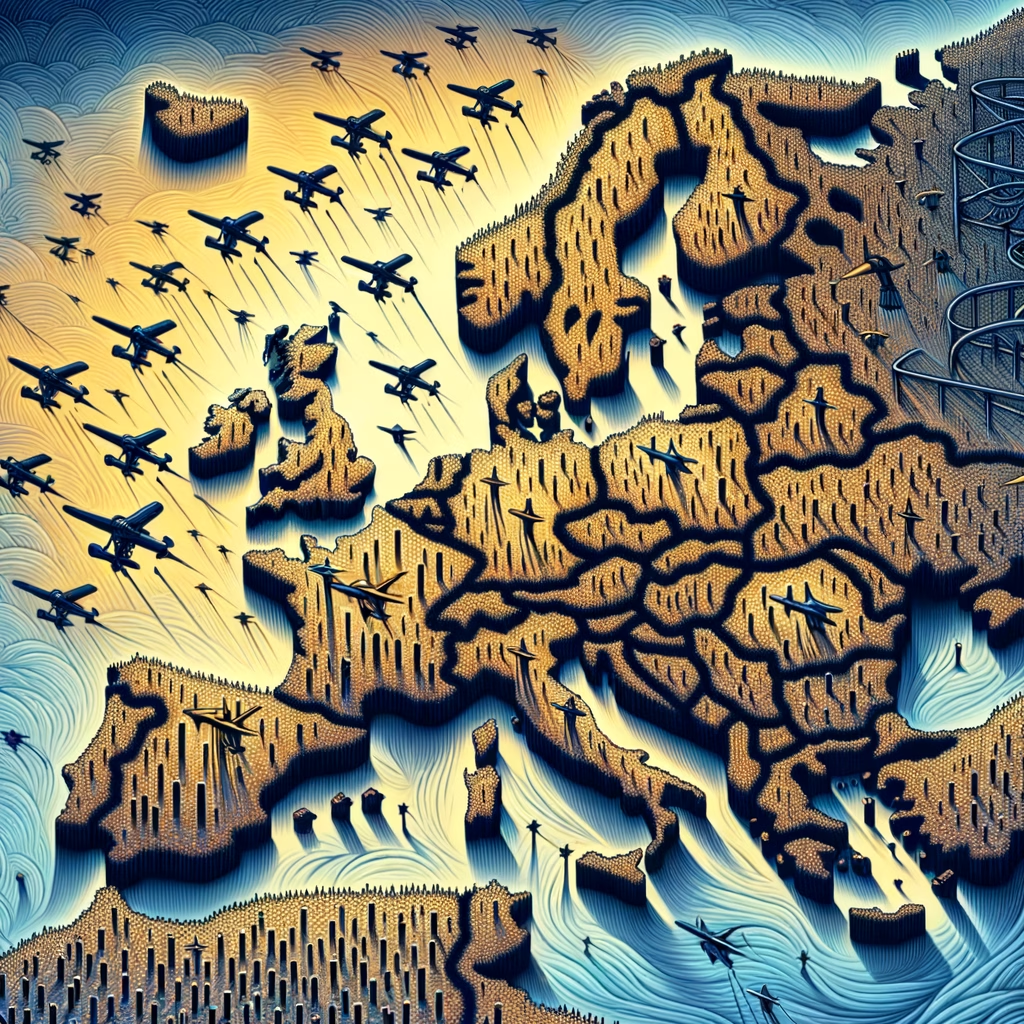
Can a continent build a wall not of stone but of sensors, software and beams of light — fast enough to blunt a wave of cheap, lethal drones descending from the skies? European capitals are confronting that question with an urgency born of watching the skies over Kyiv and Kharkiv, where the Ukraine war turned unmanned aircraft from niche to decisive. The result is a patchwork of emergency programs, private innovation and military improvisation aiming to build what officials call a “drone wall” — a multilayered air-defense shield tailored to the peculiar threats of the 21st-century battlefield.
The basic problem is stark: drones are getting smarter, more maneuverable and dramatically cheaper. That combination breaks the assumptions that underpinned post–Cold War air defenses, which were optimized for high-speed jets and ballistic trajectories. Small unmanned systems can loiter, swarm, navigate on commercial GPS, and strike with precision at low cost. They present a threat both to armies on the front lines and to critical infrastructure deep inside Europe. Detecting, identifying and defeating such targets calls for a different architecture — one built around many more sensors, rapid data fusion, and a range of soft and hard countermeasures.
Background is essential. The conflict in Ukraine crystallized lessons that had been emerging in military and academic circles for years. Adversaries used large numbers of low-cost loitering munitions and modified commercial drones for reconnaissance and strike missions, combining them with traditional artillery, cruise missiles and electronic warfare. That mixed approach overwhelmed defenders who lacked the sensing density and processing speed to sort genuine threats from the routine bustle of the electromagnetic and aerial environment. For European governments, the lesson was immediate: traditional air-defense inventories and procurement timelines are inadequate for a world of cheap, small aerial platforms.
Europeans have responded in two concurrent ways. First, by accelerating investment in capability packages tailored to countering small unmanned aerial systems (C-UAS). Second, by trying to knit those investments into an interoperable, continental-level shield — the so-called drone wall. This effort spans national militaries, the European Defence Agency, NATO, industry consortia and dozens of start-ups that emerged to meet the demand.
What does a drone wall look like in practical terms? It is not a single device but a layered system that combines:
/
wide-area radars and passive RF (radio-frequency) detectors to spot and track communications and control links
/
electro-optical and infrared cameras for visual identification
/
acoustic sensors and multisensor fusion to detect low-RCS (radar cross section) targets that evade conventional radars
/
electronic-warfare tools to jam or spoof navigation and command links
/
kinetic interceptors — from small missiles to shotgun-like systems and even trained guns — for hard kills
/
directed-energy weapons such as high-energy lasers for potentially cheaper, scalable engagements against multiple small targets
/
command-and-control systems driven by machine learning to triage swarms and authorize responses in seconds
Each layer addresses a different problem. Sensors increase the probability of detection; fusion and software reduce false positives; nonkinetic measures reduce collateral damage and cost per engagement; kinetic options provide last-resort defeat. The real innovation is in stitching those layers together so that authorities — military operators, civilian air-traffic controllers or critical-infrastructure managers — can respond coherently and legally in a fraction of the time that older systems required.
Technologists pushing these solutions face hard constraints. Small drones have tiny radar signatures and fly at low altitudes where ground clutter complicates detection. Commercial components and open-source autonomy mean builders can iterate quickly and cheaply. To match that pace, sensor networks must be dense, distributed and networked, and the software must make split-second discrimination between hostile drones and benign aircraft such as police helicopters, delivery drones or wildlife-monitoring platforms.
That need has driven rapid advances in machine learning, sensor miniaturization and cloud-edge computing. European start-ups and legacy defense firms alike are racing to deliver plug-and-play kits that municipalities or military units can deploy on towers, ships, armored vehicles or even tethered balloons and drones. The marketplace prizes modularity and interoperability: a tower-mounted sensor must feed a regional fusion node and a national command center with no proprietary lock-ins.
Policymakers face their own set of tensions. Defense ministries want capability fast; procurement systems are designed for careful competition and long testing cycles. The European Union and NATO have tools to speed joint purchases — from emergency funds to pooled procurement frameworks — but they must balance speed against rules on transparency, competition and export control. Coordination among 27 EU members and 31 NATO allies is never seamless, and sovereignty concerns complicate decisions about where sensors and effectors should be placed and who should control them.
Budgetary realities also matter. Hard-kill interceptors and lasers carry up-front costs and demand significant power and cooling. Nonkinetic measures such as jamming or cyber countermeasures raise legal and diplomatic questions: what if jamming interferes with civilian aviation or cross-border communications? Who authorizes electromagnetic attacks in peacetime? These are not hypothetical headaches — they constrain how fast and how aggressively a drone wall can be deployed around sensitive sites such as power plants, airports, or urban centers.
Users of these systems — militaries, police, infrastructure operators — want tools that are reliable, simple and accountable. Field commanders emphasize the need for user interfaces that reduce cognitive load, clear rules of engagement, and robust forensic logs to determine what happened in any given intercept. Civil authorities, meanwhile, want assurances that measures will not endanger bystanders or violate privacy and civil liberties. Several European countries have begun trials that place high priority on civilian oversight and legal compliance, driven by the continent’s stringent data-protection norms.
Adversaries take notice. The landscape of unmanned systems is fluid; techniques that work today — electromagnetic disruption, kinetic intercepts, or machine-learning classifiers — will be countered tomorrow by swarming tactics, encrypted command links, autonomy that reduces reliance on GPS, and decoys designed to exhaust defenders’ engagement budgets. That dynamic creates an arms race of attrition and adaptation, where defenders must prepare for waves of cheap, expendable platforms rather than single, expensive missiles.
There are unexpected practicalities as well. A functional drone wall requires more than weapons and sensors; it requires power, network bandwidth, secure communications and a supply chain that can scale. Software updates and patches must be delivered safely; cyber vulnerabilities in defense systems themselves must be corrected faster than adversaries can reverse-engineer them. The rush to field capability has exposed trade-offs between off-the-shelf commercial hardware — attractive for speed and cost — and hardened military-grade components designed for contested environments.
European industry has responded with a mix of improvisation and long-term investment. Incumbent defense contractors reposition their portfolios to include laser systems, miniature interceptors and sensor fusion suites. A new generation of companies is focused on counter-drone services: detection-as-a-service, remote monitoring centers, rapid-deployment roadside kits and reversible, non-lethal mitigation. Public-private partnerships have become the norm, with governments writing emergency contracts while also investing in domestic industrial bases to reduce dependence on external suppliers.
International collaboration is climbing the policy agenda. NATO officials have repeatedly said that alliance-level integration is crucial to deter cross-border drone attacks and to share threat intelligence in real time. The European Defence Agency and national programs have experimented with joint procurement and shared capabilities, though legal and political constraints still limit full interoperability. Nonetheless, the momentum is clear: European capitals recognize that building a credible drone wall is as much a diplomatic and organizational challenge as a technical one.
So why does this effort matter beyond military circles? Because the technologies and norms developed for a drone wall will spill over into civilian life. Decisions about who can jam, who can shoot down, and who can deploy surveillance sensors will shape privacy boundaries, municipal ordinance and commercial drone markets. Moreover, the economic stakes are high: a durable European capability could anchor a new export industry, but half-measures could leave critical infrastructure and populations vulnerable to asymmetric attacks.
The risks are not only strategic but ethical. Nonkinetic countermeasures can cross legal lines; misidentification in a crowded sky can produce catastrophic collateral harm; and an unchecked spiral of drone-countermeasure escalation could militarize civilian spaces. Civil society and legal frameworks must therefore be part of the conversation, ensuring that the urgency of defense does not eclipse democratic oversight.
Europe’s race to build a drone wall is, in sum, a test of institutional agility as much as technological prowess. The continent can choose rapid, coordinated procurement, clear legal frameworks and robust public oversight — or it can default to fragmented, reactive defenses that buy only temporary respite. The stakes are high: the balance between openness and protection in the air above our cities and power plants will help define security in Europe for decades.
As policymakers and engineers rush to erect this new kind of frontier, the essential question remains: can a society maintain its values while fortifying its skies, or will the urgency of security erode the norms it seeks to defend? The answer will tell us as much about the future of European defense as about the kind of continent Europeans intend to be.
Source: https://www.defenseone.com/technology/2025/10/inside-emergency-effort-create-european-drone-wall/408582/



