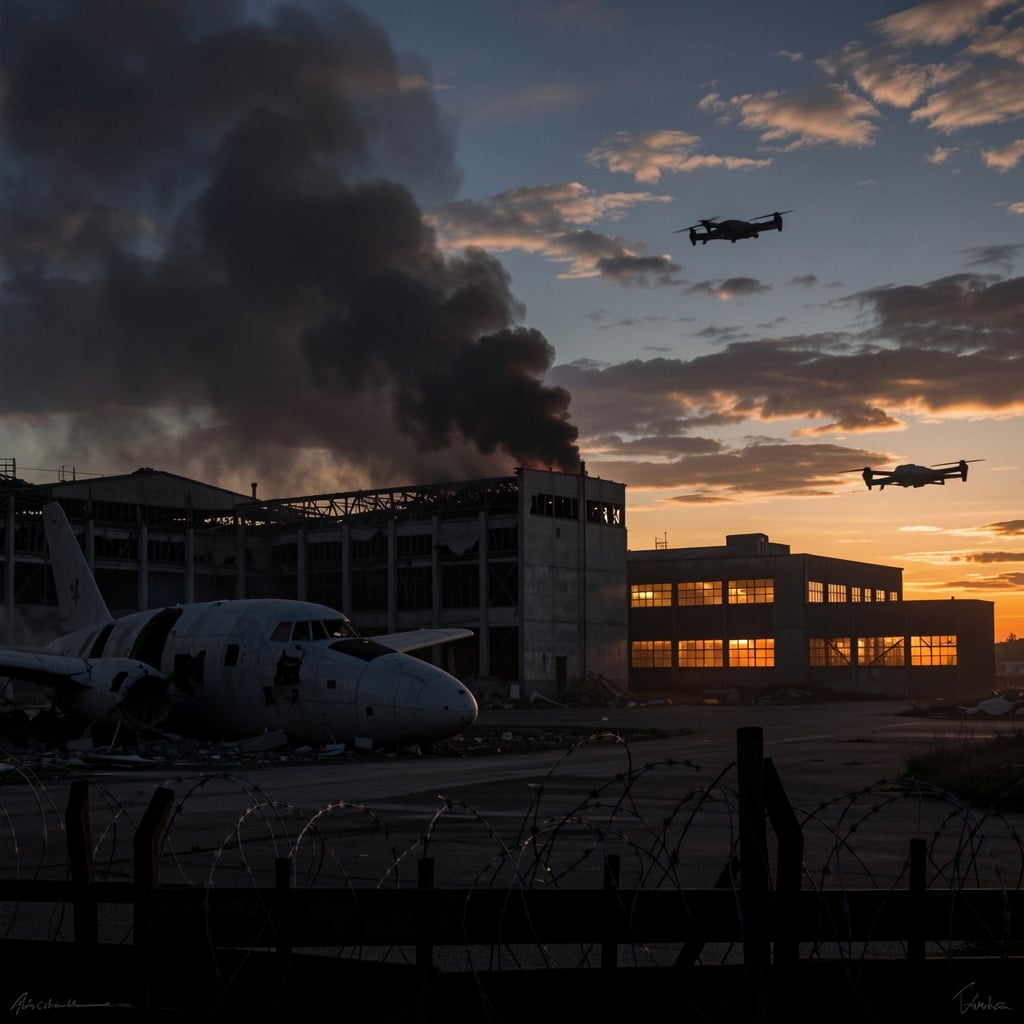
What does it mean when a drone, a technology once confined largely to reconnaissance, transforms into a weapon capable of striking deep within a nation’s industrial heart? On a recent day in Taganrog, a city in Russia’s Rostov region, this question became a stark reality as a so-called “kamikaze” drone struck the grounds of the Beriev Aircraft Company, known formally as PJSC “Taganrog Aviation Scientific-Technical Complex named after G. M. Beriev” (TANTK Beriev). The incident, confirmed by Taganrog Mayor Svetlana Kambulova, who reported debris from the unmanned aerial vehicle (UAV) falling on the facility, raises complex issues at the intersection of modern warfare, technological innovation, and geopolitical tension.
The Beriev Aircraft Company holds significant importance in Russia’s aerospace sector, specializing in the design and manufacture of amphibious aircraft. Its role extends beyond civilian applications; many of its products serve military purposes, including maritime patrol and anti-submarine warfare. An attack on such a facility reverberates through both the industrial capacity and the strategic military calculus of the region.
According to Militarnyi, the strike involved a “one-way” or kamikaze drone, a class of UAVs programmed to crash into their targets, sacrificing themselves to inflict damage. The use of such drones underscores a shift in the methods of contemporary conflict. Unlike conventional airstrikes, kamikaze drones offer a low-cost, high-impact alternative that can bypass traditional air defenses due to their size, speed, and sometimes stealth capabilities. This tactical evolution reflects a broader trend toward unmanned systems playing ever more critical roles in offensive military operations.
From a technological perspective, the incident at TANTK Beriev exemplifies both the vulnerabilities and the adaptive challenges faced by legacy industrial complexes. Many such plants were designed during the Cold War, when physical security measures did not fully anticipate the rapid advancement of drone technology. The ability to deploy UAVs effectively deepens the battlefield into the industrial and logistical networks that support armed forces, making them frontline targets. For defense technologists, the challenge lies in developing counter-drone systems robust enough to detect and neutralize these threats before they reach their targets.
Policymakers, meanwhile, are confronted with difficult decisions. The implications of attacks on critical infrastructure raise questions about escalation and retaliation. While some experts view such strikes as asymmetric warfare tactics that avoid direct confrontation with manned aircraft or missile systems, others warn they might provoke harsher responses or expanded conflict zones. The Russian government’s public acknowledgment of the attack through Mayor Kambulova suggests a measured approach to information release, likely balancing between transparency and strategic communication.
For those who study the use of drones by military and paramilitary groups worldwide, the Taganrog strike exemplifies a growing reliance on unmanned systems for precision attacks in contested environments. The operational flexibility offered by kamikaze drones can serve as a force multiplier for smaller or less technologically advanced actors, altering traditional power dynamics. Conversely, established powers must rethink doctrines and invest heavily in new defensive technologies and intelligence systems.
Adversaries observing this event will note the symbolic and practical significance of hitting a major aircraft production site. Such attacks challenge the presumed sanctity of industrial nodes within national defense networks, illustrating how modern conflicts blur the lines between battlefronts and economic infrastructure. This erosion of traditional military-industrial buffers presents profound challenges not only for Russia but for any nation reliant on concentrated industrial hubs for defense production.
As the dust settles over Taganrog, the larger question remains: how will nations adapt to a future where the skies are filled not just with piloted jets but with autonomous drones programmed to strike with lethal intent? The answer will shape the next generation of warfare, defense policy, and technological innovation. If history has taught us anything, it is that the marriage of technology and strategy is always evolving—sometimes in unexpected and unsettling ways.



