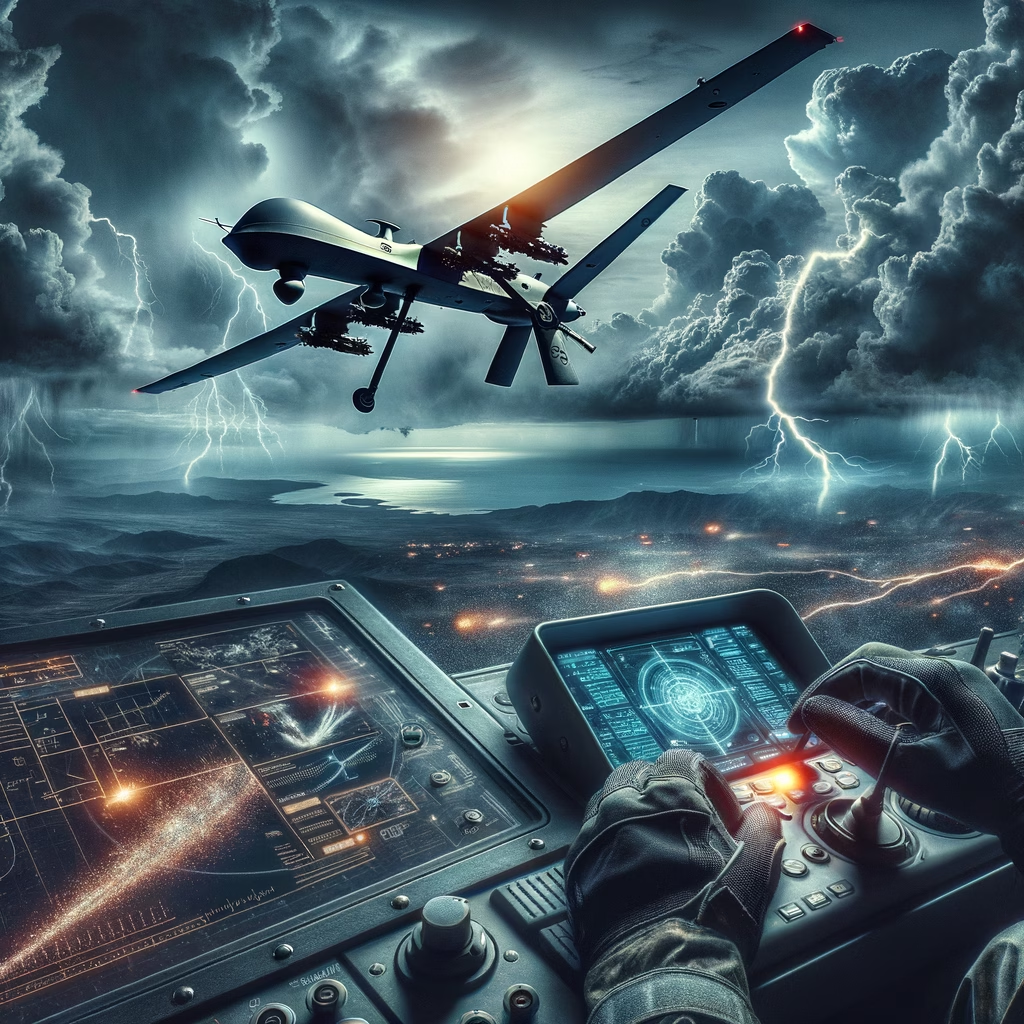
“We will push the boundaries on that, because we have to,” Lt. Gen. Gainey said — four words that cut through euphemism and expose a stark dilemma: how do you build defenses fast enough to stop a swarm of autonomous drones without giving those defenses unchecked authority to make life-and-death decisions in a fraction of a second? The modern battlefield has compressed time to an alarming degree. Cheap, small drones outfitted with cameras, jammers, improvised munitions and ever-improving autonomy can appear, assess and strike in minutes — sometimes in seconds. That tempo is forcing planners toward “act first, ask later” architectures: automated interceptors that detect, classify and defeat incoming threats with minimal human intervention.
The logic driving this shift is compelling. When sensors flag a hostile low-flying drone converging on a base, hospital or convoy, a human operator may no longer have the luxury of deliberation. Shortening the kill chain with rapid automation can reduce casualties and infrastructure loss. Yet that efficiency carries profound legal, ethical and strategic hazards. Speed without sufficient safeguards risks tragic mistakes and unintended escalation.
Drone defenses: why speed and caution collide
Automated counter-drone systems are not science fiction. From Eastern Europe to the Middle East, state militaries and irregular forces alike have turned to drones for reconnaissance, target acquisition and loitering strikes. In turn, institutions such as the Defense Department and DARPA are accelerating countermeasures: directed-energy weapons, electronic warfare suites and AI-enabled sensor fusion designed to operate at machine speed. Machines can sense and react faster than stressed humans — and that promise drives investment.
But faster is not automatically better. Fully or partially autonomous defensive systems raise immediate questions under international humanitarian law and U.S. policy: can an algorithm reliably distinguish combatant from noncombatant? Can it apply proportionality amid chaotic, time-compressed encounters? Current DoD guidance on autonomy in weapons attempts to reconcile operational need with legal and ethical constraints, but technology is leaping ahead of those guardrails.
Proponents of advanced sensing and machine learning contend that multispectral sensors, probabilistic reasoning and continuous learning can sharply reduce error rates. Properly trained algorithms can filter false positives, separate friend from foe, and adapt to adversary countermeasures. They also argue automation can be more consistent and less emotionally driven than humans in high-stress engagements.
Skeptics — including legal scholars, ethicists and some policymakers — urge caution. Even low-probability errors can yield catastrophic consequences when a system is authorized to use lethal force automatically. After an incident, attribution becomes messy: did an algorithm misclassify a target, did sensor degradation distort inputs, or were signals maliciously spoofed? Determining accountability — whether operator, commander, developer or manufacturer — becomes politically and legally fraught.
Front-line operators often offer a pragmatic middle ground. Soldiers, sailors and aircrews typically favor human-on-the-loop models that preserve supervisory control while leveraging automation for detection, tracking and engagement recommendations. They emphasize predictability and explainability so automation can be safely integrated into complex, contested battlespaces. In practice, this means automation handles rapid sensing and suggests responses, while a human retains authority to authorize lethal action except in narrowly defined, exigent self-defense scenarios.
Adversaries, however, will relentlessly probe any automated edge. Automated defenses can be spoofed, overloaded or tricked via electronic warfare, cyberattacks, decoys or data-poisoning operations that corrupt machine-learning models. Worst-case scenarios include deliberately created ambiguities that cause an automated system to wrongly engage civilians or provoke reflexive responses that escalate conflict.
Strategic risks extend beyond tactical effectiveness. Perception and precedent matter: if defensive systems are seen as reflexive and unaccountable, their deployment could lower the threshold for escalation or provoke international outrage after civilian harm. Conversely, requiring human authorization for every engagement may give attackers an insurmountable advantage when seconds count. The result could be a dangerous global patchwork: some states embrace permissive automatic responses, while others impose restraints that adversaries exploit.
Practical priorities to manage this tension are clear and urgent:
– Rigorous testing and validation of AI and sensor suites in realistic, contested environments to reveal failure modes and edge cases.
– Clear and updated rules of engagement and legal frameworks that define acceptable bounds for automated defensive action and ensure accountability.
– Robust cyber and electronic-warfare hardening, plus adversarial testing to resist spoofing and data manipulation.
– Transparent logging, explainability features and forensic capabilities to reconstruct what a system perceived and why it acted.
– Operational concepts favoring human-on-the-loop control where feasible, with narrowly scoped, time-limited exceptions for automatic action tied to tightly defined self-defense scenarios.
These prescriptions are not novel; scholars, technologists and ethicists have long advocated them. What has changed is urgency. Lt. Gen. Gainey’s blunt assessment signals that defense leaders now regard technological constraints as intolerable risk — a gap they feel compelled to close by expanding capability. The critical test will be whether that push toward speed is matched by commensurate investment in legal, technical and governance safeguards.
If states rush forward without coherent norms and oversight, the outcome could be a fractured landscape of permissive use and harmful precedents — precisely the conditions nonstate actors and revisionist powers could exploit. The choice facing policymakers is stark but not binary: embrace the speed of automated defenses and accept moral and strategic hazards, or impose restraint and risk vulnerability to lightning-fast attacks. The wiser path is calibrated: acquire the speed needed to protect forces and civilians while embedding rigorous safeguards, oversight and transparency into every layer of design and deployment.
“We will push the boundaries on that, because we have to.” Machines can move faster than we can think; the urgent question is whether our institutions can move fast enough to set rules, controls and cultural practices that prevent those machines from making catastrophic judgments on their own. Getting drone defenses right now — technically, legally and ethically — will determine whether the next generation of conflicts protects the innocent or amplifies harm for those least able to bear it.



