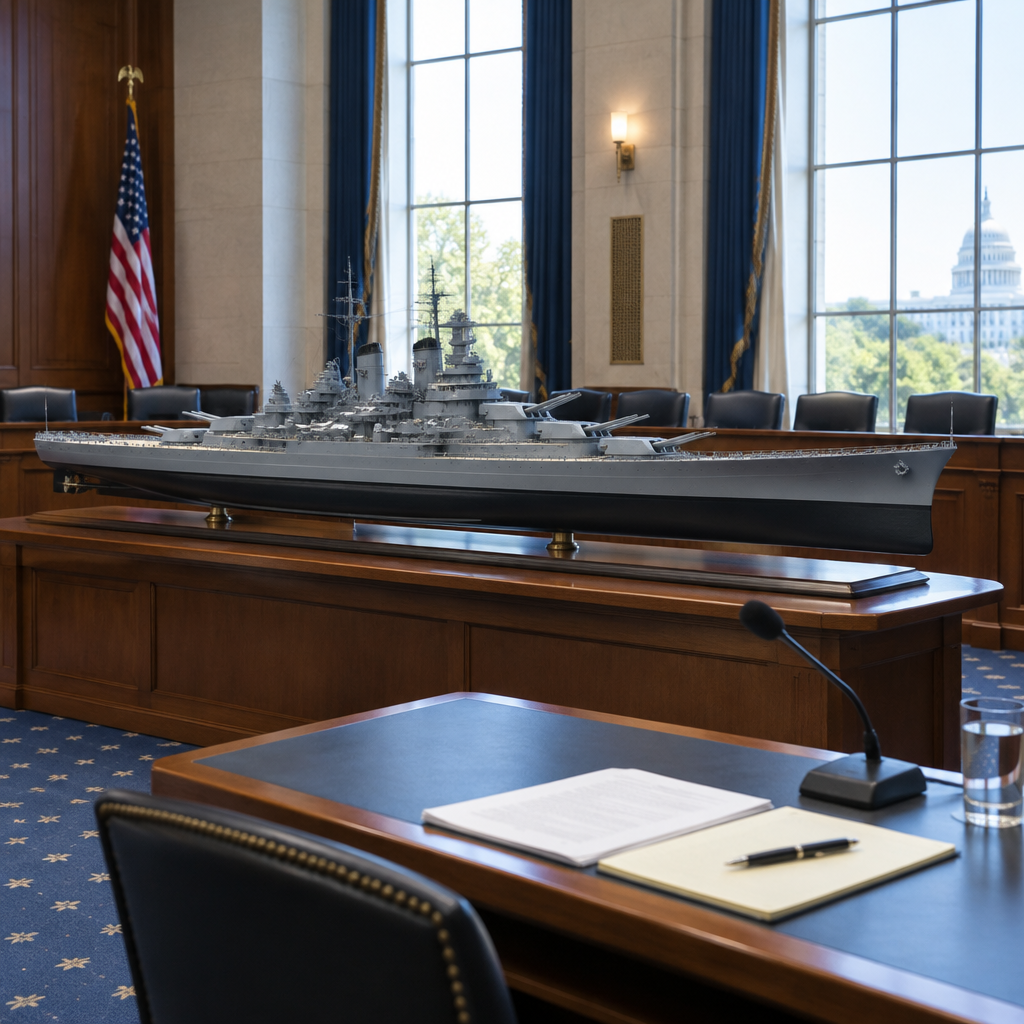
The Democratic Party’s decisive mid-term victory, which hands the party control of both chambers of Congress in January, dramatically increases congressional leverage over defense authorizations, appropriations, and committee leadership. That shift places the Trump class battleship — a 35,000‑ton, nuclear‑powered surface combatant laid out by the Navy and championed by the President — squarely in the crosshairs of skeptical lawmakers and defense analysts.
Design, armament, and schedule of the Trump class battleship
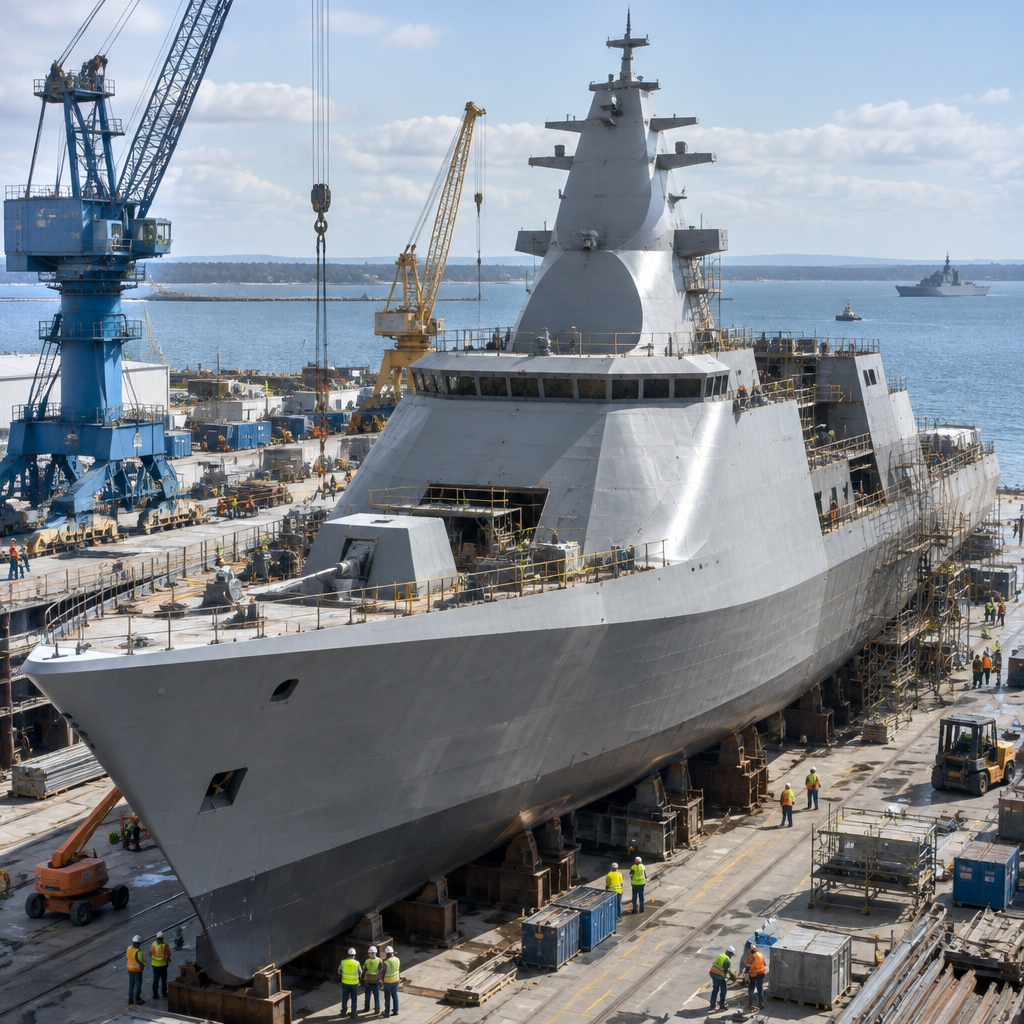
Public Navy descriptions frame the Trump class as a heavily armed, sensor‑rich 35,000‑ton warship that will carry nuclear and conventional missiles, including hypersonics, fired from very large Vertical Launch System arrays; an electromagnetic railgun; a pair of 5‑inch guns; multiple laser directed‑energy systems; and close‑in defensive weapons. The Navy confirmed in May that the class is planned to be nuclear‑powered. The first ship, slated to be named the USS Defiant, is not expected to enter service until 2036.
Costs and Congressional Budget Office estimates
The Congressional Budget Office put the potential cost of the USS Defiant as high as $23 billion, with the average price of the next 14 ships estimated at $18 billion each. TWZ noted that even the $18 billion figure would make the Trump class significantly more expensive than each of the next three Ford class aircraft carriers. Those figures have already driven bipartisan unease about the program’s opportunity cost.

The cyber insurance questionnaire just landed. Now what?
SOC 2, HIPAA, insurance renewals - someone has to own security strategy. Nubivance provides fractional CISO leadership without the full-time salary.
Get a security leadIndustrial base constraints: shipyards, reactors, and competing programs
Implementation faces concrete industrial limits. The reporting states there are only two U.S. shipyards qualified to build nuclear‑powered vessels and only one supplier of naval reactors, capacity already heavily committed to aircraft carriers and submarines. Naval nuclear components are in high demand for ongoing carrier and Columbia class submarine work; the Navy and others have flagged risks of disrupting those schedules. Observers warn that shipyard workforce shortages and rising costs are already straining established programs such as Arleigh Burke destroyers, frigates, and large uncrewed surface vessels.
Congressional actions and legislative constraints
Congress has not been passive. A Republican‑controlled House Armed Services Committee previously required the Secretary of the Navy to report on how the battleship program would avoid disrupting carrier and submarine production, with Rep. Joe Courtney calling for the report no later than March 1, 2027. The House passed an FY2027 NDAA version that included Section 131, which would block any work on the USS Defiant until the Navy certifies key weapon systems are “sufficiently mature.” That bill drew a formal Statement of Administration Policy from the Office of Management and Budget opposing Section 131; final passage of FY2027 NDAA has since stalled in the Senate over unrelated issues.
What this means for the Navy, Democratic congressional leaders, and U.S. shipyards
- The Navy: Faces pressure to defend the program’s operational rationale while balancing limited shipyard and reactor capacity and the service’s need to meet current surface combatant demands. Navy planners may be forced to reallocate research funding or shift components — for example, railgun development — into other programs.
- Democratic congressional leaders: With Rep. Adam Smith likely to seek the House Armed Services Committee chair and Rep. Joe Courtney in line for the Seapower and Projection Forces Subcommittee, Democrats are positioned to scrutinize or curtail the program, and to press broader reviews of the national defense strategy and defense spending that Rep. Smith says should not “require a defense budget in excess of $1 trillion.”
- U.S. shipyards and reactor suppliers: Will contend with potential redirection of work and funding pressure. Analysts cited by TWZ note that nuclear shipbuilding capacity is constrained and already committed to carriers and Columbia class submarines, creating a bottleneck if the battleship program proceeds at scale.
Voices on the program are sharply divided but converge on the program’s precarious position. Mark Cancian of CSIS called the Trump battleship “likely doomed both because of the branding and because the program is extremely expensive and weakly justified.” Retired Rear Admiral Mark Montgomery at FDD said the plan was “aground and taking on water,” noting the trade‑off of “as many as 10 Arleigh Burke class Destroyers for one battleship.” By contrast, Brent Sadler of The Heritage Foundation argued the Navy still “needs the capabilities resident in the proposed battleship,” while predicting the “Trump class” name “likely won’t survive but the ship will.”
The mid‑term results also bring fresh scrutiny to other Trump administration initiatives that interlock with naval plans. The president’s August memo on the Golden Fleet called for reconsidering EMALS and Advanced Weapons Elevators on the Ford class and for steam‑powered catapults and hydraulic elevators on the future USS Doris Miller; separately, the Golden Dome missile defense initiative has been flagged by U.S. Space Force Gen. Michael Guetlein as vulnerable to budgetary stoppage without resolved funding. The administration is pursuing a roughly $1.5 trillion defense budget for FY2027, including some $350 billion via reconciliation — a scale Rep. Smith and his colleagues say merits a thorough review.
For now, the battleship program’s future is uncertain but constrained by concrete fiscal, industrial, and legislative chokepoints: a multi‑billion‑dollar per‑ship price, limited nuclear‑shipbuilding capacity, pending congressional deadlines like the March 1, 2027 report, and an FY2027 NDAA process that has already inserted project‑level checks. As one analyst put it, the program “probably can’t be killed until Trump leaves office,” but all involved must “ensure that it does minimal damage to other Navy program efforts as it sinks to the bottom.”
Source: TWZ — Did The Blue Wave Just Sink Trump’s Battleship?