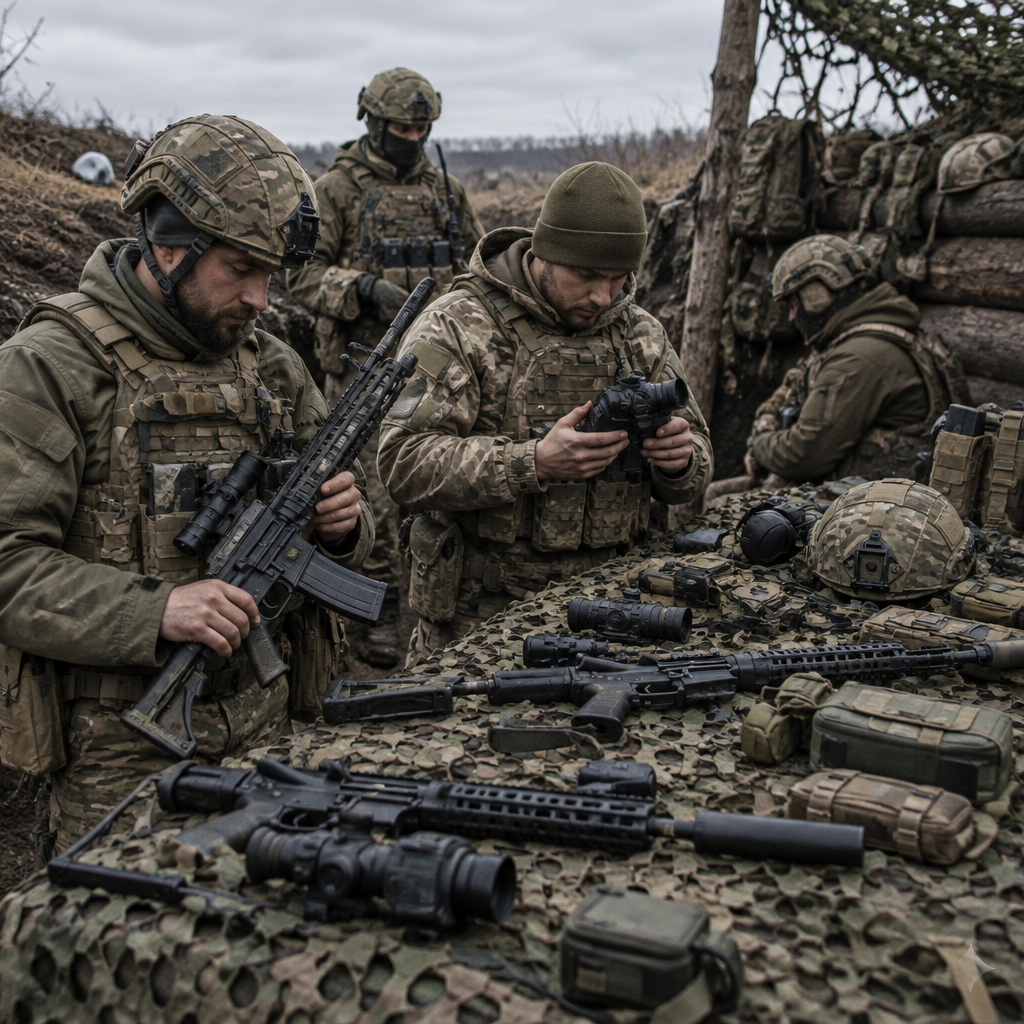
"The best rifle is the one that you have." — Chill, Chief Tactical Training Instructor, 41st Unmanned Systems Regiment Pilum, First Corps Azov of the National Guard of Ukraine.
Five soldiers from different Azov units stationed in the Dobropillia sector of Donetsk — all issued weapons through their brigade's armament service, which sources equipment from the Ukrainian Defense Ministry — described which small arms, optics and accessories work in prolonged frontline combat and which do not. Their answers repeatedly return to three practical themes: weight and modularity, reliability under dirty and wet conditions, and the ability to sustain and repair equipment domestically.
Why the UAR-15 and HK416 lead front-line preferences
Across the interviews, the UAR-15 — an AR-15 pattern rifle produced in Ukraine and commonly chambered in 5.56mm — is the "key weapon platform" for many Azov operators. Reasons cited: lighter weight, shorter length, ease of modification and the presence of a domestic manufacturer (Zbroyar) that speeds repairs and parts supply (Chewie; Barman; Chill).
Yet reliability concerns push some gunners toward piston-driven designs. Tarantino, Chief Armorer of the 12th Special Forces Brigade Azov, praised the Heckler & Koch HK416 for its short-stroke gas piston, saying the piston system "has proven itself the most efficient" and is less vulnerable to stoppages in wet trench conditions than direct impingement (DI) AR-15 variants. Several interviewees contrasted DI-based UAR-15s — which they said contaminate faster and demand more frequent maintenance — with piston systems like the HK416, which they described as easier to sustain during continuous operations (Tarantino; Chill; Barman).
Red dots, holographics and scopes: trade-offs at close and mid ranges
On red dots and holographic sights the unit mixes commercially available options. Holosun earns praise for cost-to-quality balance; Aimpoint models (M4, M5, T2) and EOTECH holographic sights are also widely used. Operators note practical trade-offs: EOTECH offers a large viewing window, while Aimpoint can better tolerate recoil from underbarrel grenade launchers without losing zero (Tarantino; Chewie; Barman).
Scoped magnification commonly stays modest: marksmen favor 3x or 5x optics for the roles described. Named precision optics in use include Nightforce, Schmidt & Bender, Kahles and Leupold; Sig Sauer scopes (1–6x) and the Elcan Specter (1–4x) also appear among preferences for intermediate-range work (Tarantino; Chewie; Barman).
Thermals are in active use. Ukrainian-made Archer devices — models cited include Archer TSA-7, Archer 7, Archer 10, Archer 55 and Archer 8 — are described as reliable and feature-rich (ballistic calculators, laser rangefinders), and are used across weapon classes; some units also use Chinese AGM thermal scopes and elsewhere units are reported to employ thermals called Safran that include coolant systems (Tarantino; Chewie; Barman).

The cyber insurance questionnaire just landed. Now what?
SOC 2, HIPAA, insurance renewals - someone has to own security strategy. Nubivance provides fractional CISO leadership without the full-time salary.
Get a security leadSuppressors, personal weapons, and niche platforms
Suppressors are present but imperfect. Operators use Ukrainian-made Ase Utra and Ukrop FAST suppressors and UAR-supplied quick-attach suppressors; complaints center on rapid wear in automatic fire and differences in whether adding a suppressor preserves zero without re‑adjustment (Tarantino; Chewie; Barman).
On sidearms, the Fort 20 and Glock 17 dominate, with CZ and Sig Sauer also mentioned; the common caliber is 9x19mm (Tarantino; Chill; Khalepa; Chewie; Barman). Most fighters eschew pistol red dots and lights for combat use, citing fragility, dirt susceptibility and the reliability of mechanical sights in the field (Tarantino; Chill; Chewie; Barman).
Specialty or legacy platforms are used sparingly. Heckler & Koch MP5 submachineguns are valued for vehicle crews but considered of limited versatility in modern combat. Bullpups (Fort 221, Fort 224, Malyuk, Tavor) receive mixed reviews: compactness is an asset in short missions, but ergonomic challenges and awkward prone firing limit wider adoption (Tarantino; Chill; Barman).
Shotguns, anti‑drone practice, and night vision
Shotguns are available but not central. They are used intermittently by vehicle crews and for shooting at small drones; Turkish- and Ukrainian-manufactured shotguns (including Benelli-pattern copies, Winchester-pattern and Hatsan models) appear in unit inventories. Operators noted that specialized anti‑drone fragmentation cartridges exist for 5.56 rifles and for shotguns, but many soldiers train to shoot down drones with standard ammunition because engagements are sudden and changing magazines or ammunition types is impractical (Tarantino; Chill; Khalepa; Chewie; Barman).
Night vision is widely used, typically helmet-mounted. Monocular PVS-14 and binocular PVS-32 devices are common; the classic PVS-7 also appears. Weapon-mounted night optics are less common; operators generally attach NV gear to helmets and use weapon sights zeroed for infrared engagement out to approximately 200 meters when required (Tarantino; Chill; Chewie; Barman).
What this means for the armament service, Zbroyar, and frontline soldiers
- For the brigade armament service and the MoD: domestic production and parts availability matter. Soldiers repeatedly cite the speed of repair and the ability to request parts from Ukrainian manufacturers as decisive.
- For manufacturers such as Zbroyar and Archer: reliability under automatic fire, quick‑attach suppressor designs and thermal optics with integrated ballistics calculators are operational priorities.
- For frontline soldiers and trainers: the balance between a weapon's theoretical capability and its maintainability in wet, muddy, high-tempo conditions governs choices — lighter, modular 5.56 UAR-15 platforms and robust night/thermal kits are practical winners, while DI systems and fragile pistol optics are treated with caution.
The soldiers’ assessments are practical rather than doctrinal: equipment that is light, repairable at home, and tolerant of contamination keeps fighters shooting when it matters. Whether piston-driven rifles, domestic thermals or quick-attach suppressors become the standard will depend on the same constraints the men described — what gets to the frontline reliably and what holds up under repeated combat use.