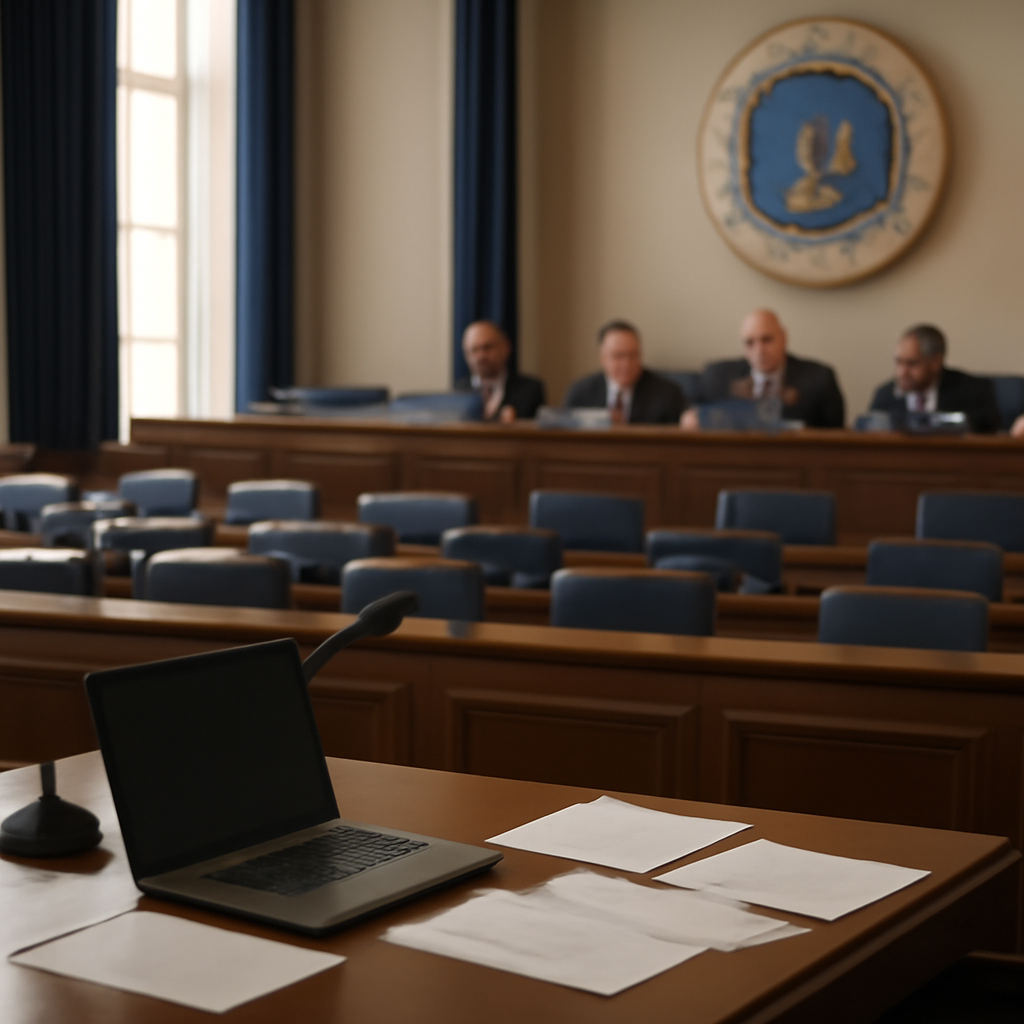
“I think if we have a solid resolution of the budget, both domestic and defense, we’ll be in a much better position to go ahead,” Sen. Jack Reed told Breaking Defense in July.
A $1.5 trillion ask and three overlapping tracks
The Pentagon has tied its FY27 plans to a two-part financing strategy: a $1.15 trillion discretionary request that the White House sent to Congress and a further $350 billion in mandatory spending the administration is seeking through reconciliation. Together, the request totals roughly $1.5 trillion — a historic sum that the Pentagon is betting can be assembled, but which faces political and procedural barriers on Capitol Hill.
Congress is juggling at least three interlocking bills: the National Defense Authorization Act (NDAA), separate defense appropriations, and a reconciliation vehicle that could carry the $350 billion in mandatory funding. The House passed its NDAA in July and a reconciliation bill in its chamber that would allocate $60 billion for defense, but the Senate has not scheduled floor action on its NDAA and Senate appropriators have not released text of the FY27 defense spending bill. Senate Democrats have blocked the upper chamber from bringing the NDAA to the floor, citing the war in Iran and questions about the defense topline. Senate Majority Leader John Thune has not yet found the votes to advance the House reconciliation package in the Senate.
Munitions, Golden Dome and the F‑35: who gets prioritized
Much of the Pentagon’s ramp-up for munitions sits inside the reconciliation request. The reconciliation language would devote $47 billion to munitions, funding increases for 12 legacy munitions and other efforts; without those mandatory funds, the discretionary FY27 request actually reduces some quantities. For example, the discretionary budget funds 267 PAC‑3 interceptors, down from 310 the previous year, while reconciliation would add almost 3,000 additional PAC‑3s.
Congressional committees diverge on approaches. The House versions authorize multiyear procurement for 13 critical munitions and require reporting on munitions capacity and inventory; the Senate Armed Services Committee authorizes multiyear procurement for 19 munitions and demanded a Pentagon briefing that the department broaden production lines and diversify inventories. House appropriators included $11.4 billion for procurement of critical munitions and described relying on reconciliation funding as “risky and uncoordinated.”
Golden Dome — the program with most of its funding in reconciliation — received $397 million in the discretionary base request, and both the House and Senate NDAAs and the House appropriations bill would fully fund that $397 million. The reconciliation package would add $17.1 billion for Golden Dome.
For the F‑35 Joint Strike Fighter, the president’s discretionary request funds 32 aircraft (24 F‑35As for the Air Force, six F‑35Cs for the Marine Corps and two F‑35Cs for the Navy). Reconciliation would add $6.7 billion to buy 21 more aircraft (totaling 53), with specific mixes for A, B and C variants; the Senate NDAA added $232 million for F‑35A procurement but kept quantities at the president’s requested 24 F‑35As. The House NDAA and House appropriations adhere to the president’s discretionary procurement levels.

This site is the portfolio.
OSINTSights runs on Cloudflare Workers, D1, R2, and Vectorize, with an AI pipeline on Hetzner ARM. Nubivance designed, built, and operates it. We do the same for clients.
See what we buildShipbuilding, aircraft buys and the E‑7 fight
Shipbuilding and aviation procurement lay bare the split between the discretionary request and supplemental/reconciliation asks. The president’s budget funds a single Arleigh Burke‑class destroyer; reconciliation documents request $314 million for that program. The House NDAA added $1 billion toward a second DDG‑51, SASC would add $2.5 billion for a second destroyer, while House appropriators adhered to the president’s single‑ship buy.
Helicopter procurement shows similar variance. The president requested one UH‑60M (funded at $32 million) and five CH‑47 Chinooks ($319 million). House committees added aircraft: the House NDAA added $250 million for six UH‑60Ms and $381 million for seven CH‑47s beyond the Pentagon’s request; House appropriations added $493 million and $456 million respectively to procure additional aircraft though exact quantities were unspecified. The Senate Armed Services Committee largely adhered to the president’s request for these rotorcraft.
The E‑7 Wedgetail program has become a discrete fight: the Air Force planned to cancel it but the Pentagon told lawmakers it planned to resuscitate it and request funding via budget amendment. The Senate NDAA and the House appropriations bill each add $1.5 billion to restore or fully fund the program; committee staff told reporters the House committee wanted to see a formal budget amendment before recommending added funding in the NDAA.
Rules, institutional shifts and policy riders
Budget language extends beyond procurement into policy and organizational questions. On foreign shipbuilding, the reconciliation request would fund studies and possible procurements via allied shipbuilders (an OMB official told reporters those funds could be used to procure a warship from Japan or South Korea). House and Senate language would restrict or remove presidential waivers on building battle force ships in foreign yards and would allow only narrowly defined auxiliary ship builds tied to U.S. capital investment requirements.
Space acquisition structure is on the table: HASC and SASC proposals would permit eliminating the Space Development Agency and the Space Rapid Capabilities Office or repeal statutory requirements relating to them, enabling DoD reorganization of space acquisition. Right to repair measures — which Army Secretary Dan Driscoll and others have urged Congress to act on — appear in both the House and Senate NDAAs as provisions granting the Pentagon default government purpose rights for technical data and software. On industrial policy, SASC would require future defense contracts to bar share buybacks or dividends without a waiver; the DeLuzio amendment to the House NDAA that would have imposed such limits was offered and withdrawn. Finally, both HASC and SASC included provisions to rename the Defense Department as the “Department of War,” with HASC voting 29–27 to adopt the amendment during markup.
How Congress, the Pentagon, and the defense industry face the FY27 fight
- Congressional appropriators and authorizers: Must reconcile differing top‑line numbers across NDAA, appropriations and reconciliation tracks, reach agreement on a continuing resolution by Sept. 30 (funding expires Oct. 1), and resolve substantive disputes over munitions, shipbuilding and program restores before the October recess and midterm elections.
- The Defense Department and acquisition leaders: Are pushing a mix of discretionary and mandatory funding; several program restorations (E‑7, Golden Dome) hinge on budget amendments, reconciliation outcomes and committee willingness to add funds in appropriations or authorizations.
- Defense contractors and industrial base actors: Face uneven signals — multiyear procurement authorities for munitions vary by committee, foreign shipbuilding restrictions would limit some procurement options, and SASC contract provisions could restrict share buybacks and dividends without waiver.
Congress returns to Washington in September with only weeks before an October recess and a hard funding deadline on Oct. 1. The political and procedural choices in those weeks — whether to pass a CR, finalize an NDAA, or advance reconciliation — will determine whether the Pentagon receives the full $1.5 trillion construct it has requested or a more constrained package.