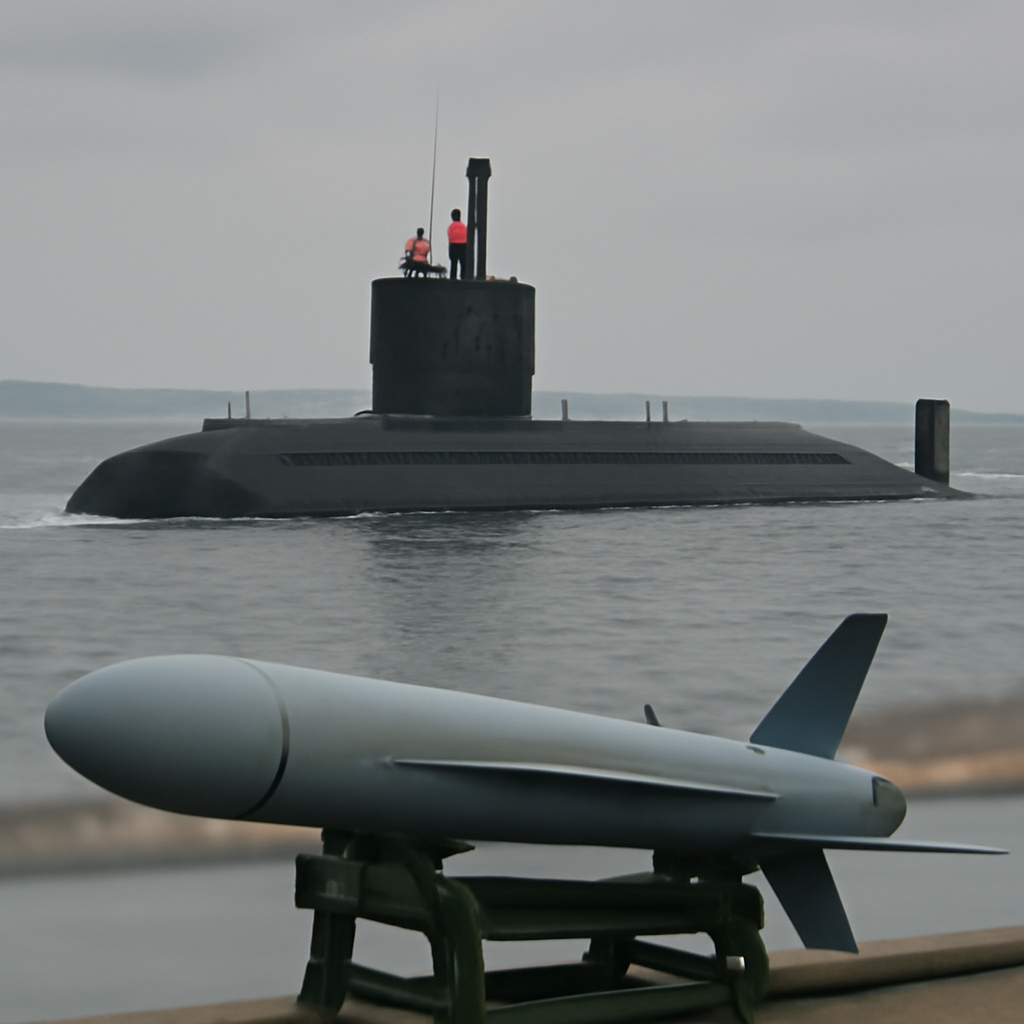
"The Secretary of the Navy may not enter into a contract or other agreement that includes a scope of work for the construction of the lead ship of the Battleship program until the date on which the Secretary certifies to the congressional defense committees that the weapon systems planned for inclusion in such lead ship are at a sufficiently mature technology readiness level," reads the provision in the proposed legislation.
The draft NDAA’s hold on Trump class construction
An early draft of the National Defense Authorization Act (NDAA) for Fiscal Year 2027, released by the House Armed Services Committee, would prohibit the Navy from contracting for the lead Trump class battleship until the Secretary of the Navy certifies that the ship’s planned weapon systems are “at a sufficiently mature technology readiness level.” The provision names no specific weapons and does not define a numerical or qualitative threshold for “sufficiently mature.”
The measure, if adopted, could delay the program’s schedule: the Navy currently plans to order the lead ship — to be named the USS Defiant — in Fiscal Year 2028, with the vessel not expected to enter service in 2036 and an estimated unit cost of $17 billion.
Weapon set driving congressional concern: railguns, lasers, hypersonics
Congress’s caution appears targeted at the Trump class’s ambitious suite of weapons. The battleship design calls for a mix of nuclear and conventional missiles, very large VLS arrays for hypersonics and other missiles, an electromagnetic railgun, a pair of 5-inch guns, multiple laser directed energy weapons and additional close-in defensive systems.
The railgun in particular raises questions. The Navy had an active railgun effort between 2005 and 2021 that was ultimately shelved and the prototype placed in storage at White Sands Missile Range (WSMR). The Navy conducted a new round of testing at WSMR in February 2025, but the source of any follow-on program — whether to resume the BAE Systems-developed prototype or pursue a new design — remains unclear. General Atomics has publicly expressed interest in involvement.
Directed energy also presents scaling challenges. The Navy currently fields HELIOS (a 60-kilowatt-class design) on one Arleigh Burke destroyer and ODIN on eight others; the Trump class calls for a 300-kilowatt-class laser, far beyond systems integrated to date. There has been discussion of scaling HELIOS to 150 kilowatts, but ODIN’s power rating is not publicly confirmed.
Hypersonic capability hinges on the Intermediate Range Conventional Prompt Strike (IRCPS) missile. IRCPS is the Navy half of a joint program with the U.S. Army (the Army’s variant called Dark Eagle). The first test launch from a warship — the stealth destroyer USS Zumwalt — is expected to come next year, and the Trump class design would include a similar launch tube array.

The cyber insurance questionnaire just landed. Now what?
SOC 2, HIPAA, insurance renewals - someone has to own security strategy. Nubivance provides fractional CISO leadership without the full-time salary.
Get a security leadNavy risk-reduction plans and design pull-through
The Navy says it will “leverage significant prior work on weapons and other systems to help reduce risk and ensure the battleship program remains on schedule.” Chief of Naval Operations Adm. Daryl Caudle told congressional and industry audiences that the ship will incorporate existing technologies such as the SPY-6 radar, the Baseline 10 Aegis combat system and the A1B Ford class reactor plant, with the hull form and certain directed energy and up-gunning elements being the primary new items.
Adm. Caudle warned of past mistakes: “we’ve started to build before the design is mature enough,” and said the Navy wants the design at “a very, very high level — I won’t try to give a percentage, but you can think like 80% or more design — before the first weld is done.” The Navy is still in the very early phases of laying out the Trump class design.
FF(X) frigate: containerized VLS, Legend class lineage, and mandated strategy
The same draft NDAA would compel the Secretary of the Navy to submit, within 180 days of enactment, a strategy for iterative development of the FF(X) frigate, with a 90-day briefing to congressional defense committees. Required elements include timelines for each planned variant, details on integrating capabilities such as Vertical Launch Systems (VLS) and the implications for space, weight, power and cost, and any additional mission sets or combat functions.
The Navy has confirmed the FF(X) design will be based on the Coast Guard’s Legend class cutter. The Flight I configuration shown so far lacks a traditional fixed VLS and instead relies on containerized, mission-tailored payloads to provide “VLS-equivalent” effects while retaining a growth path for built-in VLS and other capabilities. The Navy’s budget documents note planned studies for future flights considering expanded capabilities including VLS and anti-submarine warfare systems.
What this means for the Navy, Congress, and shipbuilders
- The Navy: must balance ambitious capability goals with Adm. Caudle’s stated desire to reach a high level of design maturity before construction; integrating novel weapons like a 300-kilowatt laser or a railgun would be a central technical challenge.
- Congress: the House Armed Services Committee has taken a concrete step to hold construction until weapon maturity is certified, creating leverage to shape timelines, cost exposure, and technical risk acceptance in a congressionally overseen procurement.
- Shipbuilders and vendors (including BAE Systems, General Atomics, and Huntington Ingalls Industries): face potential schedule and design changes; HII already offers Legend-derived concepts with integrated VLS and other capabilities, signaling where industrial adjustments might occur if future Flights are directed toward built-in VLS.
The provision in the draft NDAA could meaningfully delay start of the lead ship and reshape the program’s trajectory. Both chambers of Congress must reconcile their bills and the President must sign the final law; meanwhile the source notes that “major decisions about how to proceed in the production of these ships, if at all, will fall to the next administration.” The battle over battleships, weapons maturity and ship design is now moving from concept to the unforgiving scrutiny of budget and oversight — and the next chapters will be decided in committee rooms and budget markups as much as on the shipyard floor.