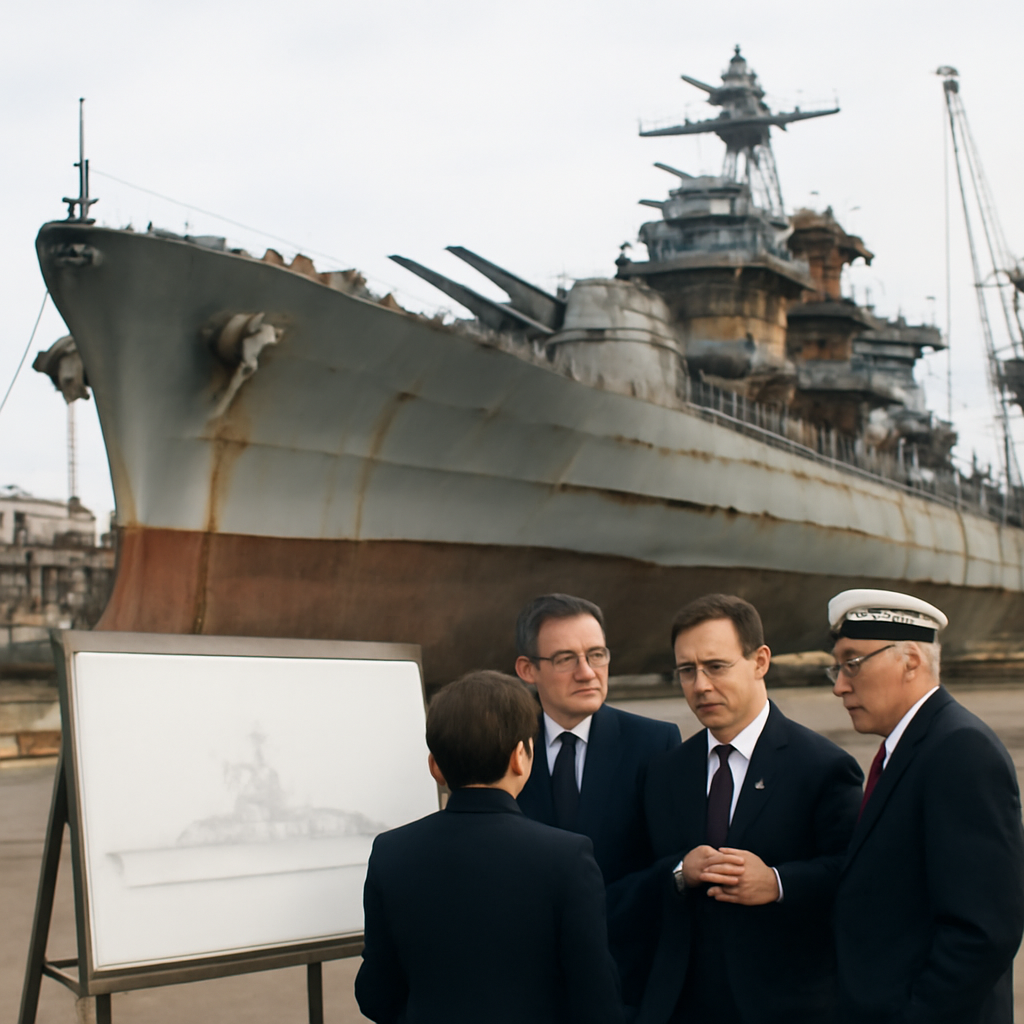
"That’s just an amount of money that really defies logic in terms of the fact that we just do not have anything close to design," Rep. Joe Courtney, D-Conn., said, capturing the skepticism on Capitol Hill about the Navy’s push toward a Trump-class battleship.
House Armed Services Committee’s NDAA restriction
The chairman’s mark of the National Defense Authorization Act (NDAA), released May 27, 2026, would bar the Navy from signing a construction contract or other agreement that "includes a scope of work for the construction" of the lead Trump-class battleship until the Secretary of the Navy establishes to lawmakers that planned weapons systems have reached a "sufficiently mature technology readiness level." The provision makes congressional approval contingent on demonstrable maturity of the ship’s systems before committing to construction contracts.
Technology readiness: hypersonics, rail guns and lasers
The House language does not enumerate which specific systems must be proven, but the plan echoes technologies referenced in the ship’s initial announcement. President Donald Trump said in December the vessel would include hypersonic weapons, electronic rail guns and high-powered, laser-based weaponry. The NDAA mark therefore ties contract authority to evidence that such cutting-edge systems—or whatever suite the Navy intends to field—are at an appropriately mature stage.

Audit-ready is a season. It shouldn't be.
Evidence in spreadsheets, controls drifting between audits, frameworks multiplying on flat headcount. Nubivance runs continuous compliance on Rapid7 Cyber GRC - SOC 2, HIPAA, ISO 27001, PCI, CMMC.
End the scrambleCongressional cost concerns and FY2027–FY2028 funding
Cost is a central driver of congressional scrutiny. Budget documents released in April show the Navy is requesting roughly $1 billion in advance procurement and about $837 million in research and development funds for the battleship in fiscal year 2027. The Navy is planning to request roughly $17 billion in procurement funding for the first ship in FY2028. Those figures have prompted lawmakers to question the wisdom of proceeding without a settled design and mature technologies.
Sen. Chris Coons, D-Del., voiced similar skepticism at a House Armed Services Seapower and Projection Forces subcommittee hearing: "As I understand it, you don’t have a design, you don’t know what’s going to be on it, you’re counting on multiple unproven technologies, and you don’t know how you’re going to build it."
Adm. Daryl Caudle’s defense: endurance, payload and nuclear power
Navy leaders have pushed back, arguing the ship fills a capability gap. Chief of Naval Operations Adm. Daryl Caudle told members of the House Appropriations Committee the nuclear-powered Trump-class is necessary because destroyers lack the hull size to house the envisioned capabilities. "The fact it’s nuclear is going to give it the sustainment it needs," Adm. Caudle said, adding that in the Pacific — which he characterized to lawmakers as an ocean three times the size of the Atlantic — the service needs "those types of legs and endurance to serve as a capital ship that comes with that firepower to be able to deliver that combat payload."
The Navy’s new shipbuilding plan released this month shows a request to buy 15 battleships over the next 30 years, with the first vessel on track for delivery in 2036, underscoring the long-term scale of the program if it proceeds as currently outlined.
$500 million added for a second Arleigh Burke-class destroyer
The draft NDAA mark also includes an additional $500 million to cover the cost of a second Arleigh Burke-class destroyer, responding to the Navy’s request. Lawmakers have repeatedly called destroyers the "backbone" of the fleet and questioned why the Navy requested only one destroyer in its budget request last month. Acting Secretary of the Navy Hung Cao has said the smaller buy was intended to allow the industrial base to "catch up."
How lawmakers, the Navy and shipbuilders are likely to act
- Lawmakers and appropriators will press for certification tied to the NDAA restriction: Congress has attached a clear precondition to construction authority, and members who have questioned cost estimates are positioned to demand documented technology maturity before releasing large procurement sums.
- The Navy will continue to justify the program based on endurance and payload needs: Senior Navy testimony emphasizes the nuclear hull’s sustainment as essential for operations in the Pacific and for accommodating capabilities beyond those destroyers can carry.
- Shipbuilders and the industrial base will watch budget signals and schedules: With first-delivery plans stretching to 2036 and procurement ramps potentially starting in FY2028, firms will need clarity on design, technology insertions and procurement pacing to plan capacity and investment.
The NDAA chairman’s mark crystallizes a fundamental tension: Congress is ready to fund an ambitious, decade-spanning shipbuilding plan only after the Navy proves the weapons and systems it wants to mount on the Trump-class are not speculative. With $1 billion in advance procurement and nearly $837 million in R&D requested for FY2027, a planned $17 billion procurement ask for FY2028, and a 2036 delivery goal, the coming year will determine whether the program is tightened to match proven technologies or delayed as design and maturation proceed.
https://breakingdefense.com/2026/05/house-pushes-navy-to-nail-down-battleship-design-details/