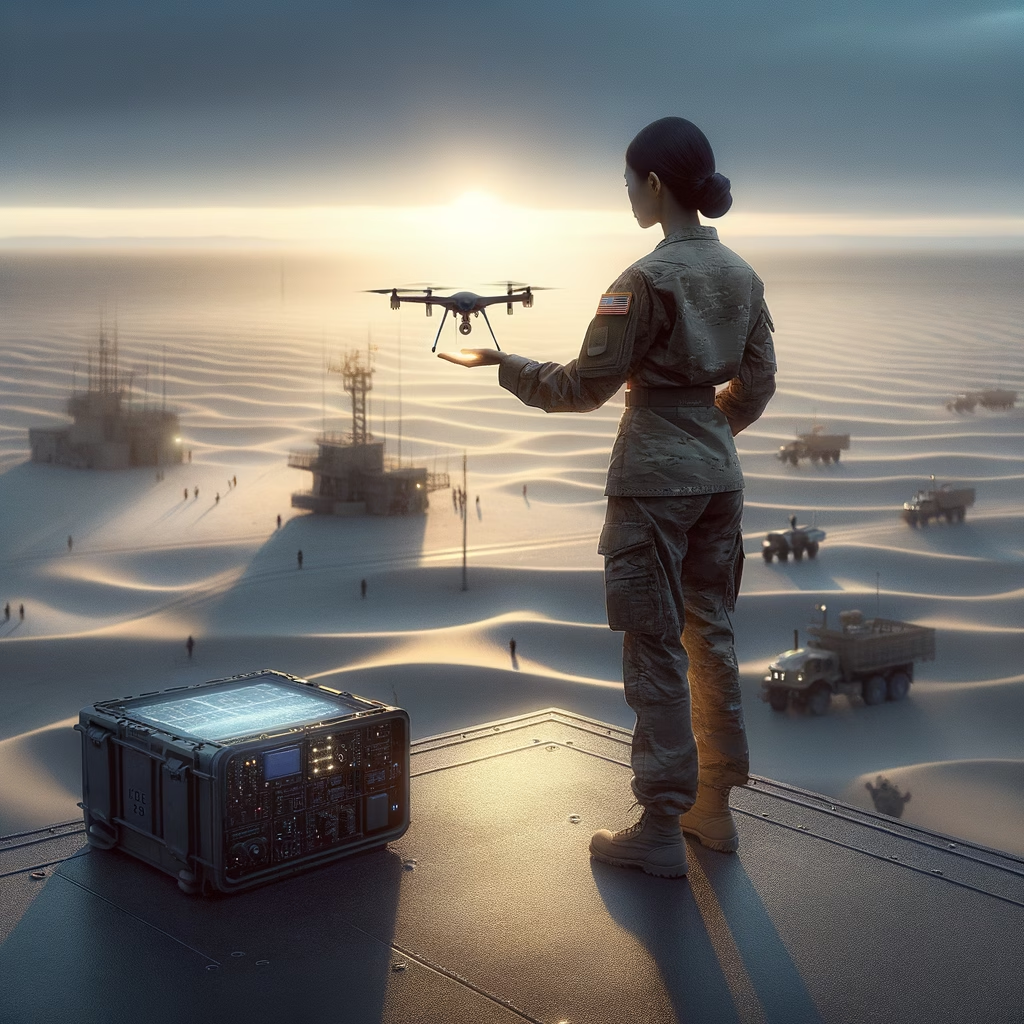
Can a machine grasp an officer’s intent well enough to act without being told every step? That question sits at the center of a new Army draft strategy that envisions unmanned aircraft systems (UAS) that do more than follow waypoints—they would interpret and execute a commander’s intent, backed by a new career field, advanced training, and even soldier-built drones, according to reporting by Defense One.
The draft UAS strategy, circulated within the Army and described in Defense One’s coverage, calls for structural changes aimed at making drones smarter, more adaptable and more tightly integrated with forces on the ground. Among its proposals: stand up a specialized career field for UAS operators and maintainers, expand advanced training for tactical autonomy and human-machine teaming, and empower units to build and modify drones tailored to mission needs.
The idea of machines that “understand” what a commander wants is less science-fiction slogan than an operational imperative. Army doctrine long places commander’s intent at the heart of mission command: clear purpose and desired end state allow subordinate leaders to act with initiative when communications fail or the situation changes. Translating that doctrine into software and hardware—so that drones can act appropriately when connectivity is degraded or officers are overwhelmed—would be a significant doctrinal and technical shift.
Practically, the strategy signals a move from treating UAS as remote sensors and weapons platforms to treating them as teammates—agents that can interpret high-level guidance, assess context, and take initiative within bounded rules. That requires advances in autonomy, explainable artificial intelligence, natural language processing, and robust human-machine interfaces, as well as doctrinal updates to define what delegation looks like on the battlefield.
Soldier-built drones are a particularly notable proposal. The draft suggests empowering units to assemble and modify platforms to meet immediate tactical needs—an attempt to shrink acquisition timelines, increase operational resilience, and foster innovation at the point of use. The idea echoes trends in industry toward modular, open-system designs that can be rapidly reconfigured.
Proponents argue there are clear operational payoffs:
/
Faster tempo—autonomous systems can act more quickly than humans on routine or time-sensitive tasks.
/
Reduced cognitive load—delegating predictable tasks frees leaders to focus on strategy.
/
Resilience—locally built or field-modified platforms can mitigate supply-chain and procurement delays.
But the path forward is complicated. Technical hurdles remain: ensuring reliable intent interpretation across noisy, contested environments; creating systems whose decisions are auditable and predictable; and hardening platforms against cyberattack, spoofing and electronic warfare. Integrating autonomy with existing command-and-control architectures will demand rigorous testing and standards.
There are also legal, ethical and policy concerns. Rules of engagement and the law of armed conflict must govern what an autonomous system may do in the absence of direct human approval. Policymakers and lawyers will have to work with soldiers and engineers to set clear boundaries—defining which tasks can be delegated, under what circumstances, and with what safeguards.
Technologists warn that “understanding” intent is a slippery term. To be useful, autonomy needs formalized representations of goals, constraints and context, and mechanisms to explain its reasoning to human leaders. That pushes research priorities toward explainable AI, rigorous validation in realistic environments, and human factors work that ensures commanders can trust and, when necessary, override machine actions.
For soldiers on the ground, the changes envisioned by the draft strategy are double-edged. Training and a dedicated career field could professionalize UAS operations and give commanders more capable tools. At the same time, entrusting autonomy with greater decision authority will require cultural change and confidence that systems will act in predictable, lawful ways—especially when those systems are created or modified at the unit level.
Adversaries will notice. Any increased reliance on autonomy raises new attack surfaces: deception of sensors, manipulation of shared intent representations, and targeting of the supply chain for soldier-built platforms. Conversely, adversaries adopting similar capabilities could accelerate battlefield tempo and complicate escalation control, making clear rules, robust interoperability and resilient systems even more important.
Implementation will not be purely technical. Standing up a career field requires personnel policy changes, billets, education and retention incentives. Training pipelines must adapt, budgets must be reallocated, and acquisition processes must accommodate rapid, modular development without sacrificing safety and oversight. Those are as much institutional hurdles as they are engineering ones.
The Army’s draft UAS strategy frames a serious, deliberate attempt to reconcile enduring military principles—mission command and initiative—with accelerating technological change. If well executed, it promises greater operational agility; if rushed or poorly governed, it risks unpredictability and legal exposure.
Ultimately, the debate comes down to trust: can human leaders entrust machines with the latitude to act on intent, and can machines be built so their actions remain understandable, constrained and reversible? As the Army experiments with career fields, training and soldier-built platforms, that question will define not just capability but responsibility on the battlefield.
Source: https://www.defenseone.com/technology/2025/10/army-wants-drones-understand-commanders-intent/408953/



