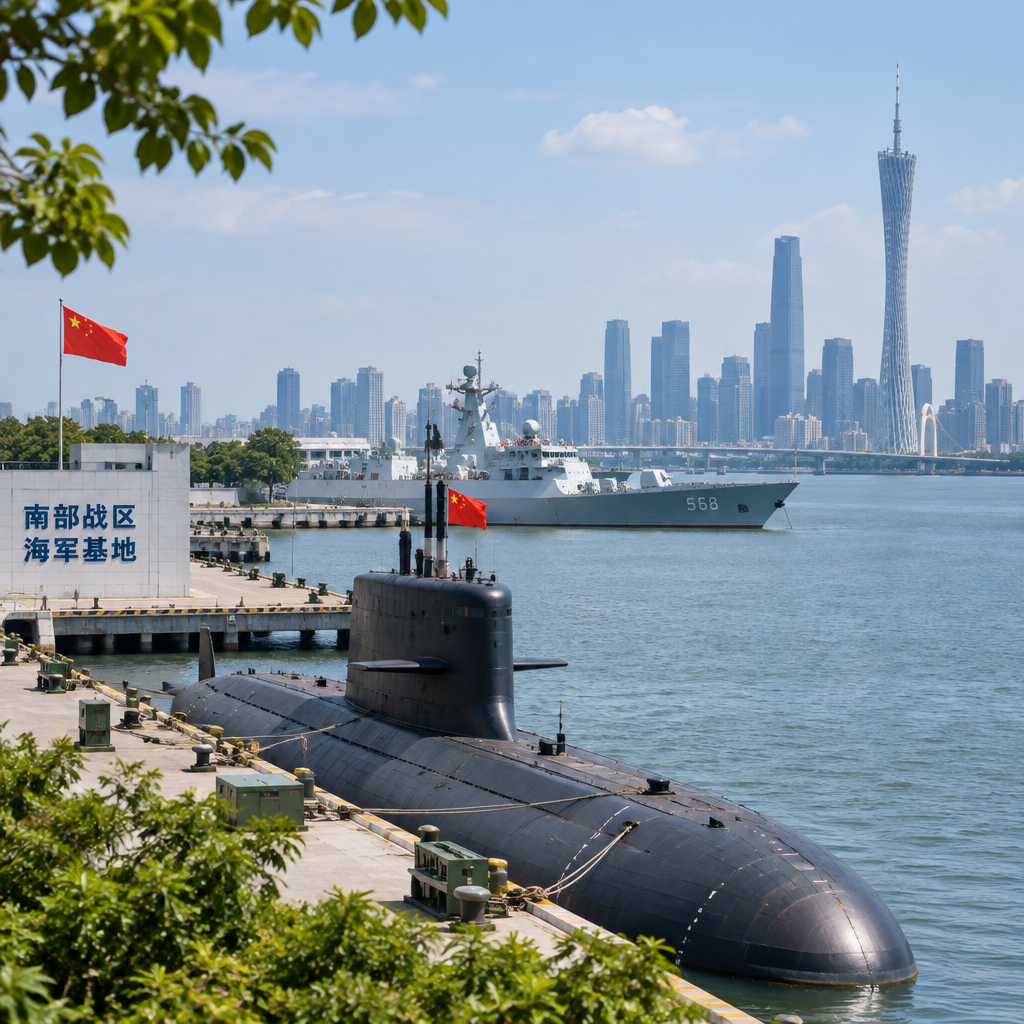
"Guangzhou-based Southern Theater Command has responsibilities extending into the South China Sea, adjacent to Australia’s primary area of military interest," an ASPI report notes.
Guangzhou-based Southern Theater Command: capability and reach
The ASPI report singles out the Southern Theater Command as the People’s Liberation Army element Australia should watch most closely in a major conflict over Taiwan. It says the command, based in Guangzhou, fields maritime and air capabilities—including submarines, surface ships and bombers—that reach into the South China Sea and down toward waters adjacent to Australia’s principal area of military interest. The report also highlights that centrally held PLA assets—missiles and cyber and space capabilities—could contribute to operations originating from or coordinated with the Southern Theater Command.
Three concrete ways the command could affect Australia
- Early long-range dissuasion or disruption: The report identifies cyber or missile attacks on infrastructure that supports Australian operations as plausible, and warns that Chinese military space capabilities could be used to disrupt command and control and complicate mustering a response from Australia.
- Threats to sea lines of communication: If United States forces, assets and logistics were to flow into Australia for follow-on operations in Taiwan, a "handful of Chinese submarines in our eastern approaches" could hamper that force flow; similarly, submarines off Australia's west coast could place vital national supply lines at risk.
- Interdiction through the northern archipelago: Southern Theater Command aircraft—bombers and refuelled fighters—together with submarines and surface combatants, could attack Australian or allied forces operating through the narrow passageways of the archipelago to Australia's north.

Audit-ready is a season. It shouldn't be.
Evidence in spreadsheets, controls drifting between audits, frameworks multiplying on flat headcount. Nubivance runs continuous compliance on Rapid7 Cyber GRC - SOC 2, HIPAA, ISO 27001, PCI, CMMC.
End the scrambleHow the Southern Theater role links to the 2026 National Defence Strategy
The report places its analysis alongside Australia’s 2026 National Defence Strategy (NDS), which "describes China as the primary driver of changes in Indo-Pacific security" and points to the Taiwan Strait as a flashpoint where miscalculation could lead to conflict. The ASPI analysis argues the NDS has "diagnosed the right problem" and that the Integrated Investment Program that sits alongside the NDS is "providing broadly the right solutions." At the same time, the report says the NDS is "understandably inexplicit" about the threats Australia needs to deter and defend against, and that clearer public discussion about what those threats might practically look like would help Australians appreciate the size, shape and cost of the capability the NDS seeks to build.
Trade, democracy and regional balance as strategic stakes
The report underscores the wider stakes it sees in a Taiwan-centred conflict. It warns that a major US–China war over Taiwan would be "particularly consequential for Australia": vital trade to and from North Asia—including with Taiwan—would be disrupted, and if China were to prevail the report says "a vibrant democracy of 23 million people would be lost and the regional balance of power would tip towards Beijing." The analysis rejects the idea that Australia and like-minded regional partners could simply ignore an invasion, likening that posture to European countries ignoring Russia’s invasion of Ukraine.
What this means for policymakers, the Australian military, and the public
- Policymakers and defence planners: The report calls for clearer, more detailed public conversations about the specific forms of threat Australia seeks to deter and how planned investments meet those threats—so budgetary choices and strategic priorities are better understood.
- The Australian Defence Force and allies: The analysis implies planners should factor Southern Theater Command capabilities—submarines, aircraft and long-range strike plus centrally held cyber, missile and space assets—into contingency planning for force flow, logistics protection, and operations through northern archipelagos.
- The Australian public and economic actors: The report argues for openness "not to cause fear, but to provide reassurance," noting Australians would face trade disruption and other effects if a Taiwan conflict escalated.
The ASPI report makes a clear, tightly argued point: while the PLA’s Eastern Theater Command has primary responsibility for Taiwan, the Southern Theater Command—by virtue of its geographic position and maritime and air weight—could directly shape outcomes that matter to Australia, from interfering with logistic flows to using cyber, missile and space tools to disrupt Australian operations. The report says Australia has identified the right problem in the NDS and put in place broadly the right investments, but urges a more detailed public framing of the threats and likely effects so Australians can better understand what the defence strategy aims to prevent or manage.