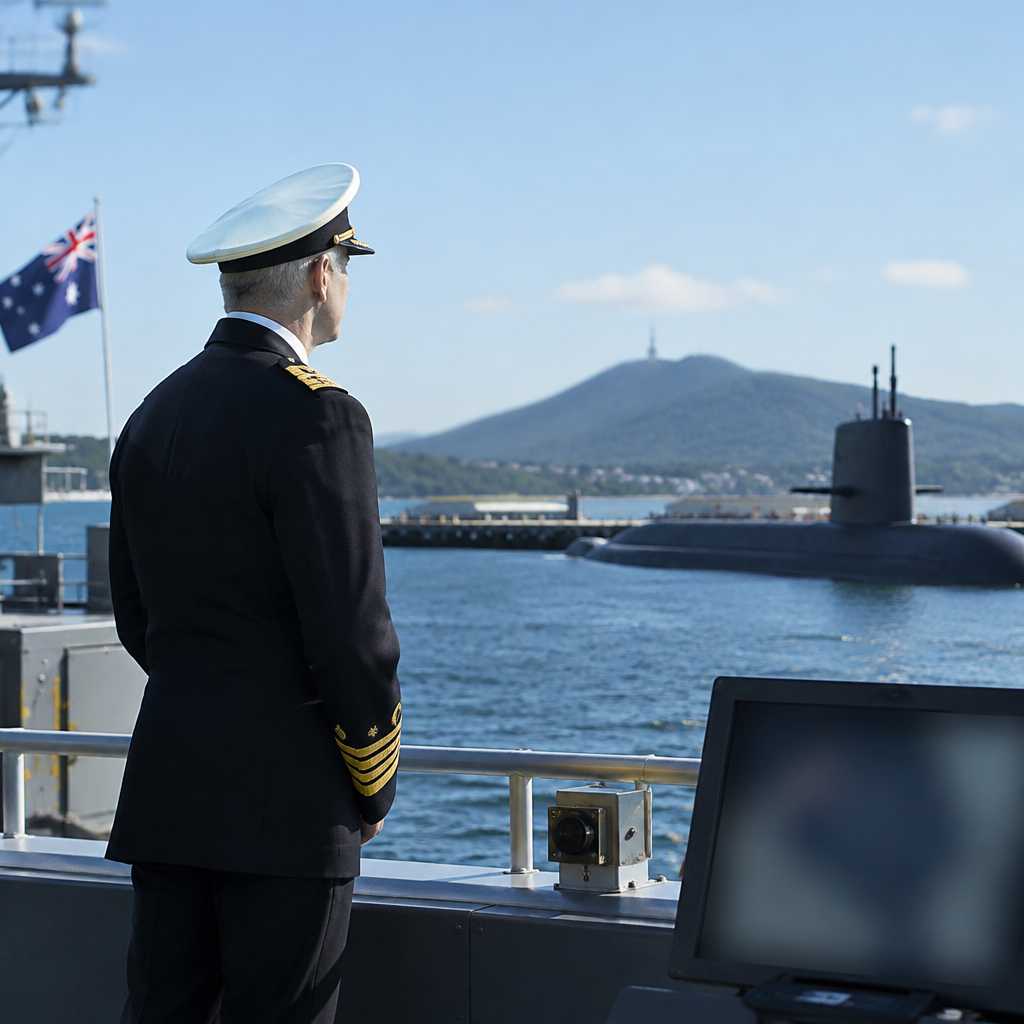
"I did not see any evidence from China ‘of global aspirations and global dominance aspirations that we’ve seen out of the United States’," said former Australian Defence Force chief Chris Barrie this week as he presented an independent-styled report on AUKUS.
Chris Barrie's AUKUS inquiry and its reception
Barrie, who led the Australian Defence Force from 1998 to 2002, co-authored the report with former environment minister Peter Garrett and used the presentation to question the submarine element of AUKUS and to call for Australia to scrap the program. The exercise was described in the public record as an independent assessment, but it drew pointed criticism over impartiality: Defence Industry Minister Pat Conroy called it “a stitch-up from day one.”
China's regional posture, as described in the analysis
The piece argues Barrie’s comparison with the United States rests on a false equivalence. It notes that the United States maintains “a worldwide network of military bases, alliances and security commitments,” and that that posture has provided a security foundation for partners. By contrast, the article describes China as following “a different path,” asserting that Beijing “seeks not partners but vassals.” It says China’s military expansion has concentrated “heavily on the western Pacific,” driven by geography, trade and territorial disputes, while its economic influence “extends much further” through investment, infrastructure and commercial relationships.

This site is the portfolio.
OSINTSights runs on Cloudflare Workers, D1, R2, and Vectorize, with an AI pipeline on Hetzner ARM. Nubivance designed, built, and operates it. We do the same for clients.
See what we buildSouth China Sea activity and coercion without conventional war
The author points to concrete examples in the South China Sea where Beijing has “spent years building and militarising artificial islands, establishing a persistent presence in waters claimed by several of its neighbours.” Chinese coast guard vessels have “repeatedly confronted Philippine ships,” the article notes, and uses those encounters to illustrate how “military and paramilitary power can change behaviour without a conventional war.” The central claim is that a state with sufficient power can steadily increase the cost of resistance until smaller neighbours begin caving in.
AUKUS, affordability, and Australia's defence choices
The analysis accepts that AUKUS is open to scrutiny. It characterises the submarine element as “expensive, technically demanding and dependent on industrial capacity in three countries,” with a timetable that “stretches across decades” while Australia’s immediate defence needs grow. Questions about affordability, delivery schedule and opportunity costs are called “entirely reasonable.” At the same time, the piece argues that China’s military modernisation — including nuclear-armed submarines — “will continue regardless of whether Australia proceeds with AUKUS” and that China’s advances “likely cannot be countered without AUKUS.”
What this means for Australia’s defence planners, Taiwan, and the Philippines
- Australia’s defence planners: The article urges accounting for dependence on US support — from weapons and spare parts to software — and planning for the possibility that such support “may not always be available when we need it.” It recommends sustained investment in domestic capabilities and industrial capacity, and closer cooperation with regional partners whose interests overlap with Australia’s.
- Taiwan: The piece says Taiwan has looked to global US military reach for reassurance because Beijing believes much of the region, “including Taiwan, is indeed its territory,” implying that Taiwan’s security calculations are shaped by China’s regional ambitions.
- The Philippines: The documented pattern of coast guard confrontations between Chinese vessels and Philippine ships demonstrates the article’s point that coercion can be enforced through persistent naval and paramilitary presence rather than open conflict.
The debate that Barrie has reignited — whether to abandon, alter or persist with AUKUS — is not simply a matter of program management. The analysis frames it as an argument about what kind of regional balance Australia intends to help sustain, and what capabilities will preserve “the capacity to make [Australia’s] own decisions.” It concludes with a blunt assessment: Beijing is acquiring the military power to shape events across the Indo‑Pacific, its willingness to use economic and military pressure is already evident, and Australia’s defence choices should be judged against that reality.