"The Saildrone Surveyor will provide persistent maritime domain awareness in strategically important waters, including the Baltic and North Seas, as well as Arctic waters, while giving customers sovereign control over their operations and data," Robert Kleist, Saildrone’s European managing director, told reporters here.
Saildrone and Umoe Mandal: who builds what
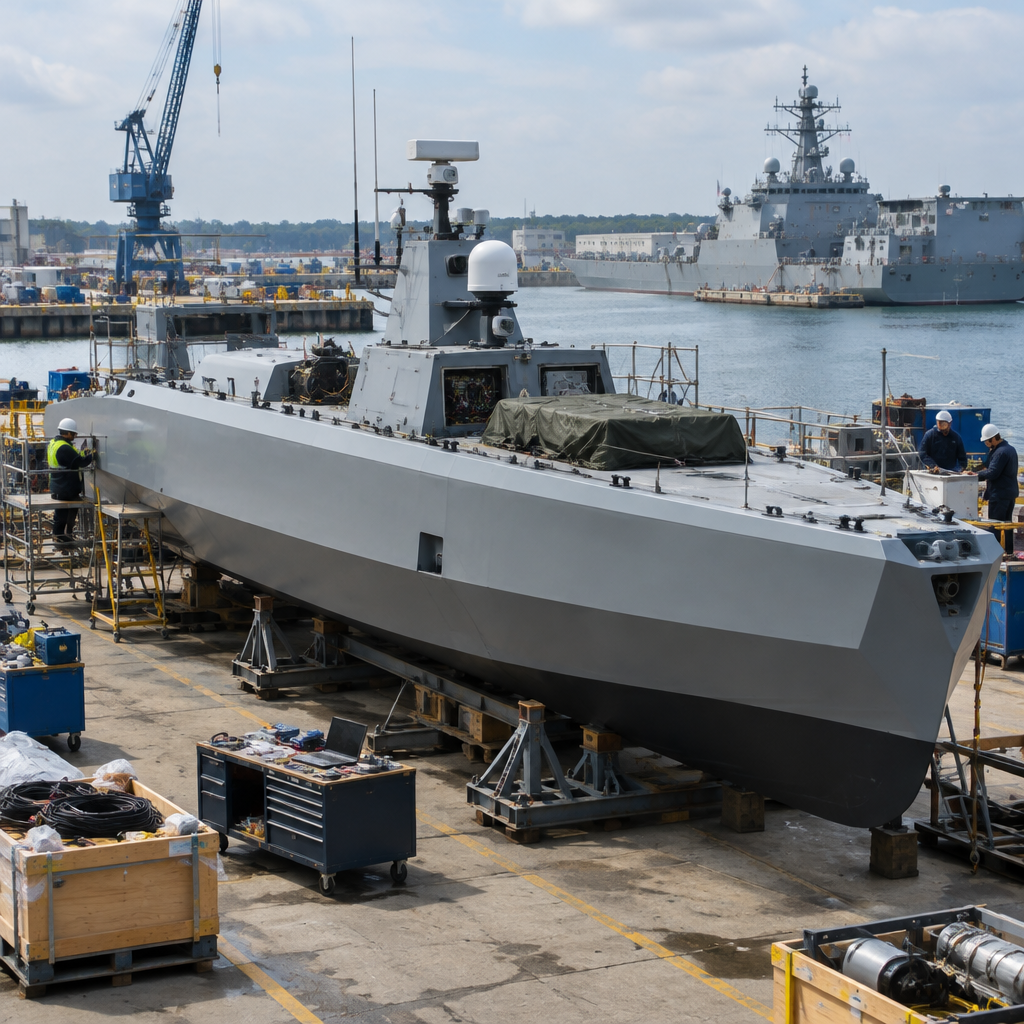
At the Euronaval defense show, Saildrone and Norwegian shipbuilder Umoe Mandal signed an agreement to produce Saildrone’s 20-meter Surveyor unmanned surface vessel (USV). Under the deal, Umoe Mandal will build the vessel — with some parts constructed in Norway — while Saildrone will supply the autonomy suite, electronics and navigation systems. The agreement formalizes a split of labor: Norwegian composite-structure expertise for hulls and masts, combined with Saildrone’s systems integration for autonomy and sensors.
Industrial scale-up: a new site and a targeted cadence
Umoe Mandal has already started building a new manufacturing site adjacent to its main plant dedicated to producing the USVs, CEO Tom Fidgeland told reporters. The company said the new facility anticipates demand even before concrete orders are in hand. Fidgeland described a baseline production capability of "two vessels a month," and said that throughput "can be expanded more than that for sure."
Umoe Mandal’s selection was attributed to its experience with composite materials — glass and carbon fiber — and the company’s existing role as a supplier, including providing the mast for the British Type-26 frigates. The move follows other recent European partnerships by Saildrone: the company opened a new headquarters in Copenhagen over the summer and in August signed an agreement with Polish firm Southern Spars to produce Surveyor’s wings in Poland.

Audit-ready is a season. It shouldn't be.
Evidence in spreadsheets, controls drifting between audits, frameworks multiplying on flat headcount. Nubivance runs continuous compliance on Rapid7 Cyber GRC - SOC 2, HIPAA, ISO 27001, PCI, CMMC.
End the scrambleNORDEFCO, Sweden’s deployment, and the surveillance-as-a-service model
Kleist pointed to Northern European countries — Denmark, Finland, Sweden and Norway — as anticipated interested parties and suggested the Nordic Defence Cooperation (NORDEFCO) framework could facilitate acquisitions. The NORDEFCO agreement allows the Nordic nations to rapidly procure different systems, including USVs, and supports a surveillance-as-a-service option in which member countries contract Saildrone to deliver maritime intelligence rather than purchase vessels outright.
The Swedish Armed Forces executed the first national deployment under NORDEFCO in October, launching a year-long maritime surveillance mission in the Baltic Sea using four Saildrone-made Voyager USVs. In that arrangement saildrones operate the vessels, which sail under the Swedish flag, while the Swedish Navy sets mission parameters and receives a continuous data stream.
Operational context: the Baltic Sea and regional security concerns
The agreement and deployments are explicitly framed around surveillance needs in the Baltic Sea, North Sea and Arctic waters. The Baltic Sea is described in the companies’ account as a key maritime area that connects many shipping routes and critical underwater infrastructure. The source notes that some countries have "vocalized increased concerns" about protecting that infrastructure amid a rise in hybrid warfare and sabotage incidents in recent months.
The story also highlights geographic access points for Russia to the Baltic Sea: Saint Petersburg and the Leningrad Oblast to the east, and the Kaliningrad exclave between Poland and Lithuania. Kleist suggested that if multiple Nordic countries adopt the same surveillance model, they would be "essentially looking at the same information," which could enable shared intelligence about Baltic Sea activities.
Security posture and the risk of seizure: Umoe Mandal’s view
When asked about the risk of Russian forces seizing a USV, Fidgeland said the companies had considered the possibility but were not worried it would happen. "We have radars, we have cameras … We can see them [Russians] miles away. If they have bad intentions, we can take nice photographs of them," he told Breaking Defense. The answer frames the vendors’ confidence in sensor suites and remote monitoring as a mitigation to physical interception in contested areas.
What this means for Nordic governments, builders, and maritime planners
- Nordic governments: The NORDEFCO pathway offers an option to contract for maritime intelligence rather than immediately buy hardware; the Swedish deployment shows the model can be executed at national scale under existing frameworks.
- Manufacturers and shipbuilders: Umoe Mandal’s early investment in a dedicated plant — and its declared ability to ramp to and beyond two Surveyors per month — signals a shift toward regionalized production capacity for USVs in Northern Europe.
- Maritime security planners: The combination of persistent sensor coverage and shared data streams under the surveillance-as-a-service model could produce more interoperable situational awareness across participating navies, but it also raises operational questions about data handling, sovereignty and risk management when operating in contested waters.
The agreement between Saildrone and Umoe Mandal links European industrial capacity to a commercially provided, remotely operated surveillance offering. It leaves open how widely the NORDEFCO model will be adopted, how production plans will match actual orders, and whether operational and data-risk calculations will hold when USVs are deployed in contested maritime theaters.