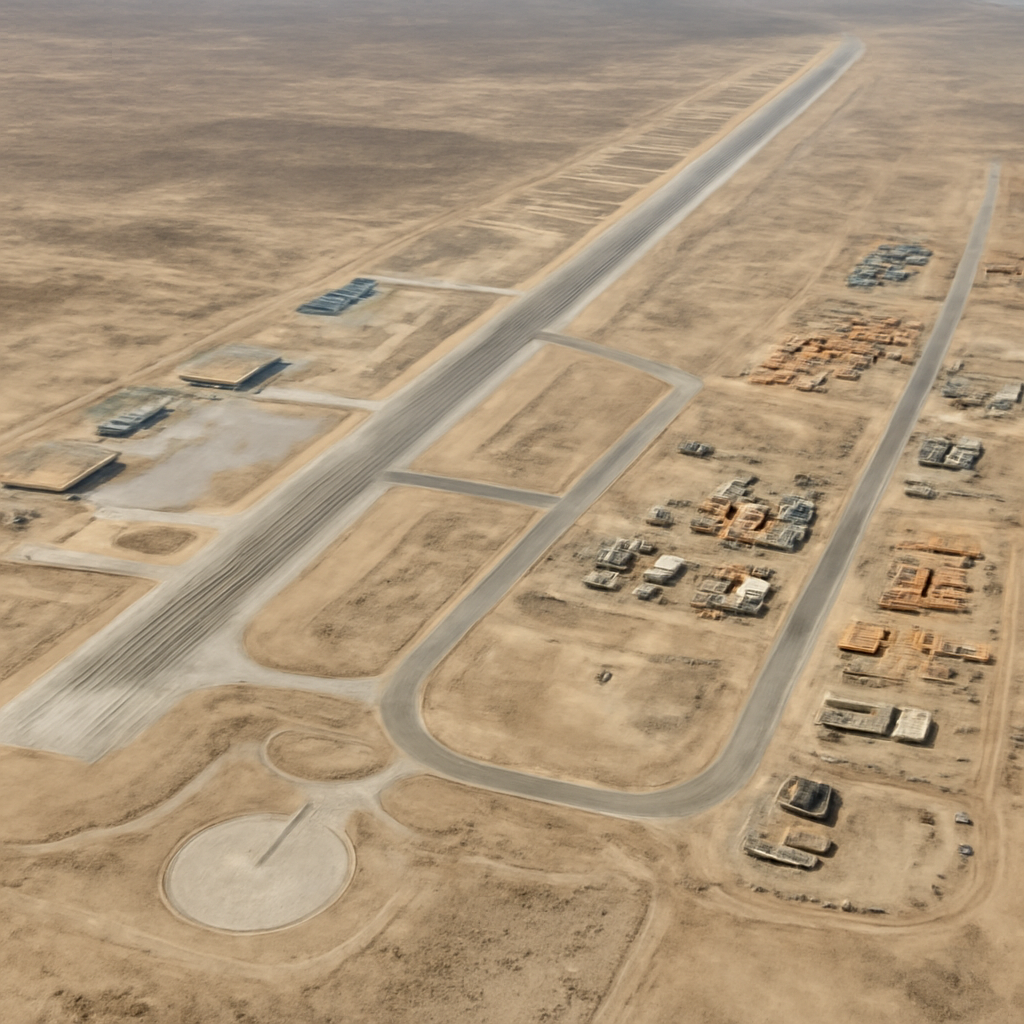
“New taxiways, aircraft turning pads, hangars and possible fuel‑storage infrastructure substantially increase the airfield’s capacity to support aircraft movements and sustained flight‑test activity,” Damien Symon told TWZ after analyzing new imagery.
Runway, apron and a fast pace: what satellite imagery shows
Planet Labs imagery from August 27, 2026, documents a rapid and widening buildout at Lop Nur Airbase in Xinjiang. The installation already boasts one of the world’s longest runways — reported at 16,400 feet (a 3.1‑mile strip in earlier imagery) — and recent months have seen construction accelerate after a marked ramp‑up beginning in May 2025. TWZ’s time‑lapse and annotated imagery show new taxiway extensions, apron expansions and multiple new structures clustered around the central ramp.
New hangars: size, placement and implied capacity
Construction includes at least three large hangars grouped on the south ramp, each measured at roughly 80 by 40 meters (262 by 131 feet), plus a fourth hangar farther south with different dimensions. The hangars’ direct access to a nearly completed southern taxiway links them to the main runway without requiring aircraft to back‑taxi. TWZ notes the hangars are sized to “accommodate all of the tactical and strategic aircraft in the PLA’s current fleet,” and that their wide proportions mirror new shelters at the Malan test base that have been built to host very large flying‑wing drones.

Audit-ready is a season. It shouldn't be.
Evidence in spreadsheets, controls drifting between audits, frameworks multiplying on flat headcount. Nubivance runs continuous compliance on Rapid7 Cyber GRC - SOC 2, HIPAA, ISO 27001, PCI, CMMC.
End the scrambleSupport infrastructure: fuel, batching plant, accommodation and engine run pad
Imagery shows a concrete batching plant on the facility’s eastern outskirts, complete with wash‑water ponds and segregated aggregate stockpiles, indicating on‑site sourcing of construction materials. A cluster of prefabricated containers arranged in tight rows has appeared behind the central apron, consistent with storage, accommodation or staging for a larger construction workforce. Damien Symon identified possible fuel‑storage infrastructure under construction — imagery shows three likely storage tanks — which TWZ reports could “support a higher sortie rate and longer periods of sustained flight activity.”
At the northern end of the runway a circular pad roughly 400 feet in diameter has taken shape with direct access to the runway and main base; TWZ assesses this feature as an engine‑run and turnaround pad. The report notes that, if a shelter were added, the pad “could also act as a ‘scoot and hide’ area for keeping sensitive test articles from being seen by satellites passing overhead.”
Aircraft and programs observed or linked to the site
TWZ first detected signs of expanded testing at Lop Nur in 2020, when the site was little more than the long runway, a small hangar and a few vehicles. Since 2023 the apron was expanded and a new large hangar added; in 2025 more hangars were added on both sides of the ramp. TWZ reports that both of China’s sixth‑generation stealth fighter designs, the J‑36 and the J‑XDS, were spotted at Lop Nur for the first time last year, far from the home airfields of their manufacturers, Chengdu and Shenyang.
The buildout follows earlier use of the site for military space development and reusable spaceplane testing as far back as 2020. The report contrasts Lop Nur’s growing focus on crewed platforms with Malan’s emphasis on unmanned systems; Malan has hosted two massive stealth flying‑wing drones, one reportedly as large as a B‑2, and other high‑performance unmanned combat air vehicles. TWZ also notes the H‑20 stealth bomber has not made a public appearance and that it remains unclear where its testing will be conducted, while adding that “Lop Nur would be an ideal locale” for sensitive programs — a point TWZ frames as speculation.
What this means for the PLA flight‑test programs, Chengdu and Shenyang, and international observers
- PLA flight‑test programs: The expanded taxiways, multiple large hangars and potential fuel storage suggest Lop Nur is being readied to support higher sortie rates and longer, sustained test campaigns, including for larger or wider wingspan airframes.
- Chengdu and Shenyang (aircraft manufacturers): The appearance of the J‑36 and J‑XDS at Lop Nur — distant from their manufacturers’ homefields — indicates the base is being used as a major, centralized flight‑test hub for next‑generation crewed fighters.
- International observers and analysts: New imagery of prefabricated accommodation, a batching plant and engine‑run infrastructure signals both rapid construction capacity and an intent to sustain long‑term testing operations at a remote, securable location near Lop Nur Nuclear Test Base.
The pattern is clear in the satellite record: what began as an austere long strip has been transformed into a sprawling test center with tailored hangars, multiple taxiways, staging facilities and logistical infrastructure. TWZ and its imagery partners document not just isolated additions but a coordinated expansion that supports higher operational tempo and the accommodation of larger, potentially more sensitive aircraft. Whether those new hangars will host the H‑20 or other classified programs remains an open, closely watched question; for now, the physical footprint at Lop Nur continues to grow.
Source: TWZ — Massive Expansion At China’s ‘Area 51’ (Planet Labs imagery, Aug. 27, 2026)