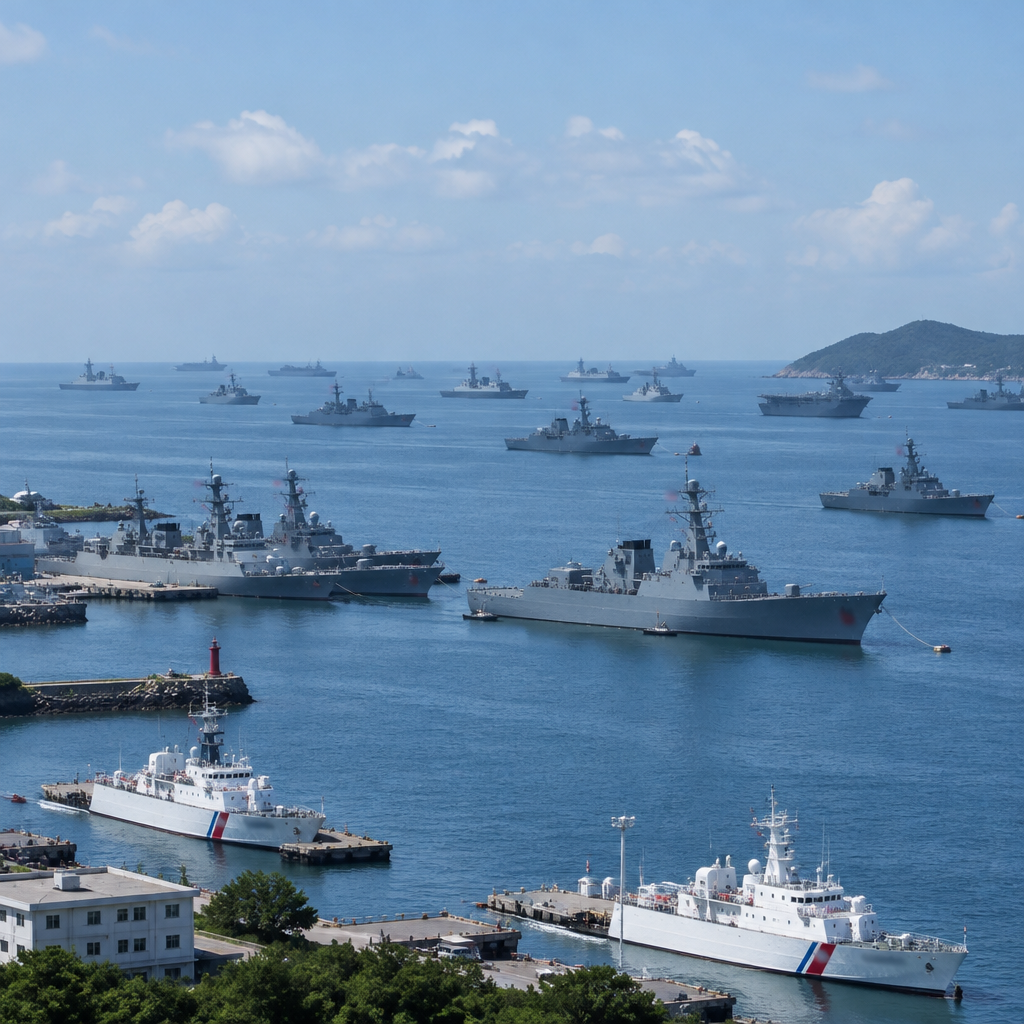
“More than 100 ships deployed across that arc,” Joseph Wu, secretary‑general of Taiwan’s national security council, reported on 3 November — an at‑a‑glance measure of a Chinese naval operation that stretched from Hainan into the Pacific and back toward the Yellow Sea.
China’s naval mobilisation around Taiwan
According to Taiwan’s national security council, China’s navy and coast guard had over 100 ships operating along an arc from the southern tip of Hainan, through the South China Sea and out into the Pacific, roughly halfway to Guam, then north past Okinawa and back toward the Yellow Sea. The deployed forces included surface task groups from the PLA Eastern, Northern and Southern Theater Commands, among them the Liaoning carrier strike group; China’s newest carrier, the Fujian, was also active in the South China Sea. At least four of China’s 10 Type 055 destroyers were present. The report notes that three task groups and the Liaoning were east of Taiwan.
ASPI observed that such coordinated cross‑theater surface operations beyond the first island chain remain a relative novelty for China’s carriers; carrier operations beyond that chain began only a few years ago. The deployment proceeded without an official exercise announcement, mirroring a pattern since June in which Chinese coast guard and civilian agency patrols east of Taiwan have been regularised rather than formally declared as drills.
US Marine rotational force shifts to sustained presence in the Philippines
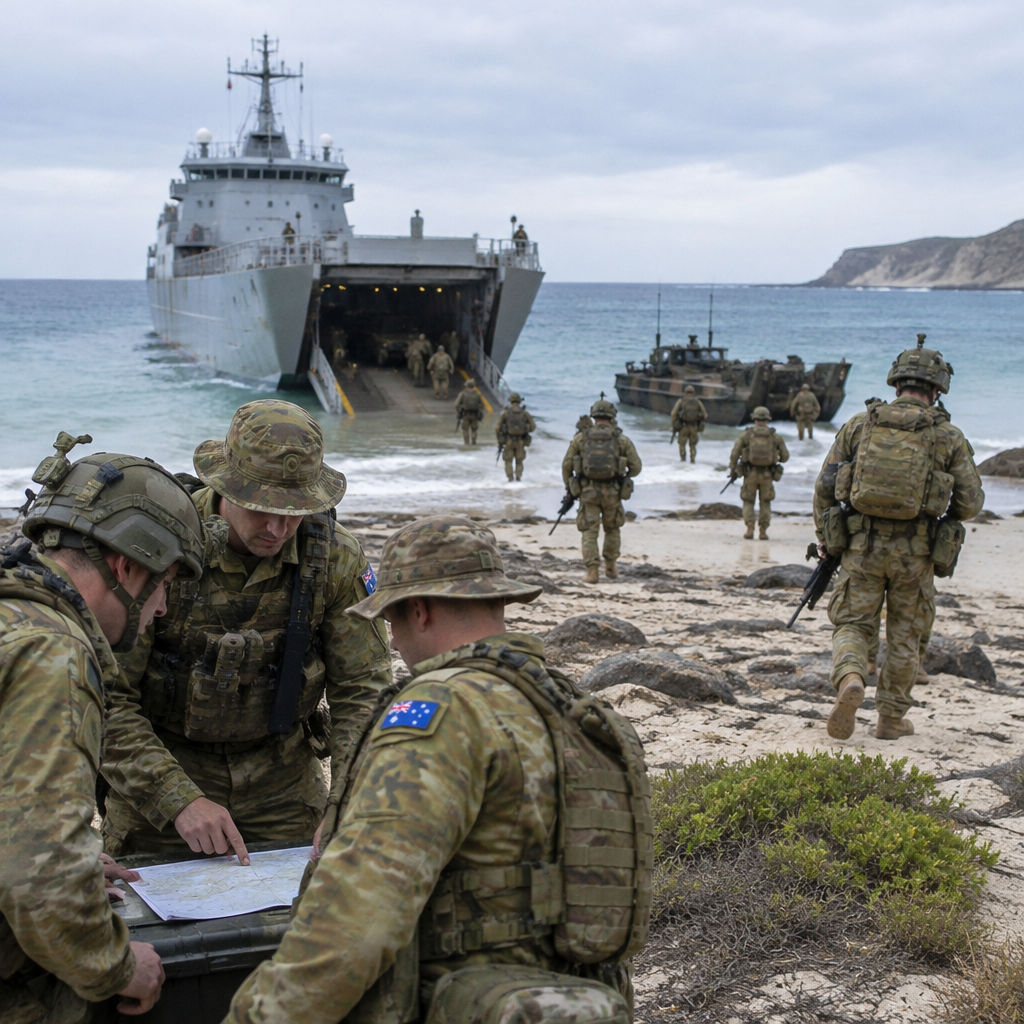
Marine Rotational Force – Southeast Asia (MRF‑SEA), established in 2022 as a six‑month, scalable task force, has moved to a more continuous posture in the Philippines. Since April 2026 successive rotations have kept a continuous command presence in the country; one rotation led a “focused effort” by Manila’s invitation and participated in Balikatan 2026. A command‑element handover at Clark Air Base on or around 26 October indicates the US and the Philippines intend to sustain that presence “certainly through Balikatan 2027.” Combined exercises across the archipelago have emphasised land‑based maritime strike operations and training in sensor‑to‑shooter links.

This site is the portfolio.
OSINTSights runs on Cloudflare Workers, D1, R2, and Vectorize, with an AI pipeline on Hetzner ARM. Nubivance designed, built, and operates it. We do the same for clients.
See what we buildPhilippine BrahMos purchases and the targeting imperative
The Philippines was the first foreign buyer of India’s BrahMos cruise missile in 2022. As of 5 November it was in talks with Delhi to acquire another five batteries and 60 missiles. ASPI summarised BrahMos’s appeal: the export model travels at about Mach 3, weighs roughly 3 tonnes and carries a 300‑kilogram warhead; the export range is limited to 290 kilometres — sufficient to reach most Philippine‑claimed features in the South China Sea from the coastline, including Second Thomas Shoal, Sabina Shoal and Scarborough Shoal.
But ASPI stresses that missiles require a targeting enterprise — sensors, communications, procedures and command structures — to turn capability into effect. The Philippines had no prior experience operating coastal anti‑ship missiles before the BrahMos purchase four years ago and has been building these systems and processes rapidly. MRF‑SEA trained with Philippine forces in August on using drones to track simulated PLA Navy ships and relay targeting data to BrahMos operators.
Taipei withdraws from Port Moresby; LNG and diplomatic fallout
After months of pressure from Papua New Guinea, Taipei agreed on 6 November to “close the office, withdraw all stationed personnel, and conduct a full review and adjustment of bilateral ties.” The foreign ministry in Taipei framed the move as evidence of “China’s continued use of political pressure and economic influence to interfere in the diplomatic decisions of other nations and suppress Taiwan’s international participation.” Taipei also made permanent a temporary ban on open‑market LNG purchases from PNG and ceased all foreign aid to Port Moresby, though its long‑term contract to import 1.2 million tonnes of LNG annually until 2030 remains in place.
Taiwan had purchased about 500,000 tonnes of PNG LNG on the open market in the first half of the year, at a value of roughly A$800 million; those open‑market purchases have now been halted permanently. Taiwan buys about one‑third of PNG’s LNG exports, which in turn represent about 8 percent of Taiwan’s LNG imports. PNG’s foreign minister, Justin Tkatchenko, had announced in July that Taiwan’s local economic office was “not recognised or required” and sought its closure to “take PNG’s relationship with China ‘to unprecedented levels’,” a move praised by China’s foreign minister, Wang Yi.
Separately, PNG police reported that an undetonated 130mm Chinese Type 59 artillery projectile was found in a commercial shipping container in Port Moresby; four Chinese nationals were arrested on 30 October and the investigation is ongoing. The Chinese embassy in Port Moresby said it was “virtually impossible for an illegal military‑grade artillery shell to be smuggled out of China to PNG.”
The Squad’s Combined Coordination Center and South Korea’s Cheonghae proposal
On the sidelines of the ASEAN Defence Ministers’ Meeting‑Plus, the informal four‑way grouping of Australia, Japan, the Philippines and the US — sometimes called the Squad — issued a terse statement committing to establish a Combined Coordination Center in the Philippines to support an expanded program of multinational exercises. The centre began in 2024 as a bilateral project and will now bring in other partners; the four countries also said they would aim to “synchronize defense investments to support the Philippines in defending its archipelago.” No implementation details have yet been released.
Separately, President Lee Jae‑myung’s cabinet approved on 10 November a proposal to expand the mandate of South Korea’s Cheonghae Unit — a rotating naval detachment stationed in the Gulf of Aden since 2009. The change would nearly double the unit’s authorised operating area eastward into international waters south of Oman, within 650 kilometres of the Strait of Hormuz, and would add a P‑8A maritime patrol aircraft and explosive ordnance disposal specialists. The proposal has not yet passed the National Assembly; Seoul has emphasised the expanded mission would remain under South Korean command.
How Manila, Taipei and Port Moresby are responding
- Manila: Continuing to acquire anti‑ship missiles and deepen combined training with MRF‑SEA; pursuing sensor‑to‑shooter integration through exercises that used drones to feed targeting data to BrahMos operators.
- Taipei: Turning to diplomatic retrenchment with Port Moresby — closing its office, withdrawing personnel, halting open‑market LNG purchases from PNG, and suspending foreign aid while maintaining its long‑term LNG contract through 2030.
- Port Moresby: Proceeding with the diplomatic shift toward China and investigating the discovery of an undetonated artillery projectile in a shipping container, following arrests on 30 October.
China’s recent deployment, the Philippines’ rapid build‑out of anti‑ship strike capabilities, and Taipei’s diplomatic rupture with Port Moresby together demonstrate how maritime strategy, arms procurement and diplomatic leverage are now tightly interlinked in the region. The coming year — marked on the calendar by Balikatan 2027 and by unresolved decisions such as South Korea’s National Assembly vote on Cheonghae’s mandate — will test how those links reshape exercises, forward presences and energy flows.
https://www.aspistrategist.org.au/fault-lines-chinas-navy-mobilises-marines-in-manila-pngs-lng/