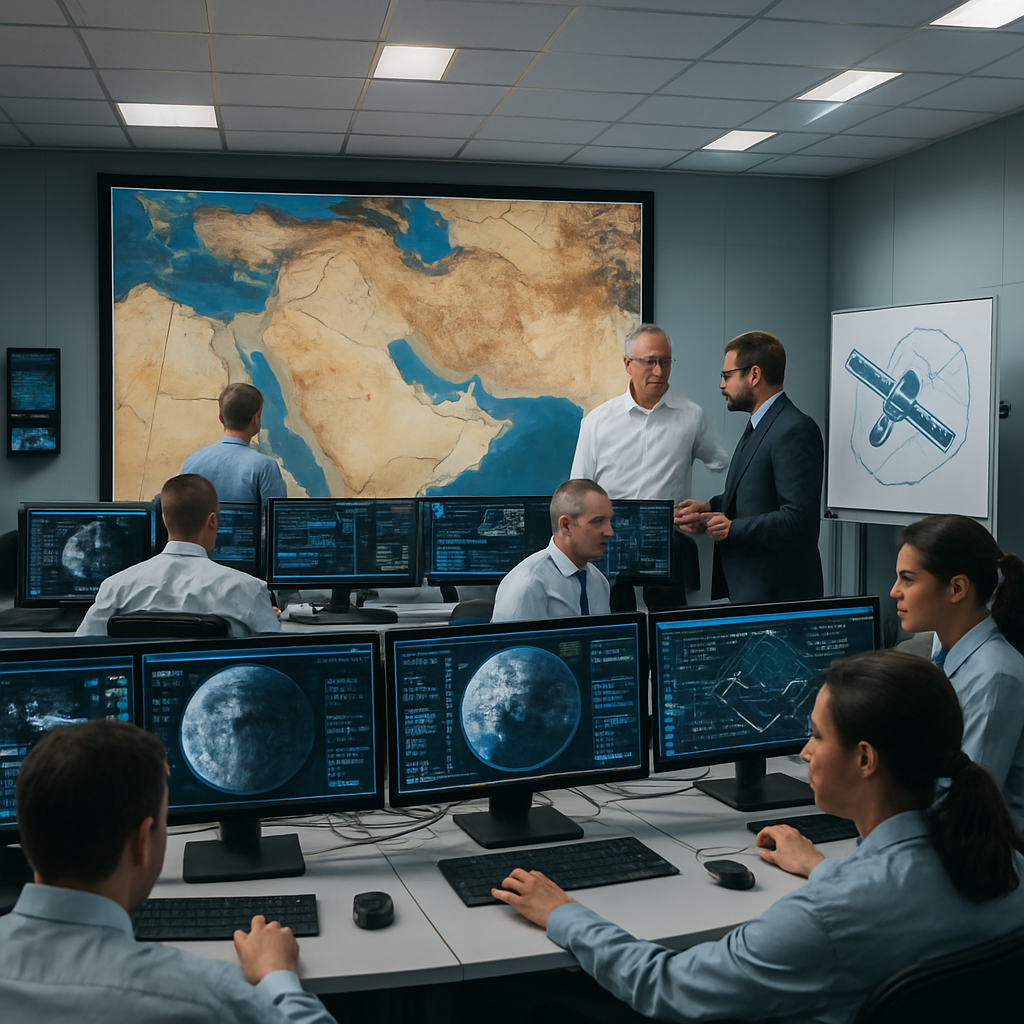
On 15 April the Financial Times reported that China had given Iran a commercial reconnaissance satellite, a transfer that, the newspaper said, provided Tehran with the "precise targeting information" to strike US military facilities in the Middle East.
Financial Times: TEE‑01B, Earth Eye Co and Emposat
The Financial Times report named a Chinese company, Earth Eye Co, as the builder and launcher of the TEE‑01B satellite and said Earth Eye provided "in‑orbit delivery" to Iran. The same report identified another Chinese company, Emposat, as a supplier of satellite data and control services to Tehran. According to the Financial Times account cited in the source material, those services supplied Iran with the commercial reconnaissance imagery and operational control that enabled more accurate targeting of US military sites.
MizarVision: published imagery and tagging of US facilities
Separate reporting referenced a Chinese geospatial AI and software company, MizarVision, which the sources say published satellite imagery with tagging data on several US military facilities both prior to and during the conflict. The reporting ties that published imagery and metadata to Iran’s ability to identify and potentially target specific installations.

This site is the portfolio.
OSINTSights runs on Cloudflare Workers, D1, R2, and Vectorize, with an AI pipeline on Hetzner ARM. Nubivance designed, built, and operates it. We do the same for clients.
See what we buildCNN: shoulder‑fired air‑defence missiles and transshipment
On 12 April CNN reported that China was preparing to provide Iran with new air‑defence systems described as shoulder‑fired anti‑aircraft missiles. CNN’s reporting characterized these as relatively short‑range systems that pose a serious danger to helicopters and low‑flying combat aircraft, and said China was shipping the weapons through third countries to conceal their origin. The source material notes China has denied CNN’s report. The piece also invoked the US‑built Stinger as an illustrative precedent, saying earlier versions of such weapons were credited with playing a major role in the late 1980s conflict in Afghanistan.
Sodium perchlorate shipments: Telegraph and Wall Street Journal reporting
Multiple reports have alleged transfers of chemical precursors linked to solid‑fuel rocket propellant. A 3 April Telegraph report, cited in the source material, said four sanctioned vessels were at Iranian ports with a fifth waiting offshore after sailing from China’s Zhuhai Gaolan port carrying sodium perchlorate — a precursor for solid‑fuel rocket propellant. That report said the quantity could be enough for hundreds of ballistic missiles and that the five ships reportedly belong to the Iran Shipping Line Group, itself under sanctions by the US, Britain and the European Union.
The Wall Street Journal — in reporting dated 2025 and referenced in the source material — similarly reported transfers of sodium perchlorate, identifying two Iranian ships loaded with around 1,000 tons of the chemical, which the Journal said would be enough for roughly 260 mid‑range Iranian missiles.
Reuters: CM‑302 anti‑ship cruise missile deal reportedly close
Reuters reported in late February, according to the source material, that Iran and China were close to finalising a deal for Chinese‑built CM‑302 anti‑ship cruise missiles for Tehran. The reporting described the CM‑302 as an export variant of the YJ‑12 missile with a range of about 290 km. The source material also records additional, more general reporting that China has provided assistance to Iran’s drone and other weapons programs, improving Iran’s combat power.
What this means for the US military, Iranian forces, and intelligence analysts
- US military and policymakers — If the reported transfers are accurate, they represent a suite of capabilities that can increase Iran’s reach and precision: satellite reconnaissance and data services, propulsion precursors for solid rockets, anti‑ship and short‑range air‑defence weapons. Those combinations of sensors, ordnance and logistics could complicate force protection and basing decisions.
- Iranian forces — The reports portray Iranian forces receiving a range of materiel and services that stretch from targeting data to propellant and missile airframes. The Telegraph and Wall Street Journal accounts, if accurate, point to quantities of sodium perchlorate described as sufficient for hundreds of ballistic missiles or roughly 260 mid‑range missiles, which would materially affect sustainment of missile operations.
- Intelligence and technical analysts — The reporting names companies (Earth Eye Co, Emposat, MizarVision) and a satellite (TEE‑01B) that intelligence analysts will likely examine for chains of custody, launch records, orbital control authorities and imagery provenance. CNN’s allegation of transshipment through third countries, and China’s denial, highlight the technical and diplomatic challenges of attributing supply chains in real time.
The cumulative picture drawn by these reports is stark: multiple news outlets identify a pattern of transfers — satellites and imagery services, missile‑fuel precursors in large tonnages, air‑defence systems, and a potential anti‑ship missile sale — that together span sensing, strike and sustainment. The source material also links those transfers to a broader strategic motive, saying China, along with Russia and Iran, has an interest in undermining the United States and the US‑led international order. China has denied at least one of the specific arms‑transfer reports, while other outlets have published named corporate actors, ship manifests and tonnages that are verifiable elements in the public record.
The reporting leaves a clear, consequential question in plain terms: if the named transfers occurred as described — TEE‑01B’s delivery, Emposat and MizarVision’s data services, the sodium perchlorate shipments, the CM‑302 deal and the reported air‑defence shipments — then Beijing’s role moves beyond rhetorical calls for neutrality and into the realm of a materially invested party in the conflict. The original reporting is available here: https://www.aspistrategist.org.au/helping-iran-china-is-a-party-in-the-war/