"Ocean-temperature modelling is useful for climate understanding, but ‘it’s also great if you’re a submariner,’" Australian Director‑General of Security Mike Burgess warned in 2021 — a line that, in the years since, has been echoed by developments across the Indo‑Pacific oceanographic research enterprise.
Argo: an international ocean‑observation network with dual uses
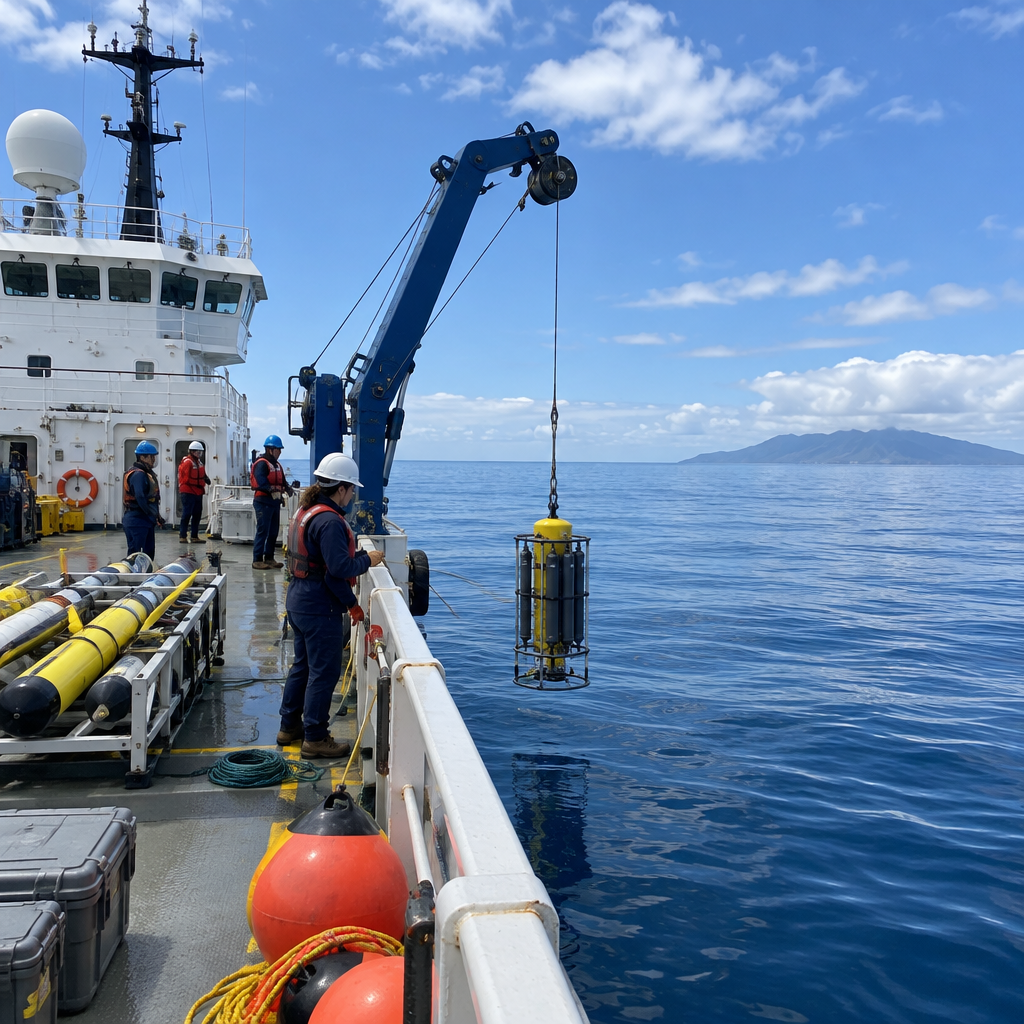
Argo, established around 1998 and built on the World Ocean Circulation Experiment, is supported by roughly 30 countries including Australia, the United States, France and Britain. It operates thousands of autonomous floats that measure ocean temperature, salinity and pressure. Standard Argo floats profile the upper 2,000 metres of the ocean; Deep Argo floats can reach down to 6,000 metres. The physical conditions these instruments record — temperature, salinity and pressure — directly influence how sound travels underwater, which in turn affects submarine concealment and sonar performance.
China’s engagement with Argo and early military links
China joined Argo in 2001. Within a year, its membership showed clear military interest: Argo’s 2002 coordination group included representatives of the PLA General Staff, naval navigation authorities and the Ministry of State Security. Official Chinese documents now acknowledge the dual utility of the data. The 2024 annual report of the China Argo office (called a station) states that the country’s Argo observation network “has civilian and military uses.”

The cyber insurance questionnaire just landed. Now what?
SOC 2, HIPAA, insurance renewals - someone has to own security strategy. Nubivance provides fractional CISO leadership without the full-time salary.
Get a security leadHow Chinese research converts public observations into military‑relevant products
Chinese institutions have moved from data collection to producing operational products. The National University of Defence Technology and Shanghai Ocean University jointly developed a high‑resolution, day‑by‑day three‑dimensional map of temperature, salinity and sound speed in the western Pacific, built to 2,000 metres and covering areas around Taiwan. A user manual hosted on China’s Argo website explains how machine‑learning methods combine international Argo observations, satellite observations and other data to generate the map. Chinese civil‑military joint studies then use that map to support modelling of underwater sound and operational simulations; a related preprint under review explicitly identifies military oceanography as an application.
Deep Argo, Chinese Xuanwu floats and adapted platforms
China first deployed a Deep Argo float in the Southern Ocean in 2017 using a French‑made instrument, and since has moved to replace Western‑supplied floats with domestic models. China’s 2026 national report for Argo documents increased deployments of Chinese Xuanwu 6,000‑metre deep‑sea floats in 2025 and plans to add 50 more each year until 2030. In 2026, China launched Xuanwu floats owned by Laoshan Laboratory from the polar vessel Xuelong 2 and from Dong Fang Hong 3 and Kexue. Reuters, cited in the reporting, places Dong Fang Hong 3 within a broader Chinese mapping and sensor campaign that naval experts assess could support Chinese submarine warfare.
Beyond passive measurement, Chinese researchers have adapted float technology into listening platforms. A 2021 study by the PLA Navy Submarine Academy and a Qingdao laboratory described experimental floats fitted with BeiDou satellite antennas and underwater microphones capable of estimating sound bearing; trials in the South China Sea in August 2019 detected a surface vessel at 13.8 km and estimated its direction.
What this means for the Australian government, AUKUS partners, and CSIRO, ANU and UQ
- Australian government and the foreign affairs minister: The source recommends an urgent AUKUS‑wide audit of oceanographic research partnerships involving Chinese institutions, examining funding, military affiliations, access to sensitive technologies, research end‑users and data‑sharing arrangements. The foreign affairs minister holds the power to terminate foreign arrangements against the national interest; in August two science‑related agreements with Chinese institutions — one by the Australian National University and another by the University of Queensland — were terminated.
- AUKUS partners and defence agencies: The reporting urges Australia to lead an audit across AUKUS to identify scientific cooperation that could be strengthening China’s undersea military and intelligence capabilities. It also notes that defence involvement in Argo is not unique to China — defence agencies in Australia, the US, Britain and France also participate in ocean research.
- CSIRO, research universities and oceanographers: Institutional partnerships can carry dual‑use risk. The Commonwealth Scientific and Industrial Research Organisation (CSIRO) set up a Hobart‑based oceans research partnership in 2017 with Qingdao National Laboratory for Marine Science and Technology; CSIRO chose not to renew that partnership beyond June 2022, months after Burgess’s warning.
Conclusion: audit, preserve access, and focus on transparency
The facts set out in Chinese reports and linked studies show a clear pipeline: international Argo observations can be combined, processed and turned into maps and models that support submarine concealment and sonar planning. China’s documented routing of global Argo observations through institutions tied to Unit 61741 and lectures at the Dalian Naval Academy, together with domestic Deep Argo deployments and experimental listening floats, underline the dual‑use reality Burgess warned about.
The source’s prescription is twofold: scrutinise institutional cooperation to curb opaque transfers of expertise and technology, and preserve AUKUS access to Argo’s public scientific stream — especially while partners such as the United States reportedly consider funding changes that could shift influence within the system. As the source puts it bluntly: Australia should not be “paying for the capability of our strategic adversary.”