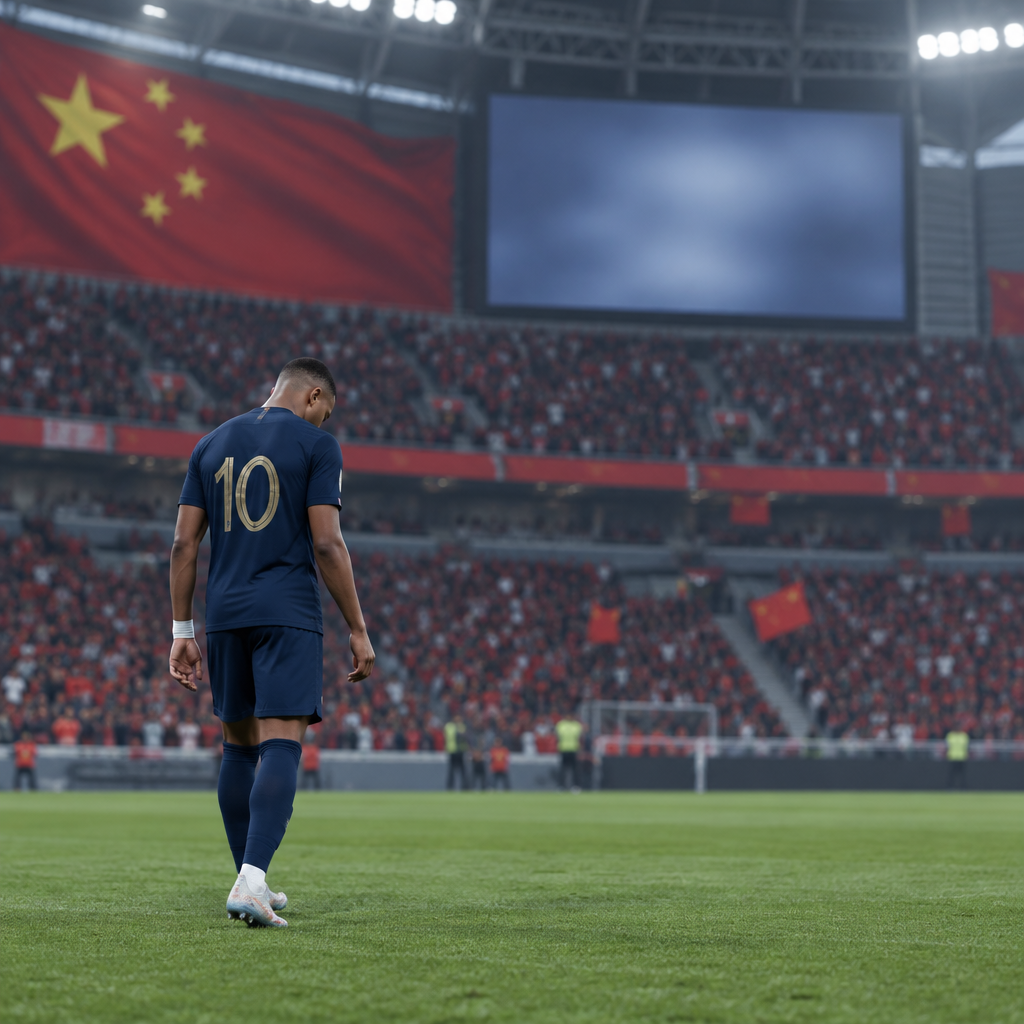
"there's also a part that's a little less funny, because we know the damage that people like that have caused throughout history," Kylian Mbappé said on 26 October, referring to memes that photoshopped his face onto a caricature of "some guy — I think he's a Chinese dictator."
Kylian Mbappé's comment and the apology that followed
In a widely circulated interview published on 26 October, the Real Madrid forward made an offhand comparison between online caricatures of himself and a figure he identified as "a Chinese dictator," invoking Mao Zedong by implication. Mbappé added, "Being compared to people who murder others, or who have made millions and millions of people miserable ... I don't think I've done that in my life." Facing immediate backlash, the player "formally apologised yesterday for hurting 'many people in China and in Chinese communities around the world,'" language the source argues appears to have been negotiated with the Chinese Communist Party because it conflates criticism of the party with criticism of the Chinese people and included a Chinese translation.
Chinese government, broadcasters and companies responded swiftly
The reaction came from multiple directions inside China. A Chinese foreign ministry spokesperson said Mbappé's "remarks and deeds … hurt Chinese people’s feelings." State television suspended broadcasts of LaLiga's Spanish league matches. Major Chinese commercial partners moved quickly: beverage firm Dongpeng said it was terminating all cooperation with Mbappé, and dairy brands Mengniu and Milkground also said they were cutting ties.

The cyber insurance questionnaire just landed. Now what?
SOC 2, HIPAA, insurance renewals - someone has to own security strategy. Nubivance provides fractional CISO leadership without the full-time salary.
Get a security leadReal Madrid, LaLiga and Javier Tebas sought to defuse the dispute
Western football institutions and clubs issued apologies and entered negotiations. LaLiga and its president, Javier Tebas, apologised; Real Madrid added its own apology. The paper reports that negotiations continued as Tebas met China's ambassador to Spain to "seek solutions," a diplomatic step intended to restore commercial and broadcast relations.
Precedent: a pattern of financial pressure on global sporting figures
The episode joins a string of prior incidents in which the source says China used economic leverage to shape international commentary and behaviour. The source lists several examples: in 2019 Houston Rockets general manager Daryl Morey's tweet supporting Hong Kong protests led to China suspending NBA sponsorship; Arsenal midfielder Mesut Özil's criticism of China's policies toward Uyghurs coincided with suspension of broadcasts of Arsenal games; Celtics basketballer Enes Kanter advocated Tibetan independence and called Xi Jinping a dictator in 2021; and Lionel Messi was perceived to have insulted China by failing to play in Hong Kong in 2024. The author frames these events as evidence that "China uses its massive financial power to ensure that commentary on China by global sporting figures is in accord with the China story required by the CCP."
What this means for policymakers, clubs, and companies
- Policymakers and regulators: The source argues that democratic governments should work with major sporting codes to sign agreements preventing foreign-government-driven responses that force apologies or business concessions. The author invokes the sports boycotts of South Africa under apartheid as a historical model for collective action.
- Sporting clubs and league leadership (Real Madrid, LaLiga): Faced with market losses and suspended broadcasts, clubs have already apologised and entered diplomatic discussions — for example, Javier Tebas's meeting with China's ambassador to Spain to "seek solutions." The source cautions that such capitulations risk encouraging further demands.
- Commercial partners and brands (Dongpeng, Mengniu, Milkground): Chinese sponsors moved immediately to cut ties, illustrating how commercial relationships are a channel for enforcing Beijing's sensitivities on global figures.
The author concludes that the episode is at once pragmatic and political: pragmatic because the engine is money — "the reason for the apology is not that anyone actually thinks Mao was not a dictator. It is money" — and political because the comments touched "the very heart of the system" by challenging the legitimacy of the party's founder. The source warns that when clubs and companies apologise to recover market access, they are not merely protecting revenue; they are, in the author's words, "selling more than their products" and "letting China censor us and control our freedoms." Whether democratic governments and major sporting codes will take the preventive steps the author recommends remains an open, concrete question following this week's events.