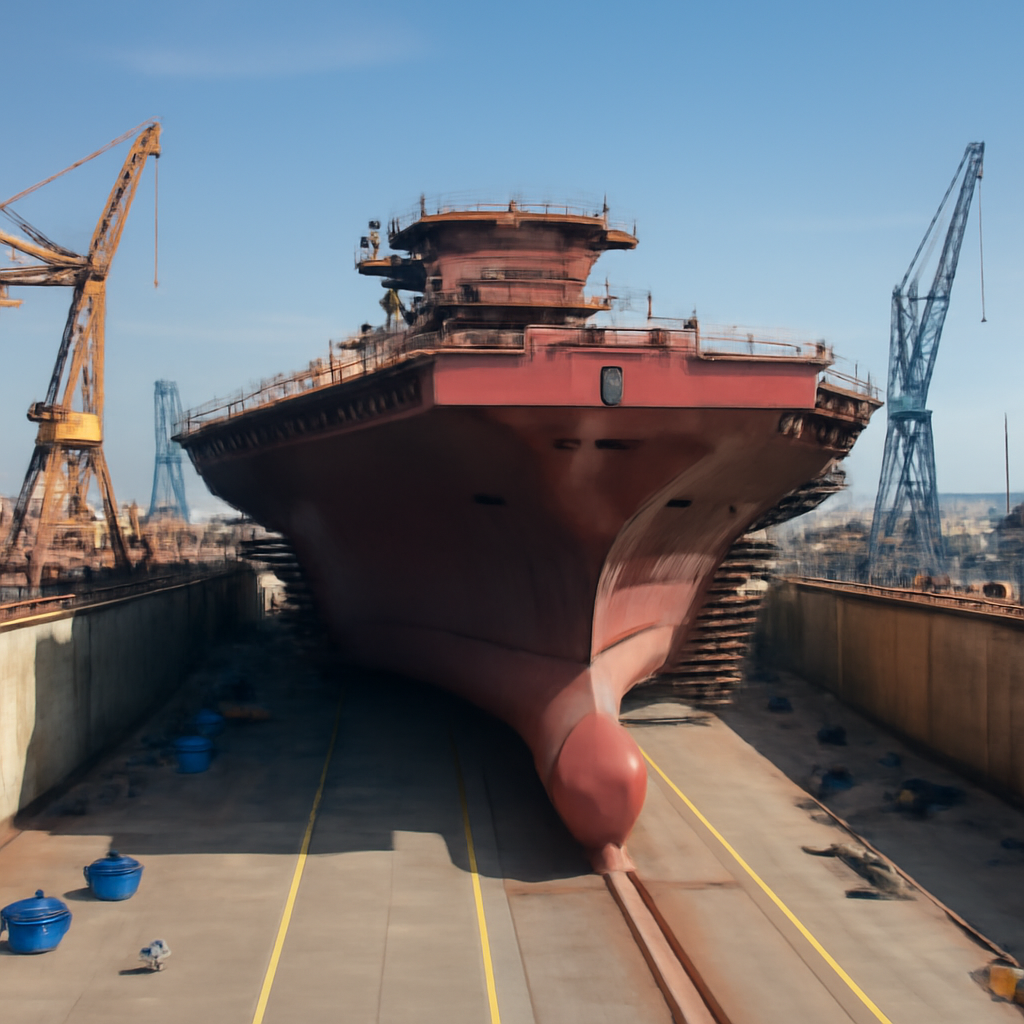
"The current length of the Type 004’s hull now appears to be around 1,050 feet (320 meters)." That measurement, obtained from recent satellite imagery, is the clearest single indicator yet that China’s fourth aircraft carrier is moving beyond early fabrication toward a full-sized hull.
Dalian Shipyard: same dry dock, accelerating assembly
Satellite imagery taken on August 21, 2026 and reviewed by TWZ shows the Type 004 under construction at Dalian Shipyard in Liaoning province. The vessel has been worked on there since at least 2024 and occupies the same dry dock where China completed its first carrier, Liaoning, and built its second, Shandong. TWZ obtained imagery from Vantor and reviewed additional imagery from Planet Labs to arrive at current dimensions and visual details.
Liaoning itself has a documented provenance in the public record: it was laid down in the Soviet Union as a Kuznetsov-class hull (first named Riga, then Varyag), sold in 1998 to ostensible Chinese buyers, brought to Dalian in 2002, and commissioned into the People’s Liberation Army Navy about a decade later. By contrast, China’s third carrier, Fujian (Type 003), was built at Jiangnan Shipyard in Shanghai.
Evidence for nuclear propulsion, and why it matters
Observers point to two distinct reactor containment structures visible in earlier satellite images and closer ground photos as the strongest evidence that the Type 004 may be nuclear-powered. Those structures are described in the imagery as broadly consistent with what is seen on U.S. nuclear-powered carriers.
Analysts cited in the reporting note that naval nuclear propulsion offers functionally unlimited range and extra onboard electrical power that can support modern weapons, sensors, and systems such as electromagnetic catapults. The reporting also stresses that the nuclear-power claim has not been definitively confirmed, and that nuclear propulsion brings increased cost and complexity. Importantly, a nuclear reactor does not eliminate the need for conventional fuel and supplies for an embarked air wing and crew — replenishment remains essential.

Audit-ready is a season. It shouldn't be.
Evidence in spreadsheets, controls drifting between audits, frameworks multiplying on flat headcount. Nubivance runs continuous compliance on Rapid7 Cyber GRC - SOC 2, HIPAA, ISO 27001, PCI, CMMC.
End the scrambleFlight-deck architecture, EMALS, and size comparisons
The Type 004’s hull is presently assessed at roughly 1,050 feet (320 meters) long with a beam of about 151 feet (46 meters), measurements that are expected to grow as the ship rises from the waterline and gains its flight deck. The Type 004 is shaping up to be significantly larger than China’s three existing carriers.
Fujian (Type 003) is currently the PLAN’s largest operational carrier, measured at roughly 994 feet (303 meters) at the waterline and 1,036.75 feet (316 meters) overall, with a flight-deck beam assessed at just over 249 feet (76 meters), according to previous CSIS analysis. For international comparison, the U.S. supercarrier USS Gerald R. Ford measures about 1,106 feet (337 meters) overall with a flight-deck beam near 256 feet (78 meters).
The Type 004 is expected to follow Fujian’s transition away from ski-jump STOBAR systems to a CATOBAR configuration with electromagnetic catapults (EMALS). Fujian already features EMALS, and the reporting suggests those launch systems are likely to carry over to the Type 004 — systems that would benefit from robust onboard power generation if the carrier is nuclear-powered.
Air wing composition, drones, and support vessels
The Type 004 will enter service as China expands its carrier-capable aviation. The PLAN is already introducing the stealthy J-35 fighter and the KJ-600 airborne early warning and control aircraft, alongside an expanding J-15 family that includes an electronic-warfare variant. Navalized drones, including versions of the GJ-11 uncrewed combat aerial vehicle, plus helicopters, are expected to be part of future carrier air wings.
Separately, China is building a very large dedicated naval replenishment vessel — a ship TWZ has previously noted will be important for supporting conventionally powered carriers, their air wings, and escort ships during long blue-water operations. The reporting underscores that even a nuclear-powered carrier will rely on conventional fuel and stores for its aircraft and escorts, making replenishment ships and logistics a crucial element of operational reach.
What this means for the People’s Liberation Army Navy, the U.S. Navy, and naval logisticians
- People’s Liberation Army Navy (PLAN): The Type 004, if nuclear-powered and CATOBAR-equipped, would expand carrier-based power projection with longer range and greater flight-deck flexibility, and would likely embark newer fighters, airborne early-warning platforms, and drones.
- U.S. Navy and policymakers: The reporting highlights size and capability comparisons with recent U.S. carriers and reiterates previously reported assessments of a growing Chinese carrier fleet; this will inform planning and force-structure discussions where the PLAN’s number and type of carriers are a factor.
- Naval logisticians and shipbuilders: Continued emphasis on large replenishment ships and shore-based test facilities — plus active carrier construction at multiple yards — points to logistics, maintenance, and industrial capacity as central constraints and enablers for extended carrier operations.
When the Type 004 will launch or enter service remains unspecified. What is clear from the August 21, 2026 satellite imagery and related analysis is that China’s next carrier is increasingly taking a full hull form in Dalian — a visible milestone in a program that, if nuclear-powered and CATOBAR-equipped, would mark a significant new capability for the PLAN.