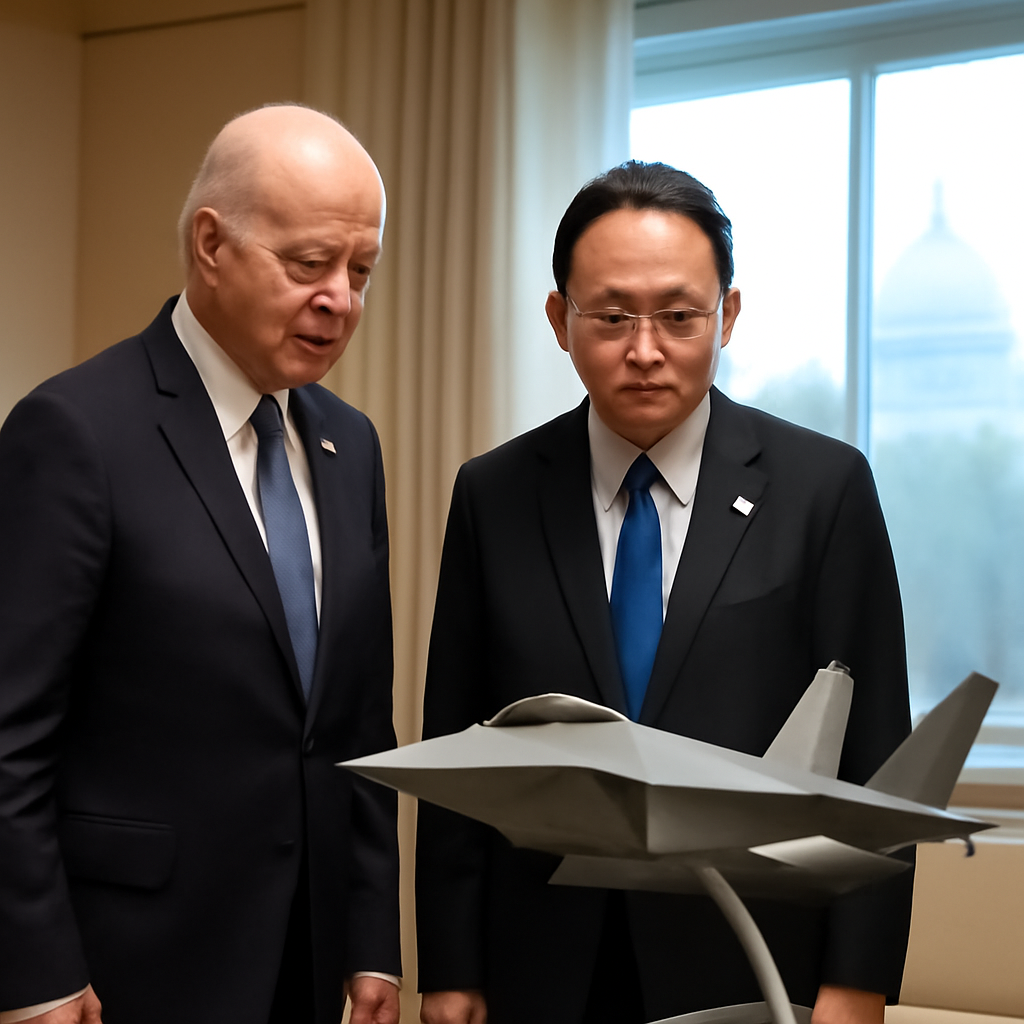
"We are interested in learning more about it. I’ll take it back to my team and see what it looks like," David McGuinty, Canada’s Minister of National Defense, told Reuters after a meeting in Tokyo with Japanese Defense Minister Shinjiro Koizumi.
McGuinty’s remark and the diplomatic moment in Tokyo
The comment marked the first public statement by a senior Canadian official indicating interest in the Global Combat Air Program (GCAP). McGuinty made the remark after meeting his Japanese counterpart in Tokyo; The Asahi Shimbun had earlier reported unnamed Japanese officials saying the two ministers discussed Canada joining GCAP as an observer. Italian Defense Minister Guido Crosetto also identified Canada as "the country most interested [in GCAP] at the moment" and said he would be "fully open" to Canada joining in an observer capacity.
What GCAP and the Tempest are — and where they stand
GCAP is a trinational program led by the United Kingdom with Italy and Japan as partners. Its crewed centerpiece is the Tempest next-generation fighter. BAE Systems in the United Kingdom is building a demonstrator for the jet, with a first flight for that demonstrator planned by the end of 2027. The demonstrator, notably, retains the Typhoon’s EJ200 turbofan engines with non-stealthy nozzles; the production Tempest is intended to have an all-new powerplant.
Senior GCAP officials have described design priorities that emphasize extreme range and a large payload — roughly twice that of the F-35A, according to the program’s advocates — and have said the jet could potentially carry enough internal fuel to fly across the Atlantic without refueling. The program targets a service entry around 2035, but the timeline is treated in this reporting as optimistic and dependent on overcoming “considerable challenges, both technical and political.”

This site is the portfolio.
OSINTSights runs on Cloudflare Workers, D1, R2, and Vectorize, with an AI pipeline on Hetzner ARM. Nubivance designed, built, and operates it. We do the same for clients.
See what we buildWhere this collides with Canada’s F-35 review and split-buy thinking
Canada’s interest in GCAP comes against the backdrop of an ongoing review of the country’s planned F-35 purchase. Ottawa previously announced plans to buy 88 F-35s in 2023, but the purchase has been under review since spring 2025 after Liberal Prime Minister Mark Carney launched a review of the program. Canada has already committed to acquire 16 F-35As as an initial tranche to replace CF-18 Hornets: four of that first batch have been paid for in full and parts for eight more purchased. The first Canadian F-35s were expected to be delivered for training at Luke Air Force Base, Arizona, in 2026.
The idea of a split buy — retaining some F-35s while acquiring another type — has gained traction. Cost has been a central factor: a 2019 estimate put the 88-aircraft program at $19 billion; more recent figures cited here place the cost at $27.7 billion, excluding weapons and infrastructure. Proponents of a mixed fleet argue it offers operational flexibility; Bill Blair, a former Canadian defense minister, has said a mixed fleet “would give the RCAF more options to handle different types of threats.”
What this means for the RCAF, Canadian policymakers, and industry
- Royal Canadian Air Force leadership: Lt. Gen. Jamie Speiser-Blanchet has previously emphasized threats posed by state actors with fifth-generation capabilities and acknowledged the operational complexity of supporting a mixed fleet, saying a split buy "would duplicate a certain amount of infrastructure and training." The Tempest’s range and payload are portrayed in the source as matching Canada’s need to operate across vast distances and into the Arctic.
- Policymakers and procurement officials: A move toward GCAP — even as an observer — would force a rethink of timelines and the scale of Canada’s F-35 buy. The source observes that Canada might have to keep more CF-18s in service longer and could end up buying roughly two thirds of the original intended F-35 numbers (around 60) if it pursued Tempest procurement, with consequences for sustainment and infrastructure.
- Canadian and foreign industry: Saab has been an active competitor in Canada’s fighter discussions, promoting the Gripen E and offering to build the jet in Canada; Saab has also emerged as a preferred supplier for Canada’s future AEW&C with its GlobalEye. Lockheed Martin Canada and Canadian industry participation in the Joint Strike Fighter program are also noted. Observer status in GCAP could provide Canadian industry access to program information and a potential pathway to deeper involvement, but workshare and national requirements among GCAP partners are already largely allocated.
Timing, tradeoffs, and the next steps
Practical constraints frame Ottawa’s calculation. The Tempest program is still in demonstrator phase with a 2027 demonstrator flight target and an optimistic 2035 service goal; Canada would be fourth in line behind the three core partners. The source suggests that industrial steering and most workshare decisions are already divided among the three partners, making deep Canadian influence unlikely unless Ottawa secures a significant partnership role early.
McGuinty’s public interest signals a deliberate widening of Canada’s options: at minimum, Ottawa will study GCAP further as part of the ongoing F-35 review and split-buy debates. The immediate next factual milestones are McGuinty taking the matter "back to my team," the 2027 demonstrator flight target, and continuation of Canada’s internal review of the fighter fleet and procurement numbers.