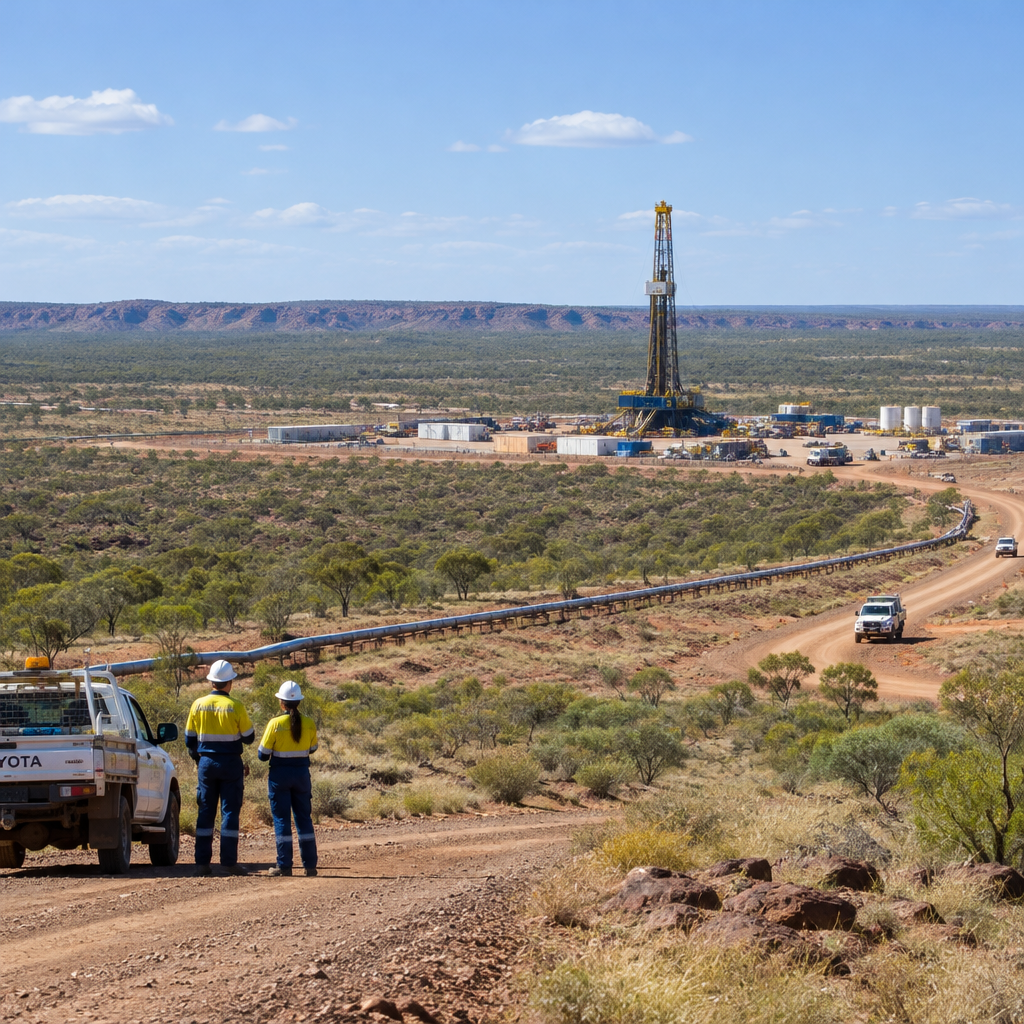
The outlook models production reaching around three billion cubic feet a day by 2035, sustained through to 2050 — a scale the Darwin Major Business Group (DMBG) says could reshape the Northern Territory’s economy.
The Beetaloo Development Outlook scenario
The independent Beetaloo Development Outlook, funded by members of the Darwin Major Business Group and launched in Darwin, models a large-scale gas development pathway that would involve roughly 1,800 wells and could support about 10,500 Territory jobs, including indirect roles. The outlook’s authors stress these are modelled possibilities, not forecasts: “Well performance, customers, finance and approvals will determine the pace.” The report notes first gas began flowing from Beetaloo into the Darwin network in September, a milestone after years of exploration and investment — but it treats that first gas as only the beginning.
Companies, capital and allied expertise already at work
Industry participation is already visible. The outlook lists companies bringing investment or specialist expertise to the basin, including Santos, Tamboran Resources, Formentera Partners, Daly Waters Energy, Beetaloo Energy Australia, INPEX, Liberty Energy and Helmerich & Payne. The report highlights that much of the capital and expertise is American and Japanese, and concludes that allied investment is already shaping development in the basin.

Audit-ready is a season. It shouldn't be.
Evidence in spreadsheets, controls drifting between audits, frameworks multiplying on flat headcount. Nubivance runs continuous compliance on Rapid7 Cyber GRC - SOC 2, HIPAA, ISO 27001, PCI, CMMC.
End the scrambleNew industries and distant markets identified
DMBG frames competitively priced gas as an enabler for manufacturing, minerals processing and other energy‑intensive industries. The outlook identifies specific possibilities such as cement blending and the finishing process for pipeline tubes used to line gas wells. It cites Arafura’s Nolans rare earths project as an example of complementary activity that could broaden the Territory’s industrial base.
International demand is also part of the modelling. The outlook identifies potential additional demand for Australian gas from the early 2030s in markets such as Japan, South Korea and Taiwan — jurisdictions the report says depend heavily on imported energy — and argues Darwin is well placed to serve North Asian markets. Separately, ASPI’s John Coyne has argued that Beetaloo gas could help power Australian AI and computing capacity; the DMBG outlook likewise flags data centres as a potential source of demand, conditioned on commercial investment and supporting infrastructure.
Infrastructure needs and a 2027–28 decision window
Drawing on experience running major projects in the north, DMBG emphasises that investment announcements alone are not enough: “They need skilled people, accommodation, transport, services and reliable infrastructure.” The outlook lists roads, pipelines, rail connections, water, ports and housing as infrastructure that would benefit both industry and communities.
Because shared infrastructure carries large upfront costs and long lead times, the report argues some risks cannot be borne by individual investors. It identifies a practical timing constraint: decisions on major gas transmission infrastructure may be needed in 2027 or early 2028 to support the outlook’s modelling. DMBG is asking the federal government to take a proportionate role in enabling that infrastructure, subject to a sound business case.
What this means for the federal government, Territory businesses, and defence partners
- Federal government: The DMBG is explicitly seeking a proportionate federal role in shared, long‑lead infrastructure and notes a near-term decision window (2027–early 2028) for major transmission choices; any involvement is to be “subject to a sound business case.”
- Territory businesses and communities: The outlook frames early capacity building — skilled people, housing, transport and services — as necessary to capture benefits rather than “scrambl[ing] to catch up once development is underway.” DMBG members say they invest locally and want coordinated planning to spread gains across the economy.
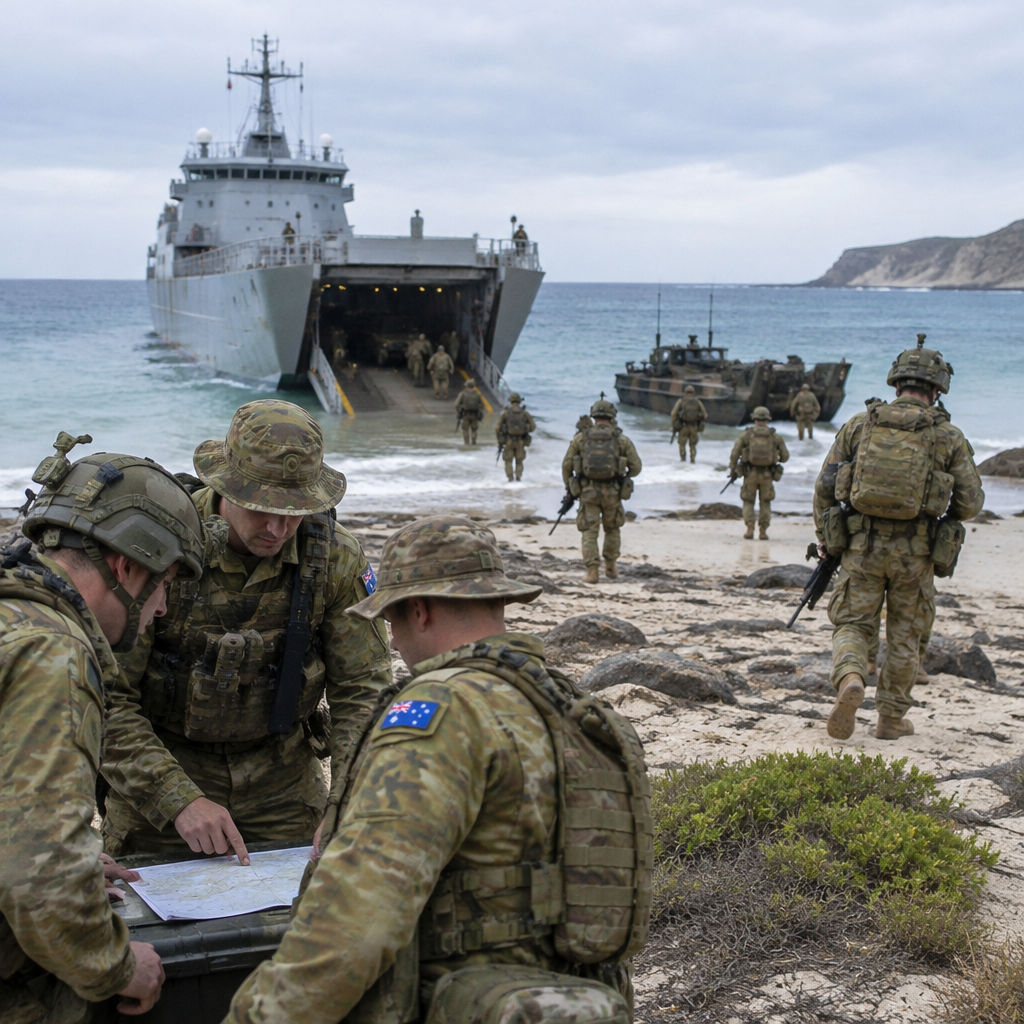
- Defence and allies: The report notes northern Australia already plays an important role in defence relationships, including cooperation with the United States and the presence of US Marines in Darwin. A stronger industrial and logistics base, the outlook argues, could support defence relationships while also attracting commercial investment.
DMBG has previously proposed a Beetaloo Authority to coordinate infrastructure, land, water and approvals while respecting Indigenous decision‑making and environmental requirements. The organisation positions the Beetaloo Development Outlook as a basis for governments, investors and the community to discuss “what needs to happen next.”
Potential alone does not guarantee lasting benefits. As the DMBG puts it plainly: “Our task is to make sure the Northern Territory is ready.”
https://www.aspistrategist.org.au/what-the-beetaloo-could-do-for-the-northern-territory/