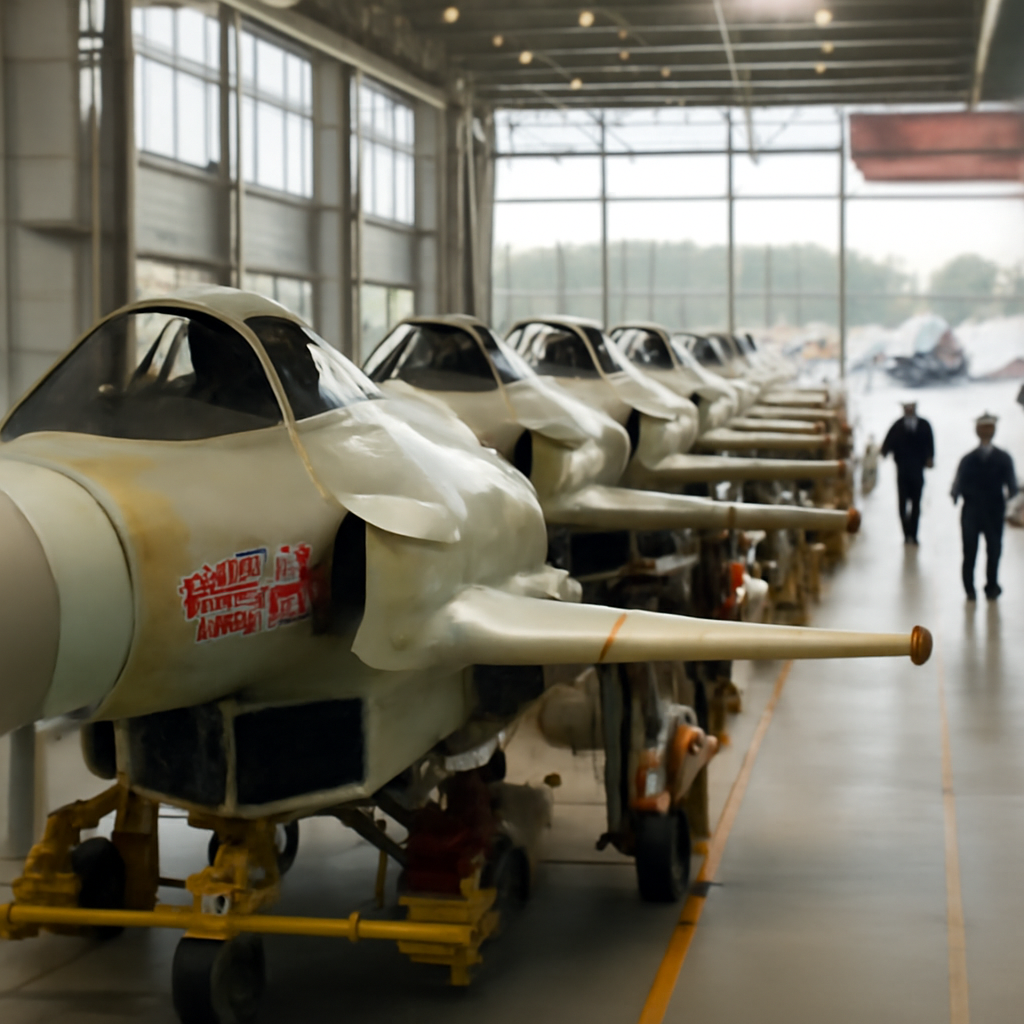
BAE Systems confirmed in its 2026 half year results on 30 July that manufacturing of Türkiye’s 20 Eurofighter Typhoon aircraft is already underway in the UK and across the Eurofighter partner nations, with first delivery scheduled for 2030.
BAE Systems begins component manufacture at Samlesbury
Component manufacture for the Turkish aircraft has commenced at BAE’s Samlesbury site in Lancashire, the half year statement disclosed as a line-item rather than a standalone programme announcement. The Typhoon workshare agreement places more than a third of each aircraft’s manufacture in the UK, sustaining a 20,000-strong workforce with nearly 6,000 jobs at Warton and Samlesbury. The company said Turkish personnel will move next; Ministry sources in Ankara told reporters at a weekly briefing on 23 July that flight personnel will be sent to the United Kingdom in August 2026 to begin flight training as soon as possible.
Delivery profile and a stepped production ramp
Defence Minister Yaşar Güler set out the delivery profile in December 2025: six aircraft in 2030, eight in 2031 and six in 2032. Neither government has announced a first flight date for a Turkish-marked Typhoon. BAE’s chief executive Charles Woodburn said Typhoon output is rising from 12 to 14 aircraft per year to close to 30, describing it as "roughly doubling the production rate," and named Türkiye’s order as a driver of that increase. The Turkish order thus operates both as a discrete supply commitment and as a lever to accelerate production across the whole Eurofighter line.

This site is the portfolio.
OSINTSights runs on Cloudflare Workers, D1, R2, and Vectorize, with an AI pipeline on Hetzner ARM. Nubivance designed, built, and operates it. We do the same for clients.
See what we buildContract architecture, headline values and political timing
The contract underpinning the work was signed at the Presidential Complex in Ankara on 27 October 2025 during then-prime minister Keir Starmer’s visit. Quwa reported that headline value as roughly $10.67 billion; BAE’s reporting restates the package at up to £8 billion (roughly $10.7 billion). That headline figure splits across two instruments: the Turkish Ministry of National Defence confirmed an aircraft contract at £5.4 billion, while trade reporting valued a separate training and support intergovernmental agreement — signed in London on 25 March 2026 by Defence Minister Yaşar Güler and then-UK Defence Secretary John Healey — at between £2.5 and £2.6 billion. The UK Ministry of Defence has not publicly disclosed a figure for that agreement. Both UK principals on the deal have since moved: John Healey became Chancellor of the Exchequer in Andy Burnham’s first cabinet on 20 July 2026, and Wes Streeting became Defence Secretary ten days before BAE’s 30 July confirmation. Starmer resigned as prime minister earlier in July 2026.
Configuration, munitions and the interim capability gap
Janes reported in March 2026 that Türkiye’s aircraft will be Tranche 4+ fitted with the Leonardo ECRS Mk 0 — an active electronically scanned development of the Euroradar CAPTOR — rather than the Mk 2, since the Royal Air Force’s Mk 2 fielding does not begin before 2030. Ankara secured the stated right to integrate Turkish munitions onto the Eurofighter, including the Gökdoğan air-to-air missile and a longer-range weapon designated Gökhan; that is a permission rather than a funded integration programme, with no contract, cost or timeline announced. Reuters reported — without an official itemised list — that the delivered weapons package covers Meteor, an advanced short-range air-to-air missile and Brimstone. Türkiye also pursued second-hand Tranche 3A aircraft from Qatar and modernised airframes from Oman; Ankara shifted priority to Qatar in January 2026 after Oman hardened its negotiating position and Omani aircraft slipped into 2028. No ex-Qatari Typhoon had been reported arriving in Türkiye against a target of late February 2026.
How Türkiye, the UK defence industry, and Turkish aerospace suppliers are responding
- Türkiye’s Ministry of National Defence and air force: preparing personnel moves and training in the UK, and securing a delivery profile that stretches from 2030 to 2032 while retaining rights to integrate domestic munitions — albeit without a funded integration programme or timeline.
- BAE Systems and the UK workforce: accelerating production and beginning component manufacture at Samlesbury and partner sites, supporting roughly 6,000 jobs at Warton and Samlesbury and sustaining a wider 20,000-strong Typhoon workforce as output targets approach close to 30 aircraft per year.
- Turkish aerospace industry and KAAN developers: remaining externally constrained on airframe workshare (no Turkish Aerospace Industries airframe workshare or local assembly has been reported), while the Typhoon buy is framed as a gap-filler until KAAN deliveries are expected in 2028 with prototypes P1 and P2 targeted to fly by the end of 2026.
Negotiations that led here were careful and incremental: Türkiye declined earlier Eurofighter partnership offers in favour of the F-35, was removed from that programme in July 2019, reopened formal Typhoon talks in late 2024 and cleared diplomatic and export hurdles through 2025. Germany signalled non-obstruction in October 2024 and granted formal export approval for up to 40 aircraft in July 2025. Yet the programme that is being manufactured today still contains several unresolved elements — no first flight date announced, no Turkish airframe workshare, permissions to integrate munitions without funded programmes, and a bridging capability question for early-fielded sensors and weapons. The first metal is being cut in the UK, but many of the decisions that will define how those aircraft operate and who benefits most from their manufacture remain to be signed, funded and scheduled.