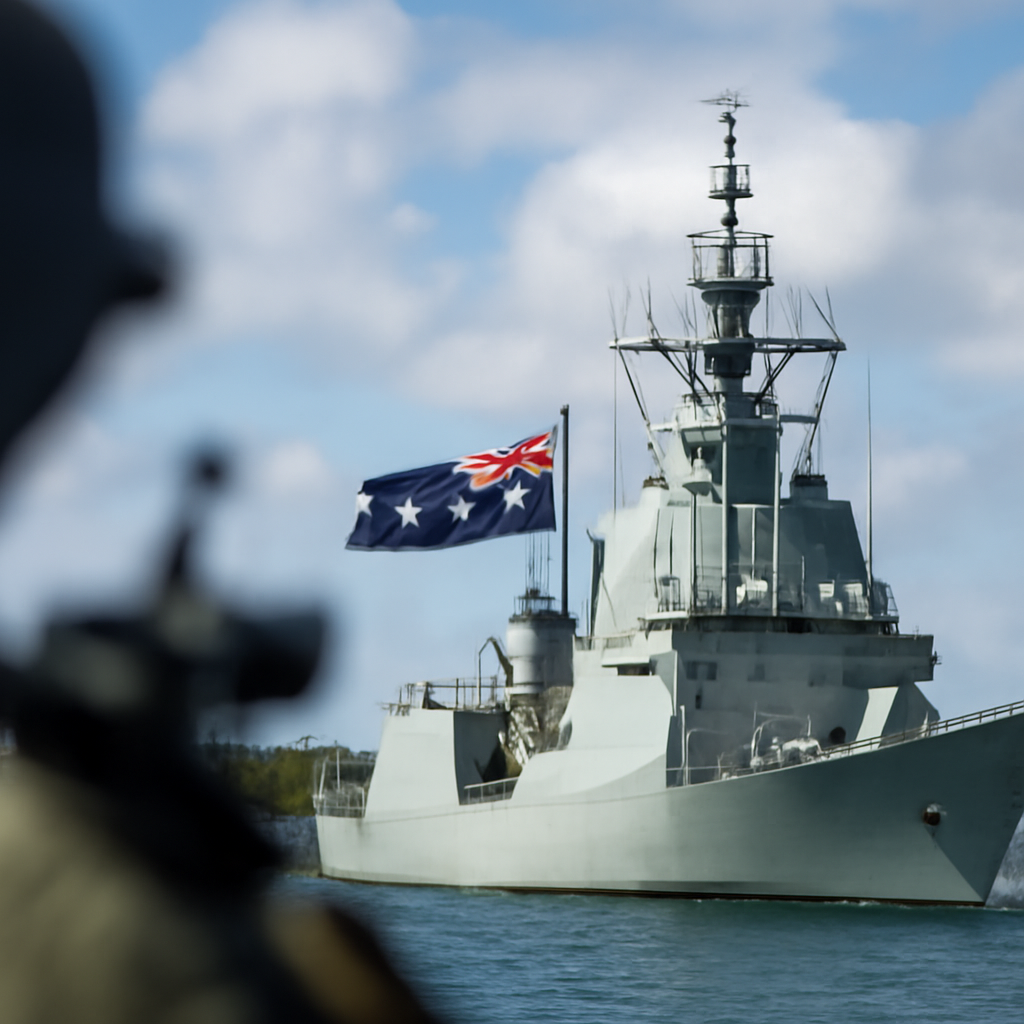
"We are facing the most threatening strategic environment since the end of World War II," Deputy Prime Minister and Defence Minister Richard Marles often says.
That assessment frames a hard judgment in a recent strategic critique: the National Defence Strategy (NDS) of 2026 sits squarely in a long Australian tradition of independent defence thought, but it is designed for the wrong era. The strategy recommits to a decade-long hedge — recapitalising the navy, reorienting the Army toward littoral operations to the north, sustaining a small but potent air force, and building a credible strike capability — but its timetable and scale leave Australia exposed if a great-power conflict in the Pacific arrives sooner than planners expect.
Historical continuity: Federation, Singapore, and later reversals
The article traces continuity in Australian defence thinking back to the 1880s, noting that colonial leaders including Henry Parkes and Alfred Deakin pushed for independent sea power — Deakin's campaign led to the acquisition of the battle cruiser HMAS Australia in 1913. The Singapore strategy of the 1920s and 1930s, which relied on a Royal Navy base at Singapore to deter Japan, was widely accepted then and later judged a mistake when it failed.
World War II and its aftermath prompted renewed emphasis on self-reliance. The piece recounts post-war rapid demobilisation and the signing of ANZUS in 1951; it highlights a 1963 warning by John F. Kennedy to Robert Menzies that ANZUS did not amount to a blank cheque, a message that pushed Australia toward thinking about independent defence capability. It also credits the 1987 Defence White Paper under Kim Beazley with finally translating aspiration into concrete policy and funding.
What NDS 2026 actually does — budgets, timelines and strategic reliance
Officially, NDS 2026 funds a base "force-in-being" at about 2 percent of GDP using the traditional definition of defence spending. Most new money announced in the NDS is skewed toward the latter part of the decade to 2035–36, and most significant new capabilities are not due to arrive until the mid-2030s. The Australian Strategic Policy Institute's report The cost of Defence is cited as setting this timetable and fiscal picture out "honestly and clearly" and as puncturing government propaganda.
The strategy accepts persistent dependencies: Australia remains heavily reliant on the United States for key military enablers such as space-based intelligence, surveillance and reconnaissance systems; to operate platforms such as the F‑35 Lightning; and for the acquisition of nuclear-powered submarines under AUKUS. The chosen path is therefore a mix of self-reliance in local defence and continued dependence on allied enablers.

Audit-ready is a season. It shouldn't be.
Evidence in spreadsheets, controls drifting between audits, frameworks multiplying on flat headcount. Nubivance runs continuous compliance on Rapid7 Cyber GRC - SOC 2, HIPAA, ISO 27001, PCI, CMMC.
End the scrambleImmediate risks: a Pacific war could arrive sooner than the hedge allows
The central critique is blunt: NDS 2026 does not pursue an urgent expansion to the "heavier force" needed to resist a great-power attack in the near term. The article warns there is a "plausible prospect" of a Pacific war, "possibly as early as next year." Were such a war to break out between the United States and China in the next few years, the piece argues, there is a credible prospect Australia would be attacked to deny the use of its territory by US forces.
The author notes that a classical model of hedging — building a base force to be expanded over a decade — made sense when a proximate regional threat such as an aggressive Indonesia could be expected to unveil itself with at least ten years' warning. That model no longer fits a potential sudden great‑power confrontation in the Pacific, the article contends; even a 10 percent assumed chance of conflict before 2030 demands more urgent action.
What this means for the ADF, the government, and the Australian public
- The Australian Defence Force: The piece urges boosting combat readiness "over months and not years" and planning to fight as part of a US‑led combined coalition force while insisting on leading Australia's local defence.
- The government: The article calls for improved national resilience and civil defence, including bringing community and the private sector into a genuine national defence strategy, reviving the War Book of the 1950s, and rapidly enhancing protection of critical infrastructure. It also urges making clear to China that Australia would support its treaty ally the United States and insisting on being taken into a deeper level of confidence on US war plans.
- The Australian public and private sector: Citizens and businesses are asked to be part of national resilience planning and to expect civil defence measures and infrastructure protection to be prioritised urgently.
Accountability and the record that will matter
The article finishes with an accountability warning. It predicts that, should Australia enter a Pacific war unprepared, a royal commission would inevitably follow and that key documents would be central exhibits: a declassified history of Australian strategic policy covering 1976–2020, being prepared for the Department of Defence and due for publication later this year, and cabinet papers regarding the 2009 Defence White Paper scheduled for release in 2029. "We are putting ourself in a position of peril with eyes wide open," the author writes, adding that "One could write the terms of reference now."
Original story: https://www.aspistrategist.org.au/nds-2026-the-right-strategy-for-the-wrong-era/



