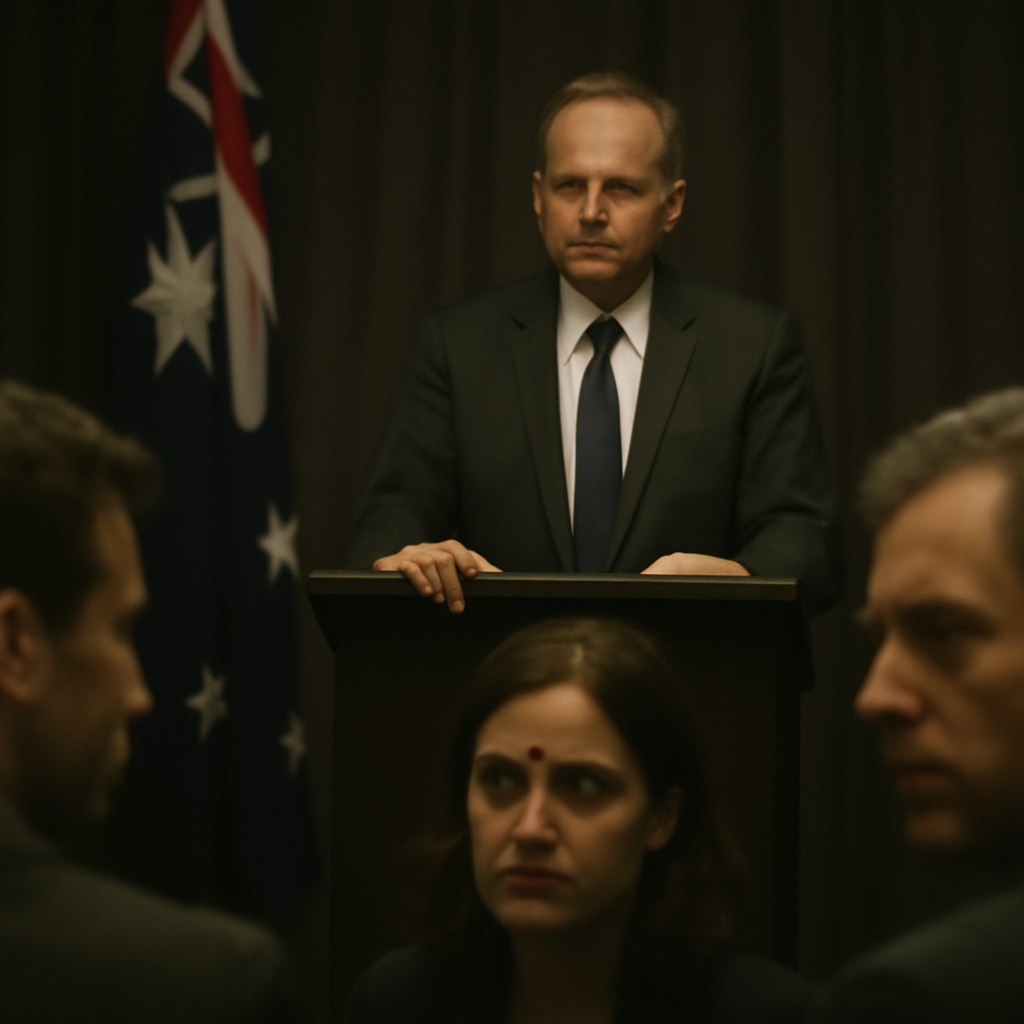
"brought to our doorstep through no choosing of our own," Senator James Paterson warned, framing the strategic risk he says Australia faces if a major regional war erupts. Speaking at a fireside with former defence minister Joel Fitzgibbon during the 2026 ASPI Defence Conference, Paterson argued that Canberra’s leaders have largely diagnosed the problem correctly — but have not yet told the public the full extent of the consequences.
At the ASPI conference: diagnosis without full disclosure
Senator Paterson, the shadow defence minister, and Joel Fitzgibbon, who as defence minister in Prime Minister Kevin Rudd’s government delivered the 2009 Defence White Paper, agreed on a central point: a bipartisan consensus largely shapes Australian defence policy. Both described that consensus as useful for limiting politicisation but warned it has become an instrument of elite management rather than public engagement.
Paterson criticised a form of politics that offers reassurances to voters, selective opacity to Parliament, and stabilising language to Beijing. He argued the public has not been candidly briefed on how current preparedness shortfalls would play out in a high-intensity conflict in the region.
Preparedness: munitions, sustainment and rapid consumption
Paterson emphasised multiple preparedness shortfalls. He said delivering capability to agreed scope, schedule and budget remains "a deeply fraught enterprise" and highlighted concern about the depth of the Australian Defence Force’s munitions inventory. He pointed to modern warfare’s rapid consumption of supplies and equipment — "as seen in Ukraine and the Persian Gulf" — and said no one has clearly set out to the public the implications of that rate of consumption.
Paterson quoted service members’ private worries: in conversations outside Senate Estimates, many in uniform tell him they do not think Australia is ready, that sustainment and maintenance spending is insufficient, and that limited supplies and stocks mean a matter of weeks of high-intensity conflict in the region would leave the country unable to resupply itself. "That’s diabolical," he said.

Audit-ready is a season. It shouldn't be.
Evidence in spreadsheets, controls drifting between audits, frameworks multiplying on flat headcount. Nubivance runs continuous compliance on Rapid7 Cyber GRC - SOC 2, HIPAA, ISO 27001, PCI, CMMC.
End the scrambleBipartisanship, elite management, and public consent
Both men warned that the prevailing bipartisan approach has depoliticised defence to the point that policy is managed among elites and communicated in ways that exclude the public. Paterson described an "elite politics — in language which is inaccessible to [the public], conducted in places where they are not participating in, including in rooms like this." He argued that neither scaremongering nor inaccessible elite processes can build the broad public mandate needed to increase defence spending.
The pair stressed that defence historically relied more on public indifference than on informed consent. If defence is to ask Australians for a higher sustained share of resources, Paterson said, the electorate must be given clear, concrete explanations of trade-offs and of why those trade-offs are necessary.
AUKUS Pillar One and the costs of modernisation
Paterson singled out the future costs of force modernisation as a driver for candour. He named "AUKUS Pillar One" among the future commitments that will demand a public shift in understanding and resources. He argued the government must make "the trade-offs inherent in raising defence spending concrete, understandable, sensible and reasonable to the public."
Central to that argument is an appeal for honesty about the relationship between Australia’s prosperity and the international order that underpins it. Paterson said the nation’s "extraordinary prosperity" and the welfare and public services it enables rely on that order, and that Australia owes "some kind of hard-power responsibility" to sustain it.
What this means for the Australian Defence Force, elected officials, and the public
- Australian Defence Force: senior and junior personnel are described as privately worried about readiness, sustainment funding, and munitions stocks; those concerns imply pressure on logistics, maintenance and supply chains if a high-intensity conflict occurs.
- Elected officials and policymakers: Paterson and Fitzgibbon signal that leaders must shift from elite reassurance to public-facing candour, making concrete trade-offs and building a mandate for higher defence expenditure without resorting to scaremongering.
- The public (including younger voters): the speakers note defence is not front of mind for many voters; changing that will require accessible explanations of costs and consequences tied to specific programs such as AUKUS Pillar One.
Paterson and Fitzgibbon left a clear, pressing question for Canberra: if the strategic diagnosis is largely right, will political leaders break the bad defence news to the public in plain terms and seek the mandate — and the funding — that the speakers say would be necessary to prepare for a conflict "brought to our doorstep"? The answer will determine whether current reforms and spending debates are marginal adjustments or the start of a broader democratic conversation about defence and national resilience.



