Freight transport by road and rail uses 20 billion to 25 billion litres of diesel a year, a volume that leaves Australia highly exposed when international fuel routes are disrupted.
Why diesel exposure matters now
Recent disturbance to oil supply through the Strait of Hormuz has underlined a vulnerability the source calls "obvious": Australia relies heavily on imported fuel for long‑distance freight. Road and rail combined account for well over half of the nation's diesel consumption, and although rail moves almost 60 percent of the domestic freight task by tonne‑kilometres, that statistic is skewed toward heavy bulk commodities; rail still has only a small share of general intercity freight. Shifting more general freight from trucks to battery‑electric trains would lengthen diesel stocks during an import interruption and reduce the risk of cascading economic disruption from fuel‑starved transport links.
National Freight Energy Authority: a coordinated plan
The proposal centres on a new National Freight Energy Authority to coordinate federal, state and territory governments, the Australian Rail Track Corporation, major freight operators and clean‑energy financiers such as the Clean Energy Finance Corporation (CEFC) and the Australian Renewable Energy Agency (ARENA). The authority would co‑fund infrastructure, steer fleet replacement through concessional finance and standardised procurement, and set interoperability standards so battery‑electric locomotives can operate across priority corridors.

This site is the portfolio.
OSINTSights runs on Cloudflare Workers, D1, R2, and Vectorize, with an AI pipeline on Hetzner ARM. Nubivance designed, built, and operates it. We do the same for clients.
See what we buildThe Melbourne–Sydney corridor: three 50 MW solar hubs and a five‑year payback
The Melbourne–Sydney intercity freight line is identified as the first priority. A joint federal–state program using ARENA, CEFC and state decarbonisation funds could back three grid‑connected solar hubs of around 50 MW capacity at Goulburn, Wagga Wagga and Albury–Wodonga. The capital cost is estimated at about A$200 million; the source projects that diesel savings could repay this outlay in roughly five years. On a typical Melbourne–Sydney freight trip, swapping about A$15,000 of diesel for perhaps A$5,000 of solar power is estimated to save more than A$40 million a year on the corridor. With typical solar equipment lives of 25 to 30 years, the plan is presented as buying decades of low‑cost freight energy for the equivalent of around five years of current fuel spending.
Pilbara and Queensland pilots, and the heavy‑haul imperative
Australia is already running several major battery‑electric locomotive pilot projects on heavy‑haul networks in the Pilbara and Queensland, but the source notes there is no firm plan for general use of the technology. Heavy‑haul mining and bulk‑freight rail account for by far the largest share of traffic and fuel use; the article argues that transitioning these operations is essential not only for emissions reductions but to protect diesel reserves and safeguard export revenues that flow from bulk commodities to port.
Technology, costs and practical operation
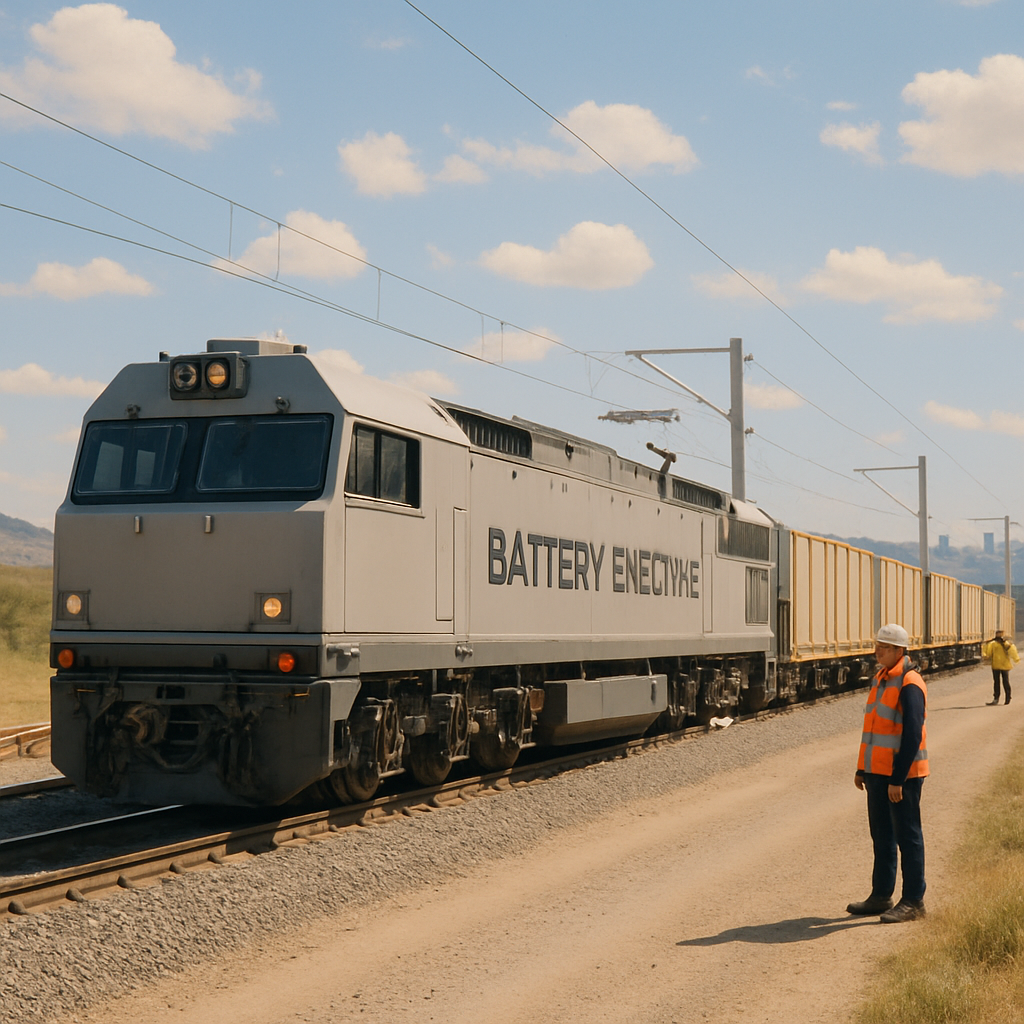
On interstate general‑freight corridors, electric locomotives paired with battery tenders holding 7 to 14 megawatt‑hours of energy could achieve practical ranges of several hundred kilometres. The operational model described involves suitably spaced hubs where trains swap exhausted battery tenders for charged units recharged from the grid or by nearby mid‑sized solar farms. Although battery‑electric locomotives cost more to buy than diesels, lower maintenance makes total cost of ownership comparable; electricity as the energy source is much cheaper than diesel, yielding an overall cost advantage that the source says should make rail increasingly competitive for intercity freight.
What this means for the Australian Rail Track Corporation, CEFC, and major freight operators
- Australian Rail Track Corporation: would be a key coordination partner under the proposed National Freight Energy Authority, helping to prioritise corridors and ensure infrastructure interoperability across state borders.
- Clean Energy Finance Corporation and ARENA: positioned as financiers and program partners, able to co‑fund solar hubs and support concessional finance for fleet replacement to accelerate uptake.
- Major freight operators: face near‑term fleet renewal decisions — about half of the diesel locomotive fleet is coming up for replacement between 2032 and 2037, according to a 2024 estimate from the Australian Railway Association — and could be nudged toward battery‑electric purchases through concessional finance and standardised procurement.
The arithmetic in the source is direct: with half the diesel fleet due for replacement in the 2032–2037 window, pilots already under way, utility‑scale solar now the lowest‑cost new electricity in Australia, and concrete savings projected on a single major corridor, converting freight traction to battery‑electric power is presented as both an energy‑security measure and an economic opportunity. The central policy step demanded is prompt adoption of measures by the federal, state and territory governments to encourage the shift — starting with a coordinated authority, targeted solar hubs and financing mechanisms that align purchasing decisions with the new system.